


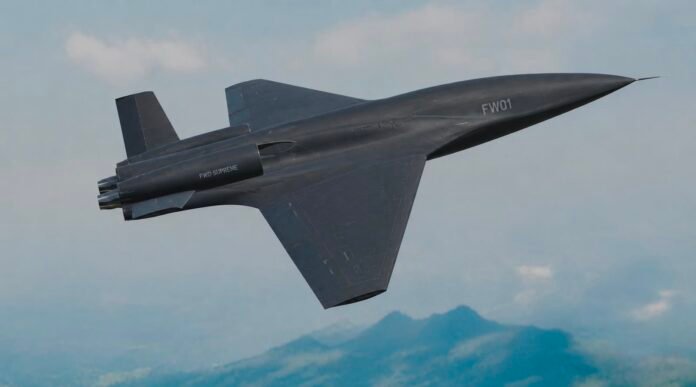
Bengaluru: In a historic leap for India’s defence ecosystem, Flying Wedge Defence & Aerospace (FWDA), an Indian AI warfare company, on June 23 unveiled the nation’s first AI-Piloted Fighter Jet Concept, FWD Supreme. Designed to advance the future of air combat through the Mobbing Doctrine, the company also announced the first flight of its FWD Supreme Lite technology demonstrator is targeted for Q3, 2026.
With the programme, India enters the global AI fighter race with a new doctrine. It joins an exclusive group of top 3 nations, including the United States, Turkey, and Germany that are actively pursuing AI-piloted fighter aircraft programmes aimed at redefining the future of air combat.

Unlike conventional unmanned aircraft that are remotely operated by human pilots, FWD Supreme is an AI-piloted fighter jet which will use Artificial Intelligence (AI) to fly itself. The programme aims to integrate advanced situational awareness, sensor fusion, autonomous decision-making, cognitive mission execution, and advanced combat capabilities into a next-generation fighter jet architecture.
FWD Supreme is being designed to perceive, analyse, decide, and act in highly contested environments with minimal human intervention. The platform is being built around the Mobbing Doctrine, a new warfare doctrine envisioned by Suhas Tejaskanda, Founder and CEO of FWDA.
While speaking about the vision, Suhas Tejaskanda, the brain behind Mobbing Doctrine, said, “The idea is to deploy multiple AI-piloted fighter jets operating together as a coordinated swarm force against higher-value enemy manned platforms. By leveraging intelligent networking, autonomous decision-making, and cost asymmetry, it will address high cost combat scenarios where even if four to five aircraft are lost during an engagement, the remaining aircraft can continue overwhelming enemy defences, or force enemy manned fighters to retreat. The objective is to function as a force multiplier by fundamentally altering the economics and dynamics of air combat.”
“The future of air superiority will not be achieved by a single fighter aircraft. It will be defined by the most intelligent and adaptive combat systems working together as a network at machine speed”, he further added.

According to the information, the platform is being manufactured indigenously at FWDA’s manufacturing unit in Bengaluru. The programme is led by Girish Dixit, Secretary ADA and control systems expert, and is joined by distinguished aerospace scientists including V Subba Rao, Outstanding Scientist (OS), Scientist ‘H’, Project Director, LCA Tejas programme; G Radhakrishnan, Outstanding Scientist ‘H’, Airframe and Structural Systems; Mahesh Prabhakar Padwale, Outstanding Scientist ‘H’, Propulsion and Engine-Integration and R S Rao, Outstanding Scientist ‘H’, Avionics and weapon integration; collectively bringing decades of experience in military aviation, fighter aircraft development, aerospace engineering, and advanced defence technologies.
The FWD Supreme Family is Currently Envisioned in Two Variants:

FWD Supreme Lite
- Approximate all-up weight: 250 kg class
- Designed as the initial technology demonstrator and operational test platform
- First flight targeted for the next quarter
FWD Supreme Heavy
- Approximate all-up weight: 1-tonne class
- Designed for extended-range autonomous combat operations
- Configurable for ISR, strike, collaborative combat, and future air dominance missions
The programme’s performance objectives have been divided into two phases:
Performance Objectives- Phase 1
- Maximum speed: Up to Mach 0.9
- Cruise speed: Approximately Mach 0.5
- Operational range: 700–1,000 km depending on mission profile
- Autonomous take-off, mission execution, and recovery
Future Roadmap- Phase 2
- Supersonic performance targets approaching Mach 2
- Advanced AI-enabled mission autonomy
- Enhanced survivability and low-observable characteristics
- Expanded collaborative combat capabilities
- Multi-aircraft autonomous teaming
The unveiling of FWD Supreme marks the beginning of a long-term development roadmap aimed at creating scalable AI-piloted combat aircraft capable of supporting future military operations across air, land, and maritime domains.
Focused on the development of next-generation combat aviation technologies, Flying Wedge believes that AI-piloted fighter aircraft will become a defining element of future warfare, enabling nations to field intelligent, adaptable, and collaborative combat systems capable of operating across increasingly complex operational environments.
FWDA became the first Indian company to secure DGCA type certification for an indigenous unmanned aerial vehicle (UAV). The company subsequently unveiled India’s first unmanned bomber aircraft, the FWD-200B, which successfully completed its maiden flight on 3 September 2024.
On August 22, 2025, FWDA announced the readiness of the Kaal Bhairava E2A2 programme, India’s first AI-powered Medium Altitude Long Endurance (MALE) Autonomous Combat Aircraft. Designed and developed entirely in India, the platform is engineered for up to 30 hours of endurance and a range of 3,000 km, delivering AI-driven autonomy for precision strikes, swarm operations, and real-time Intelligence, Surveillance, and Reconnaissance (ISR) missions.
Built with zero foreign dependency, the platform ensures complete data sovereignty and eliminates external kill-switch risks while being positioned at a fraction of the cost of comparable Predator-class UAV systems. The programme has secured a USD 25 million export order from a South Asian nation and enabled the company’s first international manufacturing partnership in Portugal, marking a significant milestone in India’s global expansion strategy.
The Kaal Bhairava Lite variant has successfully conducted flight demonstrations with the Indian Army, including operations in high-altitude environments in Jammu & Kashmir. The platform has been showcased to multiple Indian defence stakeholders and is currently undergoing further evaluation and engagement processes with various security forces.
With a growing portfolio of autonomous strike systems, AI-enabled combat platforms, and scalable unmanned aircraft programmes, Flying Wedge Defence & Aerospace aims to position India as a global hub for next-generation autonomous defence technologies.






