


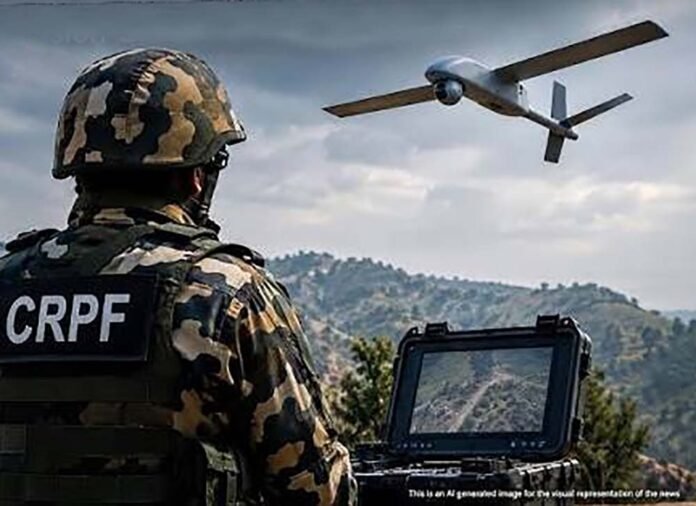
The Central Reserve Police Force (CRPF) has invited manufacturers and vendors to submit technical details for a proposed fleet of first-person-view kamikaze drones. The draft requirements describe systems using both optical-fibre-cable and radio-frequency links, with separate day- and night-vision aircraft. The force is seeking responses by November 25, but has not announced a purchase order, contract value, quantity or deployment timetable.
The proposed aircraft would be designed for one-way missions, combining aerial observation with the ability to strike a designated target. The draft specifies a minimum full-payload speed of 150 kilometres per hour and a mission range of at least 15 kilometres. It also calls for two high-explosive anti-personnel warheads and a stated 10-metre “killing radius”. These are requested specifications, not confirmation that any offered system has been selected or acquired.

The CRPF is now seeking technical input from original equipment manufacturers, suppliers and other firms on its draft qualitative requirements and trial directives. Companies are expected to provide product specifications against each parameter rather than simply state whether their systems comply. Vendors must identify the manufacturer and provide its authorisation, while firms are also required to submit relevant test certificates.
The proposed endurance requirements vary according to the aircraft’s configuration. At an altitude of 1,000 metres above mean sea level, the draft calls for at least 30 minutes of flight without a warhead and fibre-optic spool, and at least 20 minutes with them attached. It also specifies vertical take-off and landing within a five-by-five-metre area and an acoustic signature below 40 decibels at 300 metres above ground level. The draft says endurance should decrease by 10 per cent for each additional 1,000 metres of altitude.
Testing would involve physical inspection and practical assessment of the systems, including their launch and recovery, range, endurance, operating altitude and flight modes. The requirements also address operation in challenging conditions, including wind speeds of at least 35 kilometres per hour. The process is intended to let the force evaluate what suppliers can offer before any final decision is made.
The request follows reports that the CRPF is exploring loitering munitions for specialised counter-insurgency and counter-terrorism operations. The proposed capability could be relevant to units operating in sensitive areas, including Manipur and Jammu and Kashmir. Those reports describe a potential operational role, not a confirmed deployment plan; the force has yet to disclose where, or whether, the systems would be used.

The procurement remains at an early stage. Companies’ submissions will need to be reviewed and systems tested before the CRPF can determine whether any meet its requirements. The force’s call for technical information therefore signals interest in the technology, rather than a completed acquisition.
The proposal reflects a wider move by security forces to incorporate unmanned aircraft into operations, while raising the stakes around oversight, target identification and the use of weapons capable of combining surveillance with a strike. The CRPF’s draft focuses on technical performance and testing; its public description does not detail rules governing operational authorisation or the safeguards that would apply to any eventual use.

For now, the next formal milestone is the November 25 deadline for responses. The CRPF will then have supplier information to assess against its draft specifications. Any eventual purchase, scale of deployment and operational role remain subject to that evaluation and subsequent procurement decisions.







