


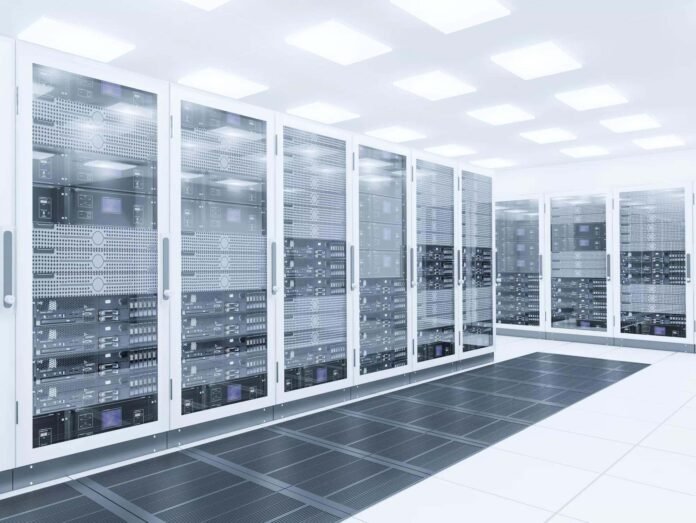
Tel Aviv: Israeli company Veloryx has developed a multi-layered system that it claims protects data centres that have become a target in recent military confrontations.
Data centres in Europe face a growing and active threat of attacks, sabotage, and geopolitical targeting. Recent cross-border drone strikes and bombardments—such as those between Russia and Ukraine and attacks on digital infrastructure in the Middle East—have turned data centres into direct military and economic targets. Experts warn that physical or cyber-attacks on these facilities can paralyse government functions, healthcare, banking, and the broader economy.

European officials have raised alarms about a rise in hybrid warfare and sabotage threats. Because data centres act as the physical backbone for cloud services, artificial intelligence, and communications, they represent high-impact, low-effort targets for disruption.
A large share of Europe’s critical digital infrastructure is heavily clustered around major hubs like Frankfurt, London, Amsterdam, Paris, and Dublin (known as FLAP-D). This concentration makes major regional outages or localised security breaches capable of affecting millions of people and causing billions of euros in damage. Beyond military threats, data centre projects face rising public and offline/online protests over high energy consumption, strain on local power grids, and water usage in countries like Austria, France, Italy, and Ireland.
In response to these vulnerabilities, some nations (such as the UK) have officially designated data centres as critical national infrastructure, elevating their security status to match water, energy, and healthcare systems.
Industry advisers and United Nations experts are urging European planners to rethink where they build future AI infrastructure, moving away from hyper-concentrated urban targets toward more resilient, distributed designs.

“The legal ownership of a facility tells us very little about its real security significance,” said Roy Bargil, chief executive of Veloryx, an Israeli homeland security group. “The relevant question is who depends on it and what stops functioning when it goes down. A private data centre can become a national point of failure without ever being formally defined as national infrastructure.”
Protecting such a site requires more than guards, fences, cameras or cybersecurity. The process begins by identifying which services cannot stop and mapping their dependencies, including power, cooling, communications, fuel, access routes and key personnel.

Physical protection may combine controlled access, perimeter detection, thermal cameras, radar, radio-frequency sensors and counter-drone systems. But these capabilities cannot operate as isolated layers. They need to form a System of Systems, connected through a command-and-control layer that can turn multiple alerts into a unified operational picture, understand their potential impact and coordinate a response in real time.
“But even a well-protected site can be hit. This is where the shift from protection to resilience becomes critical,” Bargil said.
Operators need diverse power and communications routes, protected backups, geographic separation, copies of critical data outside the same threat area and the ability to move workloads. They must test the loss of an entire facility and verify not only that alternative systems exist, but that they can actually carry the required load when the primary site is unavailable.
Veloryx is building its homeland security activity around this integrated approach. Rather than treating drones, aerial-threat mitigation, sensors, radars, robotics, detection and command-and-control as separate capabilities, the objective is to connect the relevant layers around the mission that must be protected.
For a data-centre operator, that means beginning with the threat, the operational mission and, most importantly, the service that must continue. Technology is then selected and integrated around that requirement, creating a single architecture for protection, response and resilience.
“A collection of excellent products does not automatically create an effective security system,” Bargil said. “The gaps usually appear between them: between physical security and cyber, between detection and response, or between the main facility and its backup. Our role is to connect those layers around the operational outcome the customer needs to preserve.”
The issue is particularly relevant in Europe. The critical entities resilience directive reflects a broader shift from protecting individual infrastructure assets toward ensuring the resilience of entities that provide essential services.






