


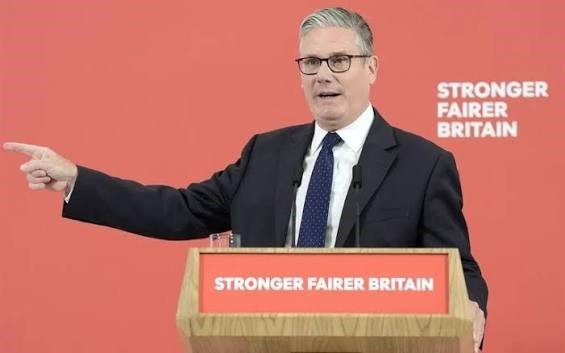
Aresignation two years in the making: Starmer’s fall was less an event than a slow puncture. Labour’s landslide 2024 victory gave way, within eighteen months, to collapsing approval ratings, a dismal set of local election results in May 2026, and the rapid rise of Nigel Farage’s Reform UK.
Health Secretary Wes Streeting resigned from cabinet in May accusing Starmer of losing his party’s confidence; a coordinated manoeuvre then saw Labour MP Josh Simons stand down in Makerfield so that Andy Burnham, the popular Greater Manchester mayor, could re-enter Parliament via by-election.

Burnham won comfortably on June 18, and within days Starmer bowed to the inevitable. He announced on June 22 that he would step down once a successor was chosen, with nominations opening July 9 and a new leader expected before Parliament’s summer recess – Burnham the overwhelming favourite to become Britain’s seventh prime minister in a decade.
Running in parallel to the leadership crisis was a bitter row over military spending. On June 11, Defence Secretary John Healey resigned along with Armed Forces minister Al Carns, arguing that the Treasury’s proposed Defence Investment Plan (DIP) was too thin to meet Britain’s strategic needs and risked leaving the armed forces “less safe”
Running in parallel to the leadership crisis was a bitter row over military spending. On June 11, Defence Secretary John Healey resigned along with Armed Forces minister Al Carns, arguing that the Treasury’s proposed Defence Investment Plan (DIP) was too thin to meet Britain’s strategic needs and risked leaving the armed forces “less safe.” That resignation was one of the hammer blows that hastened Starmer’s own departure.
The £300 billion drone-first plan
Rather than leave the DIP to his successor, Starmer chose to publish it himself on 30 June, styling it as a legacy achievement even as he headed for the exit. The package lifts total defence spending to almost £300 billion over four years, with a £15 billion top-up funded largely by reprioritising money away from road and energy projects.
Its centrepiece is a decisive tilt toward unmanned and autonomous warfare: more than £5 billion for drones and autonomous systems, £8 billion for a next-generation stealth fighter built jointly with Japan and Italy, £11 billion to rebuild weapons stockpiles, and £64 billion to modernise Britain’s nuclear deterrent. Rather than new destroyers, the Royal Navy will get hybrid vessels designed as command hubs for fleets of drones.

Speaking at a drone manufacturer, Starmer argued that Ukraine’s use of cheap autonomous systems to cripple Russia’s Black Sea fleet showed that “the very nature of conflict is changing before our eyes.” Under the plan, spending reaches 2.7% of GDP by 2029, with the long-promised 3.5% NATO target pushed out to 2035 — a full parliament away.
A plan built to be criticised
The blueprint drew fire from almost every direction. The Institute for Fiscal Studies noted that hitting 3.5% by 2035 would require roughly £25 billion a year beyond what has been budgeted, while £10.7 billion of the plan depends on unspecified “efficiencies” by 2030.

Most damagingly, documents released alongside the announcement revealed a £4.7 billion funding gap that has simply been deferred to the autumn budget – after Starmer leaves office.
The blueprint drew fire from almost every direction. The Institute for Fiscal Studies noted that hitting 3.5% by 2035 would require roughly £25 billion a year beyond what has been budgeted, while £10.7 billion of the plan depends on unspecified “efficiencies” by 2030
Conservative critics branded this a “delayed-action poison pill”; former Tory defence secretary Liam Fox called it a “poisoned chalice” for Burnham. Retired General Richard Barrons told the BBC that Britain is “not keeping up with our allies” and certainly not with potential adversaries, given that Washington can no longer be relied upon to underwrite European security. Even the scale of the increase – £15 billion – fell short of the £28 billion military chiefs had reportedly requested.
Burnham’s uneasy inheritance
Burnham himself stayed conspicuously quiet in public, letting outgoing defence secretary Dan Jarvis vouch for his commitment to the plan. But reporting suggests his team was blindsided by the size of the shortfall they are inheriting, and allies reportedly protested that Starmer had “no right” to publish the DIP before the NATO summit in Ankara on 7–8 July, given he would not be the one implementing it.
One commentator described Burnham’s attempts to insert himself into the process as “performative,” arguing it would have been more useful to let Starmer “own” the plan and take the political hit for it. Either way, Burnham now faces a first budget in which he must simultaneously find billions more for defence, honour spending pledges on transport and energy that Starmer’s DIP just raided, and manage a party desperate to differentiate itself from a leader it just forced out.
Economic and political stakes
The economic logic is a familiar “guns versus butter” trade-off: every pound redirected to drones, submarines and stockpiles is a pound not spent on the road and energy projects Starmer has now shelved, at a moment when growth is sluggish and the Treasury’s fiscal headroom – estimated at £22 billion – is, according to economists, being steadily eroded by inflation and weak growth.
Politically, the manoeuvre lets Starmer claim credit for the “biggest sustained increase in defence funding for 45 years” while leaving Burnham to explain unpopular trade-offs to voters just as he tries to rebuild Labour’s standing against Reform UK. Whether Burnham inherits a platform to build on or a bomb to defuse may determine how quickly his own honeymoon curdles
Politically, the manoeuvre lets Starmer claim credit for the “biggest sustained increase in defence funding for 45 years” while leaving Burnham to explain unpopular trade-offs to voters just as he tries to rebuild Labour’s standing against Reform UK. Whether Burnham inherits a platform to build on or a bomb to defuse may determine how quickly his own honeymoon curdles.
A Boon for India
Britain’s pivot to drones, autonomous naval hubs and AI-enabled warfare opens a door India is well placed to walk through. The two countries have deepened defence ties through a 2025 ten-year Defence Industrial Roadmap and a June 2026 Executive Steering Group meeting focused explicitly on emerging technologies, interoperability and co-production.
India’s own drone sector – bolstered by post-Operation Sindoor investment, a projected UAV market growth to roughly $4 billion by the mid-2030s, and an official push toward a dedicated “drone force” – gives it credible manufacturing scale and rapidly maturing indigenous technology.
With Britain’s Ministry of Defence under pressure to “buy British” but also stretch a constrained budget, co-development and component-sourcing arrangements with Indian firms could offer a cost-effective route to filling capability gaps, provided technology-transfer and export-control questions can be resolved.
As European rearmament accelerates, India’s drone ambitions and Britain’s budget bind may prove more complementary than either side has yet acknowledged.

-The writer is a New Delhi-based senior commentator on international and strategic affairs, environmental issues, an interfaith practitioner, and a media consultant. The views expressed are personal and do not necessarily carry the views of Raksha Anirveda





