


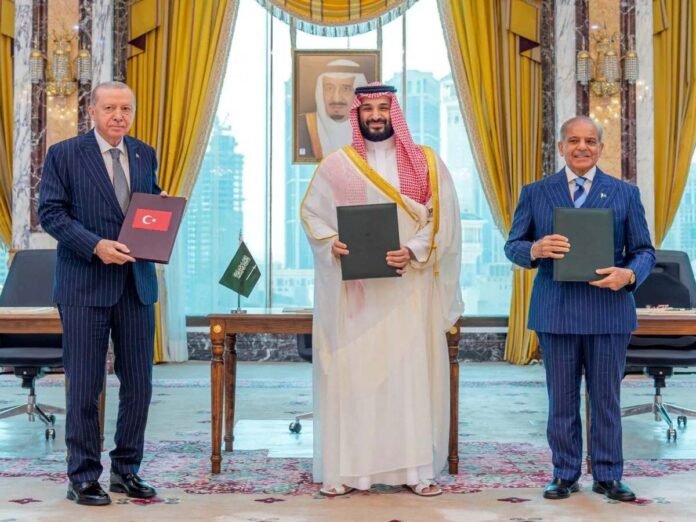
within hours of the Makkah Joint Defence Agreement being signed at Al-Safa Palace on August 7, 2026 the label had already hardened in the headlines: an “Islamic NATO,” a “Sunni bloc,” a nuclear umbrella stretched from Rawalpindi over Riyadh. It is a tidy story, and almost none of it showed context with the actual text.
What Saudi Arabia, Türkiye and Pakistan actually put their names to is basically one single, load-bearing sentence, like an armed attack on any one of the three shall be seen as an attack against them all, wrapped in that familiar talk about brotherhood, Islamic solidarity and collective deterrence, as if it’s all one cloth, one thing.

Read quickly, it echoes NATO’s Article 5. Read closely, it does no such thing. There is no integrated command, no standing force, no automatic trigger. Turkish Foreign Minister Hakan Fidan, the pact’s most candid interlocutor, has already supplied the caveat that guts the comparison: if a member is attacked, the others will first consult to decide the nature and scale of any assistance. Consultation is not a guarantee. It is a meeting.
The gap between the rhetoric and the reflex was exposed almost immediately, like right away. Within a day of the signing, Houthi drones were again striking Saudi territory, that same contingency the pact is supposed to discourage, and neither Ankara nor Islamabad offered any visible military comeback.
The alliance’s first test was met with silence. That quiet is not some accident of timing; it feels like the design. The agreement is hedged to the point where the practical meaning of it is almost impossible to nail down, and that’s exactly the reason three governments with different interests could even sign it at all, without it meaning what anyone thinks it means.
While unlikely to result in direct military intervention, the collective-defence language provides Pakistan with a ready-made narrative and diplomatic megaphone against Indian counter-terrorism actions
So why should India care about a pact that may never fire?

Because the collective-defence clause is the least important thing in it, the parts that matter are the connective tissue, the defence-industrial pipelines, the financing, the training relationships that the agreement formalises and accelerates.
Türkiye brings a maturing arms industry and is already deeply invested in Pakistan’s defence ecosystem. Saudi Arabia brings financial depth of a kind Islamabad has never been able to generate on its own.

Layer the two together, and you get something more consequential than a mutual-defence promise: a mechanism that steadily enhances Pakistan’s military resilience without a single clause mentioning India. That is the signal Delhi should read, and it does not depend on the clause ever being invoked.
There is a sharper question buried in the fine print. Suppose India, following a major cross-border terrorist attack, once again strikes terrorist infrastructure inside Pakistan, as it did during Operation Sindoor. Does that trigger the Mecca clause?
India’s position has been consistent and correct: counter-terrorism action taken in self-defence is categorically different from aggression against a sovereign state. But the pact’s studied ambiguity cuts both ways. It hands Islamabad a ready-made narrative that any Indian response is “an attack on all three”, and a diplomatic megaphone with which to broadcast it. The clause may never be honoured militarily. As political cover, it is already working.
Here, Egypt’s absence is the most instructive detail of the whole episode, and the one the triumphalist framing keeps missing. Cairo sat through the four-nation talks and then declined to sign.
It has a peace treaty with Israel, deep defence ties with the UAE, existing commitments touching Greece and Cyprus, and a fast-growing economic relationship with India, more than 700 Indian companies, billions in investment, bilateral trade worth some $6.5 billion.
Egypt looked at a bloc that would bind it to Pakistan’s quarrels and Türkiye’s, weighed it against the relationships it already values, and walked away. If the pact was the seamless expression of Islamic solidarity its boosters claim, the Arab world’s most populous nation and largest army would not have found the exit so easy.
India needs calm, persistent diplomacy – monitoring the actual defence-industrial pipelines taking shape rather than reacting to the symbolic headlines in Makkah
None of this warrant alarms in Delhi. Saudi Arabia remains one of India’s most important partners, a top trading relationship, a pillar of energy security, an increasingly serious counter-terrorism interlocutor. Riyadh has every incentive to keep it that way, and no interest in becoming an instrument of Pakistani adventurism.
India’s calibrated official response, that it is studying the implications while safeguarding its interests, was totally right. The task now is quiet, persistent diplomacy: securing from Riyadh the clarity that this arrangement is not aimed at India and does not dilute its commitment to fighting terrorism in every form, while holding firm to the principle that no security architecture, however it is dressed up, can furnish political or strategic cover for cross-border terror.
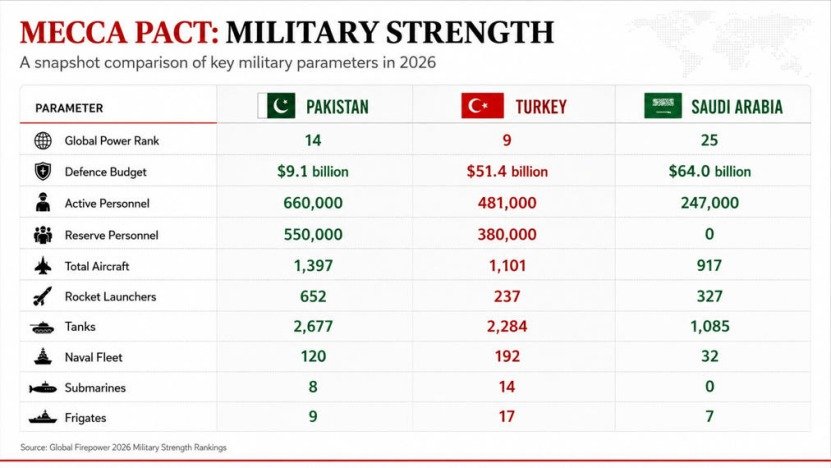
But India should also read the pact as a symptom rather than an event. It is the first visible tremor of a retreating American security guarantee. Through this year’s war on Iran, Gulf capitals watched missiles and drones penetrate the shield Washington was supposed to hold over them, and drew the obvious conclusion: even overwhelming US support could not insulate them from the fallout.
The Mecca Pact is their hedge, an attempt, however inchoate, to build a regional security order that leans less on an outside power. As Washington steps back, others will step forward to fill the space, and not all of them will be friendly to Indian interests. Multi-alignment, India’s instinctive posture, may no longer be sufficient on its own. The hedge needs hedges of its own.
The Mecca Pact’s greatest strength is its ambiguity, vague enough to sign, elastic enough to grow, deniable enough to reassure Tehran and Tel Aviv in the same breath. That ambiguity is also its greatest weakness; an alliance that cannot name its enemy will struggle to actually act when one appears.
For New Delhi, the lesson is neither panic nor complacency, but a sort of learning. Read the fine print, not the headlines, because if you miss the details, then everything gets blurry. The flags and fanfare in Mecca will fade. The pipelines the pact quietly switched on will not.

The writer is an expert on geopolitics, national security, and counter-terrorism; and he regularly contributes his subject thought-leadership and academic commentary with several publications in newspapers, journals, and periodicals. He works with investigative agencies, regulatory bodies, financial institutions and enterprises, providing strategic and regulatory advisory. The views expressed are personal and do not necessarily carry the views of Raksha Anirveda





