


India’s debate should no longer be limited to whether it can eventually design a sixth-generation fighter. The more useful question is whether the country can create, during the AMCA era, the technological and industrial system from which a sovereign sixth-generation capability can emerge.
The timing matters. In March 2025, the US Air Force awarded Boeing the Engineering and Manufacturing Development contract for the F-47 under Next Generation Air Dominance. The Air Force described the programme as using digital engineering, government-owned architecture and Collaborative Combat Aircraft (CCA), and noted that preceding X-plane activity had already accumulated hundreds of flight hours. In July 2026, the UK announced a £4.6 billion GCAP industry contract with Italy and Japan, retaining the programme’s target of introducing a sixth-generation aircraft from 2035. These programmes demonstrate that the next competition is already moving from conceptual studies towards engineering organisations, experimental hardware and production-oriented architectures.

India does not need to imitate either programme. Its strategic circumstances, budgets, force structure and industrial base are different. It does, however, need to ensure that the post-AMCA generation is not approached as another clean-sheet project started after the preceding aircraft is complete.
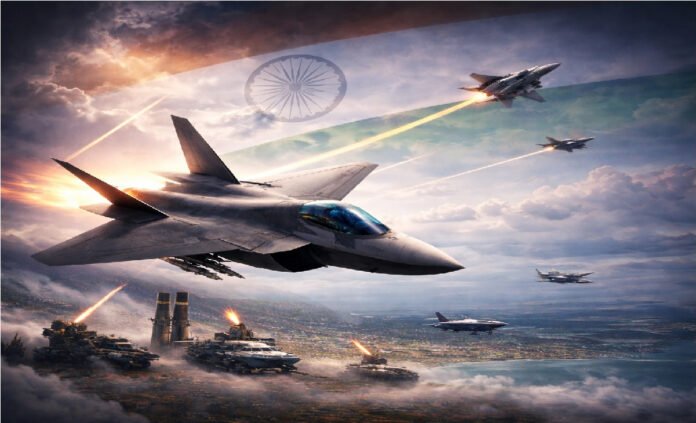
India should resist defining the programme around an artist’s impression. The defining capability is more likely to be a distributed combat-air system in which a crewed platform, autonomous collaborative aircraft, airborne and space-based sensors, ground and maritime nodes, and weapons exchange information through resilient mission networks. The aircraft is consequently one node in a larger system of systems
AMCA Should Be the Bridge, Not the Waiting Room
The AMCA programme creates an unusually important institutional opening. In May 2025, the Ministry of Defence approved an execution model under which ADA will execute AMCA through industry partnership, with Indian private and public companies able to compete independently, as joint ventures or as consortia. This should be viewed as more than a procurement arrangement: it can become the foundation for a broader Indian combat-air industrial base.
A sixth-generation programme started today should therefore be complementary to AMCA rather than competitive with it. AMCA must remain focused on delivering a credible fifth-generation operational capability. In parallel, a separate Future Combat Air Technology Programme should mature technologies whose development cycles extend well beyond a single aircraft: advanced propulsion, collaborative autonomy, distributed sensing, electronic warfare, resilient networking, thermal and power management, multifunction structures, digital engineering and rapid software insertion.
Define Sixth Generation as a System, Not a Shape
India should resist defining the programme around an artist’s impression or a predetermined fighter configuration. The defining capability is more likely to be a distributed combat-air system in which a crewed platform, autonomous collaborative aircraft, airborne and space-based sensors, ground and maritime nodes, and weapons exchange information through resilient mission networks. The aircraft is consequently one node in a larger system of systems.

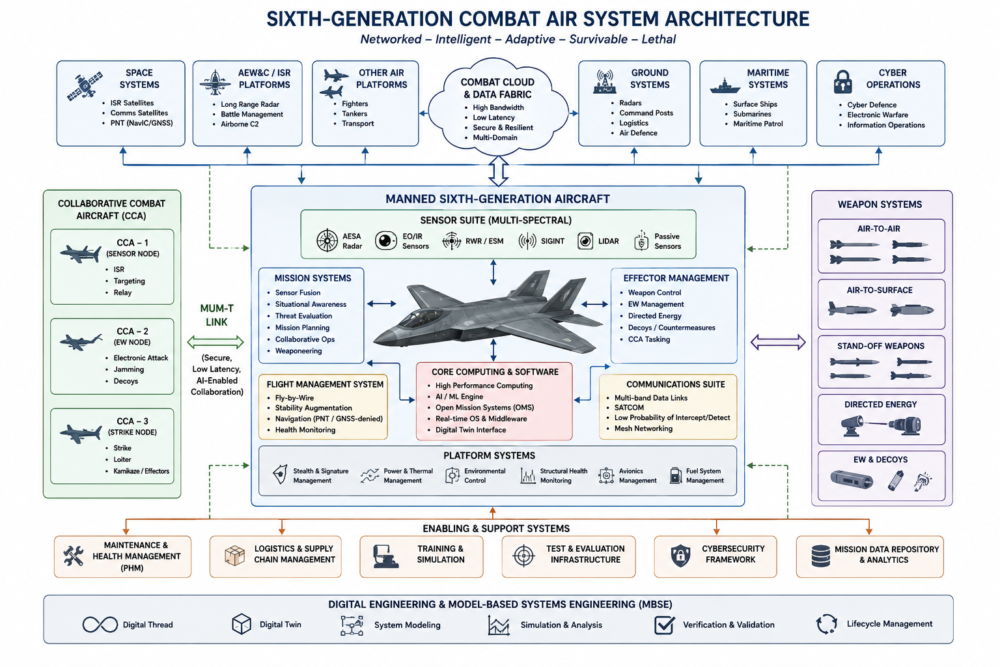
This framing changes programme priorities. Open interfaces, software assurance, data standards, sensor fusion, autonomy verification and configuration control become as important as aerodynamic performance. It also allows technologies to mature on smaller experimental vehicles before a crewed combat-aircraft configuration is frozen.
India should establish a consortium in which a capable private-sector organisation can serve as Lead Systems Integrator and, subject to government oversight and airworthiness arrangements, Design Authority. This does not imply excluding ADA, DRDO, HAL, BEL or other public institutions. It means separating the role of national technology custodian from the industrial responsibility for integrating a complete system
A New Industrial Model: Private Consortium as Lead Integrator
India should consider establishing a purpose-built Indian consortium or special-purpose programme entity in which a capable private-sector organisation can serve as Lead Systems Integrator and, subject to government oversight and airworthiness arrangements, Design Authority. This does not imply excluding ADA, DRDO, HAL, BEL or other public institutions. It means separating the role of national technology custodian from the industrial responsibility for integrating a complete system.

The consortium should not be a loose association of vendors. It should possess a permanent systems-engineering organisation responsible for requirements, model-based systems engineering (MBSE), interface control, configuration management, digital thread, safety, verification, mission-system integration and prototype integration. Strategic members would lead propulsion, structures, RF/AESA, electronic warfare, electro-optics, flight controls, mission computing, communications, autonomy and manufacturing. Universities should operate long-duration research centres tied to measurable technology demonstrations rather than one-off studies.
This direction is consistent with the policy trajectory already evident in AMCA and DRDO’s Technology Development Fund, which explicitly supports public-private sector industry — especially MSMEs and start-ups — and allows collaboration with academia and research institutions for indigenous defence technology development.
Develop Demonstrators Before Developing the Fighter
The programme’s first major output should not be a full-scale fighter prototype. India should adopt an experimental-aircraft philosophy: progressively fly the difficult technologies before committing them to the operational aircraft.
|
Stage |
Indicative period | Principal output |
Purpose |
|
0 |
2027–2029 | National architecture & consortium | Requirements, MBSE, labs, IP and interface framework |
|
1 |
2029–2032 | Subsystem demonstrators | Autonomy, RF/EW, structures, controls, networking, thermal systems |
|
2 |
2032–2034 | Uncrewed X-aircraft / CCA | Flight-test low observability, autonomy, sensing and teaming |
|
3 |
2033–2038 | Representative X-plane | Integrate propulsion, apertures, power/thermal and mission architecture |
|
4 |
2036 onward | Operational system development | Freeze configuration only after enabling technologies mature |
Illustrative roadmap; dates are proposed by the author, not an announced Government of India schedule.
Propulsion remains the highest strategic technology risk. India should not allow the future combat-air programme to be held hostage by a single engine schedule; early experimental aircraft can use available propulsion while an indigenous next-generation engine programme advances independently. At the same time, engine sovereignty cannot remain indefinitely deferred
A CCA-class uncrewed demonstrator is particularly valuable because it forces development of autonomy, flight controls, secure networking, sensor fusion and human–machine teaming without immediately accepting the cost and certification burden of a crewed fighter. Experimental vehicles should be treated as learning assets: rapid iteration and occasional failure must be institutionally acceptable.
Propulsion Must Become a Parallel National Mission
Propulsion remains the highest strategic technology risk. India should not allow the future combat-air programme to be held hostage by a single engine schedule; early experimental aircraft can use available propulsion while an indigenous next-generation engine programme advances independently. At the same time, engine sovereignty cannot remain indefinitely deferred.
In February 2026, the defence minister reiterated the government’s commitment to self-reliance in aero engines during a review at GTRE, where indigenous military gas-turbine projects and engagement with industry, academia and R&D institutions were discussed. A future programme should convert this objective into a sustained national propulsion mission covering engine-core demonstrators, high-temperature materials and coatings, advanced manufacturing, thermal management, controls and test infrastructure.
Selective foreign collaboration is rational where it transfers know-how, accelerates materials or manufacturing maturity, or provides access to specialised test capability. The test for collaboration should not simply be the percentage of indigenous content. India should ask whether it retains design understanding, manufacturing capability, integration freedom, lifecycle support and the legal ability to modify and upgrade the resulting technology.
Sovereignty Should Mean Control of the Architecture
Attempting to make every component indigenous at programme launch would increase cost and schedule risk without necessarily producing strategic autonomy. A more useful definition of sovereignty is control over the system architecture and the ability to sustain, modify and evolve it without external permission.
Selective foreign collaboration is rational where it transfers know-how, accelerates materials or manufacturing maturity, or provides access to specialised test capability. The test for collaboration should not simply be the percentage of indigenous content. India should ask whether it retains design understanding, manufacturing capability, integration freedom, lifecycle support and the legal ability to upgrade the resulting technology
India should therefore treat the following as strategic national assets: system architecture and interface standards; flight-control and vehicle-management software; mission software and sensor fusion; electronic-warfare architecture; autonomy and human–machine teaming frameworks; secure communications; digital engineering models; integration and certification knowledge; and critical propulsion intellectual property. Components may be sourced or co-developed selectively, but the programme must avoid black boxes that prevent sovereign integration.
Governance, Funding and the First Five Years
The programme requires stable governance more than a spectacular initial budget. A small empowered national programme office should establish the operational problem set with the Indian Air Force, maintain a controlled technology roadmap and fund competing demonstrators. Government should act as strategic customer, regulator and co-investor; the consortium should carry industrial integration responsibility; academia should pursue high-risk enabling science.
During the first five years, success should be measured by tangible capabilities rather than by announcing a fighter: a government-approved reference architecture; a functioning secure digital engineering environment; integrated avionics and sensor-fusion rigs; flight-qualified autonomy experiments; low-observable structural test articles; propulsion-core progress; and at least one flying uncrewed experimental aircraft. Existing mechanisms such as TDF can support portions of the ecosystem, although a sixth-generation programme would ultimately require a much larger, dedicated funding instrument.
The programme requires stable governance. A national programme office should establish the operational problem set with the Indian Air Force, maintain a controlled technology roadmap and fund competing demonstrators. Government should act as strategic customer, regulator and co-investor; the consortium should carry industrial integration responsibility; academia should pursue high-risk enabling science
Conclusion
India should begin thinking about sixth-generation combat aviation now — but it should begin in the correct way. The immediate objective is not to announce another fighter. It is to create a sovereign architecture, a durable public–private–academic industrial system, a culture of experimental aircraft, and long-horizon technology missions that mature before the operational platform is frozen.
AMCA should remain the national priority for establishing fifth-generation capability, while simultaneously becoming the bridge to the next era. A private-sector-led consortium with genuine systems-integration responsibility could add industrial competition, specialist innovation and programme capacity, provided that government and the Indian Air Force retain strategic oversight and that national design authority is protected.
The central recommendation is therefore simple: India should launch a Future Combat Air Technology Programme during the AMCA development era, fly its first technologies on experimental and collaborative aircraft, pursue propulsion as a parallel national mission, and defer the final sixth-generation aircraft configuration until the enabling technologies have demonstrated maturity. Starting the learning cycle now is more important than prematurely naming the aircraft.

The writer is Founder and Chief Executive Officer of Pranayam Industries Pvt Ltd. The views expressed are personal and do not necessarily carry the views of Raksha Anirveda





