


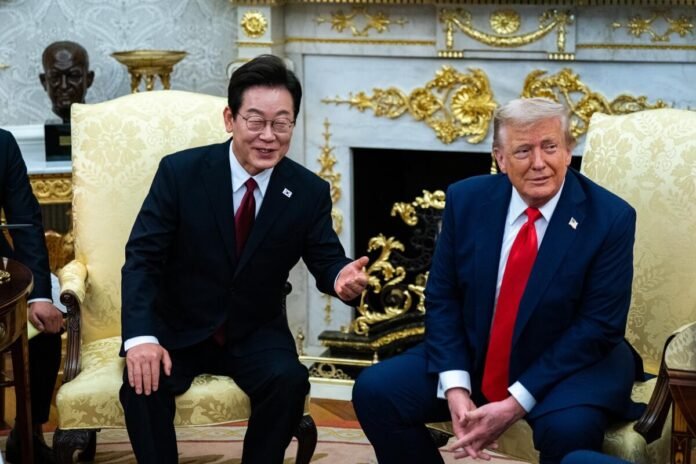
Only US President Donald Trump can do this. Just hours before his country started the annual joint military exercise with South Korea, one of America’s steadfast allies in the Indo-Pacific for more than 75 years, he orders his defence secretary, Pete Hegseth, to “substantially” reduce it.
Incidentally, the annual Ulchi Freedom Shield (UFS) exercise began this morning (Monday, August 17). It is supposed to run until August 27, featuring combined and all-domain operations to boost the allies’ readiness and capabilities.

The reasons that Trump has cited for his decision are that he had a positive relationship with North Korean leader Kim Jong Un and that Seoul has not lived up to his expectations as an ally by refusing to join him in his war with Iran.
“Based on my very good relationship with Kim Jong Un, of North Korea, I am not happy with the fact that the United States has, long ago, agreed to participate in Joint Military Exercises with South Korea,” Trump wrote on Truth Social.
“These exercises are not only costly, with much of these costs paid for by the United States of America (as usual!), but send a signal that is totally inappropriate and hostile to a Country that, as long as Donald J Trump has been President, has been unthreatening and respectful,” he added.
In what could be the second reason, Trump, in his social media post, went on to raise his request for South Korea to help with the US war against Iran. “While somewhat unrelated (?), I recently asked the President of South Korea if they would like to join us in the Denuclearisation of the Islamic Republic of Iran, and they said, ‘No thanks!’” Trump wrote.

Just hours before the annual Ulchi Freedom Shield exercise, Donald Trump instructed Defence Secretary Pete Hegseth to “substantially” reduce joint military drills with South Korea, disrupting long-standing Indo-Pacific security arrangements
However, there seems to be a third but hidden reason why Trump said what he did. And, in the humble view of this writer, that unsaid reason is much more significant than what the US President has actually said.
On closer scrutiny, neither of the two points that Trump made is in line with the long-term strategic goals of the United States. If Trump is really fighting for the denuclearisation of Iran, then how does one justify his support for North Korea, a country that came out of the NPT and started building nuclear weapons and missiles, some of which are claimed to be reaching the US mainland? Has Trump’s friendship with the North Korean dictator made the latter abandon nuclear weapons? NO.

Besides, it sounds ironic that while Trump is fighting Iran, he is praising the North Korean dictator who is supporting Iran. Kim said the other day that the United States’ war with Iran proves his country made the right decision to keep its nuclear weapons after denuclearisation talks with the US failed during Trump’s first term.
In a speech to North Korea’s Supreme People’s Assembly published in March, Kim accused Washington of “acts of state-sponsored terrorism and aggression”. He might not have named Iran as the victim of aggression, but it was obvious that he meant Iran.
In any case, it is America that coined the term “AXIS OF EVIL”. US President George W Bush, in his State of the Union address on January 29, 2002, had used this phrase to describe three countries – Iraq (then under Saddam Hussein), Iran and North Korea.
But now American leaders, officials and strategic experts frequently use “Axis of Evil” to include Iran, North Korea, China and Russia. For them, the Axis is a modern authoritarian alignment countering Western influence, sponsoring international terrorism, and seeking weapons of mass destruction (WMDs).
That brings Trump’s second grudge: that, as an ally, South Korea did not help Trump in the war against Iran. But then the question arises: which American ally of America, other than Israel, has really helped in this war? Did any NATO country help? If, as an alliance, NATO does its business and Trump attends its summit meetings, why should South Korea fall in his esteem?
Trump highlighted his positive relationship with Kim Jong Un and criticised Seoul for refusing to support US actions concerning Iran. However, praising North Korea – a nuclear-armed ally of Iran – directly conflicts with broader US strategic objectives
These questions are important because, all told, the US–Republic of Korea (South Korea’s official name) alliance, which is based on the Mutual Defence Treaty signed in 1953 during the Korean War, is one of the most successful bilateral defence arrangements in modern history.
South Korea is the second country, after Japan, in the Indo-Pacific where the United States maintains a permanent military presence, with approximately 53,000 to 54,000 troops stationed in Japan and 24,000 to 28,500 troops in South Korea.
What is more important, of the three criteria that the Trump Administration says are important for becoming America’s “model allies”, South Korea fulfils two.
Despite falling short of the 5% GDP defence spending demand, South Korea satisfies crucial US alliance metrics through massive arms purchases, defence industrial investments and hosting 28,500 American troops along the First Island Chain
Indeed, South Korea does not spend 5 per cent of its GDP on defence, as Trump wants all American allies to do. Its actual defence spending sits at approximately 2.3% to 2.8% of its GDP (roughly 66.3 trillion won or $47.4 billion); it has only formally targeted reaching 3.5% of GDP by 2035.
But then, except Lithuania and Estonia, no NATO ally spends the agreed 3.5% of its GDP on core defence such as troops and weapons and a further 1.5% of GDP on broader defence and security-related investments – such as adapting roads, bridges and ports for use by military vehicles, and on cyber-security and protecting energy pipelines.
However, South Korea easily fulfils Criterion 2 (two) for being a model ally of the Trump-led America, given the size of arms it purchases from the US and investments in the US defence industrial base.
Of the arms that South Korea imported in the period from 2020 to 2024, 86 per cent of them were from the United States. It has also agreed to security-adjacent investments, such as the $150 billion investment in the US for naval and commercial shipbuilding.
Criterion 3 (three) for becoming Trump’s model ally is taking greater responsibility for regional deterrence along the FIC (First Island Chain). Stretching from Japan down through Taiwan and the Philippines before curving toward the South China Sea, the FIC is one of the most important geographic concepts in modern military strategy.
What America implies here is that allies and partners will allow the US military greater access to their ports and other facilities so that there is a credible deterrence by denial to prevent China from achieving regional hegemony. And here too, South Korea, like Japan, fulfils this criterion; it hosts 28,500 US personnel.
The fundamental issue revolves around wartime operational control. While President Lee Jae Myung advocates for a swift recovery of OPCON to establish defence autonomy, US military leadership emphasises a measured transition dependent on full operational readiness
But then, while fulfilling this third criterion, there are some operational issues to resolve. Trump’s third but hidden message seems to lie somewhere here.
In South Korea, there is what is called the Combined Forces Command (CFC) to deter or defeat external aggression. It is headed by an American four-star general, with a South Korean four-star general serving as the deputy commander.
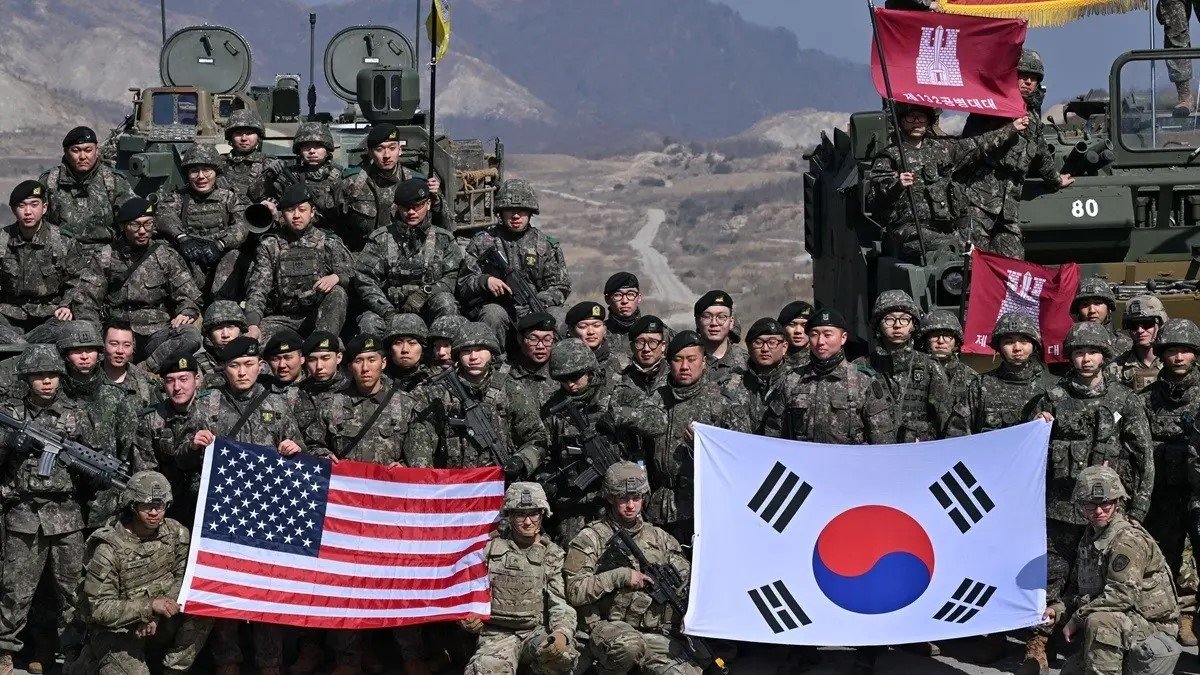
In the event of a war in South Korea, the American general exercises full wartime operational control (OPCON). And this is precisely where the debate is all about. South Korea’s political leaders want OPCON to be under a Korean general, as it is a sovereign country, whereas the Americans and many South Korean analysts call for caution and a clear-cut roadmap, as the issue is not merely political but also involves military capabilities and threat perception.
The US is seemingly prepared for the OPCON transfer. However, differences persist on how effectively Seoul and Washington should manage the transition that will shape not only the future of the bilateral relationship, but also the alliance’s role in the broader regional order. Here, the tricky issues are the timeline, military readiness and geopolitical pressures.
On May 27, President Lee Jae Myung, like many of his predecessors, reiterated in a meeting of the Cabinet and Korea’s Future Defence Strategy Committee the need for Korea to swiftly recover wartime operational control of its military. He stressed that recovering OPCON is “a central element to defence autonomy” while pledging to complete a detailed roadmap through deliberations with the US.
However, General Xavier Brunson, American Commander of US Forces Korea (USFK), has warned of the dangers of an OPCON transfer driven by political timelines, stating that “political expediency should not precede conditions”. During a hearing before the US Senate Armed Services Committee on April 22, he testified that a realistic roadmap of this transfer could be considered only in the first quarter of 2029.
Supporters of the current setup highlight the principle of unity of command, drawing comparisons to NATO’s structure where an American general serves as Supreme Allied Commander Europe without infringing on member states’ sovereignty
Military analysts of both the US and RoK want a slow and steady approach. They would like to see that the RoK has the critical military capabilities to lead combined defence, including C4ISR, ballistic missile defence, and counter-artillery systems, that the country possesses essential capabilities to respond to North Korea’s nuclear and missile threats at the early stages of provocation, and that the security environment on the Korean Peninsula and in the region (here, there are factors of China and Russia) must be conducive to a stable transition.
Even otherwise, there are some tricky questions. After the creation of the FCFC, when a RoK four-star general would command, what happens to key US strategic assets – B-52s, SSNs, space-based ISR, cyber capabilities? Would a RoK commander be able to task a US strategic bomber wing, or would it require White House approval?
Even otherwise, the essential political argument that a country loses its sovereignty, if its forces are not under the command of a national General during the war, cannot be stretched too far, if the country does have a military alliance with another country, that is much more resourceful and powerful.
For instance, wartime OPCON over NATO’s armed forces of its 32 member states, including the United Kingdom, France and Germany, is exercised by the Supreme Allied Commander Europe (SACEUR), who is an American military general.
US officials remain hesitant to use the current exercise as a test for South Korean command, prioritising necessary C4ISR capabilities and regional stability over politically expedited deadlines
SACEUR is responsible for the overall command, direction and planning of all NATO military operations. But none of these European countries, all proudly sovereign, regards this arrangement as a ‘violation of national sovereignty’.
The important issue here is “the Unity of command”. And that applies to the US-RoK alliance, so the argument goes. But President Lee does not seem to be convinced. He wants South Korea to retake wartime command from the US as early as next year.
He would love the ongoing UFS to be a testing ground where the allies can evaluate South Korea’s capabilities to lead the combined forces once Seoul retakes wartime OPCON from Washington.
But that is something the Americans are not prepared for. No wonder, contrary to some previous UFS drills, this year’s UFS does not involve training, in which the South Korean deputy commander of the Combined Forces Command (CFC), takes over the role of the CFC commander, currently held by the US Forces Korea (USFK) commander.
The US remains cautious over Seoul’s push to expedite the OPCON transition. Trump’s hidden message may be seen in this context.

The writer is veteran editor, author and strategic affairs commentator with over three decades in media, academia and policy consulting. The views expressed are personal and do not necessarily carry the views of Raksha Anirveda





