


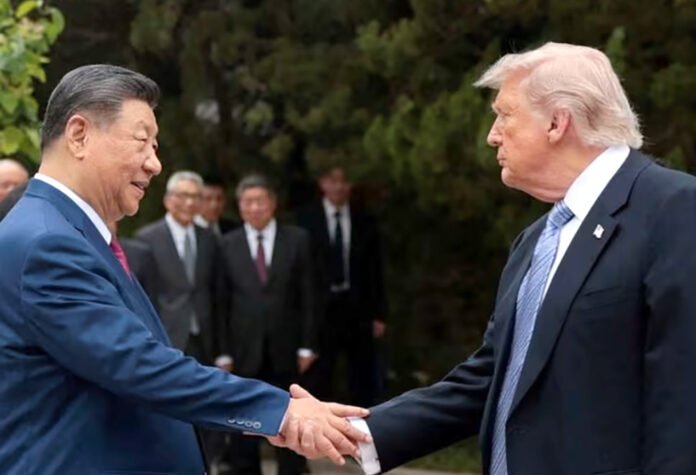
The Trump-Xi summit in Washington has ended, but its strategic consequences are only beginning. Over three days, President Donald Trump and President Xi Jinping extended their trade truce by two months, opened a channel for dialogue on artificial intelligence, and agreed to a fresh round of tariff cuts.
Spectacle Over Substance
Yet, the central disputes over Taiwan, technology, critical minerals, trade and China’s relationship with Iran remain unresolved. The outcome extended the truce rather than delivering a durable settlement, and analysts who watched the run-up to the meeting had already warned that the real test would come after the leaders left the room.

The United States and China are not moving from strategic competition to a strategic partnership. They are experimenting with a new model: managed competition with selective transactional cooperation. For India, this is neither a crisis nor a comfort. It is a strategic warning.
From Confrontation to Managed Rivalry
Both economies remain deeply connected, and both governments have reasons to avoid a confrontation that could disrupt global supply chains, financial markets and technology ecosystems. The two sides extended their trade truce by two months, pushing the deadline into January and giving negotiators more time to address tariffs, agricultural purchases, rare earth supplies and technology restrictions. The extension postpones the hardest questions rather than resolving them. A truce is not a settlement.
The same applies to artificial intelligence. AI has shifted from being primarily an economic and technological competition to a national security issue involving military power, intelligence, cyber operations and strategic decision-making. Washington and Beijing agreed to open a communication channel for AI-related incidents, even as the United States remains committed to maintaining its technological edge.
Washington and Beijing have postponed their hardest disputes, from tariffs and technology restrictions to rare earth Managed competition, rather than reconciliation, now defines the relationship
The paradox is clear. Cooperation may increase precisely because competition has become more dangerous to leave unmanaged. That paradox, not any grand reconciliation, is likely to define the next phase of the relationship.

The Critical Minerals Lesson
Perhaps the most important structural issue beneath the diplomacy is China’s position in critical minerals.
China has enormous leverage across rare earth mining, refining, metals and magnets. Industry estimates put Chinese control at roughly seventy per cent of global rare earth mining, eighty-five per cent of refining capacity and around ninety per cent of rare earth metal alloy and magnet production. These materials feed industries ranging from automobiles and electronics to aerospace and defence, and this shifts the character of economic power.

The new AI dialogue channel reflects a dangerous paradox: communication is expanding not because competition has faded, but because its risks have become harder to contain
The lesson is not simply that China possesses rare earths. It is that control over processing, refining and manufacturing can generate strategic leverage even when the resource itself is geographically dispersed. For India, this is a direct warning. Critical minerals cannot be treated as a mining question alone. India needs an integrated national capability spanning exploration, extraction, refining, recycling, stockpiling and manufacturing. The same logic applies to semiconductors, batteries, drones and pharmaceutical inputs. Strategic autonomy begins much earlier in the supply chain than on the battlefield.
Taiwan Remains the Fault Line
The summit did not resolve the Taiwan question. Analysts who examined the run-up to the meeting had already flagged Taiwan as the key indicator of whether strategic stability would come at the expense of regional partners.
This matters to India because the Indo-Pacific security architecture cannot be neatly compartmentalised. Any significant shift in the US-China balance around Taiwan would affect Japan, South Korea, Australia, the Philippines and the wider maritime environment, and would also influence Chinese military calculations elsewhere.
India must therefore avoid a narrow continental reading of Chinese power. The PLA’s growing capabilities across the Indian Ocean, Tibet, the western Pacific, cyberspace and space are part of the same national power system. Events in the Taiwan Strait can influence China’s freedom of action and resource allocation along the Himalayan frontier and in the Indian Ocean.
The India Question
This is where the summit becomes particularly relevant for New Delhi. India has benefited strategically from Washington increasingly seeing China as its principal long-term competitor, and the Quad, Indo-Pacific cooperation, and defence technology partnerships have all developed against this wider strategic backdrop.
China’s dominance in refining and processing shows that economic dependencies can become instruments of national India needs an integrated capability spanning mining, refining, recycling, stockpiling and manufacturing
But India should not assume that the US-China rivalry will remain permanently intense. If Washington gains greater predictability from Beijing on trade, minerals, or AI risk, American attention may become more flexible, still competing with China while managing that competition and pursuing other priorities. That would not make India irrelevant. But it could change the terms of the relationship.
India’s strategic value cannot rest on being useful simply because China is difficult. It must rest on what India itself can bring to the table: military capability, economic scale, resilient supply chains and advanced technology.
Strategic Autonomy Needs a Stronger Foundation
The summit also reinforces the value of India’s strategic autonomy, which does not mean equidistance between Washington and Beijing, nor does it mean refusing strategic partnerships. It means retaining sufficient national capability and policy freedom to cooperate with different powers without becoming dependent on any one.
India will need the United States for technology, investment and advanced defence systems, while continuing to engage with Russia where legacy systems and other interests require it. It will stay close to the Global South while continuing to compete with China through open channels of communication with Beijing.
The answer is not diplomatic balancing alone. It is capability balancing. A country with technological depth, economic resilience, military strength and diversified supply chains has more diplomatic options than one dependent on external guarantees.
China Will Not Stop Being China’s China
The summit should not be read as a fundamental shift in China’s strategic behaviour. Beijing can cooperate with Washington in one domain while competing aggressively in another, seek economic stability while expanding military capability, and participate in international institutions while seeking greater influence over the rules that govern them. This is not contradictory. It is statecraft.
New Delhi cannot rely on enduring US-China Its strategic value must come from military strength, advanced technology, economic scale and resilient supply chains
India should adopt the same clarity. Engagement with China should continue where interests converge, but it must not be confused with trust, and economic interdependence must not be allowed to become a strategic vulnerability.
The lesson from the rare earth issue is especially relevant. Dependencies that seem commercial in peacetime can become instruments of national power in a crisis. India therefore needs a permanent strategic vulnerability audit covering critical minerals, energy, semiconductors, cyber infrastructure and defence components.
The Military Lesson
The Trump-Xi model also has military implications. Future strategic competition may remain below the threshold of conventional war for extended periods, with economic pressure, cyber operations, supply chain disruption, sanctions and space competition shaping the battlefield before a shot is fired. For India, this means investing in resilient C5ISR, redundant communications, AI, electronic warfare and space resilience.
The next conflict may not begin with a missile launch. It may begin with a disruption. A satellite link fails. A supply chain halts. Navigation degrades. An unmanned system penetrates defended airspace. The country that can absorb the first shock, understand it more quickly, and restore combat power will possess a decisive advantage.
India’s Opportunity
However, a major opportunity exists. If the United States and China are moving towards managed competition, countries such as India can become important bridges across economic, technological and strategic networks, but only if India develops capabilities that others genuinely need.
Strategic autonomy requires more than diplomatic India must reduce vulnerabilities in semiconductors, energy, cyber infrastructure, defence systems and critical minerals while expanding partnerships across the Indo-Pacific
India should shift from strategic relevance based on geography to strategic relevance based on capability: a trusted hub for advanced manufacturing, defence technology, semiconductors, critical minerals and resilient supply chains. That means strengthening the Quad without turning it into an anti-China bloc and expanding partnerships with Europe and the wider Indo-Pacific. The objective should be neither alignment nor isolation. It should be leverage.
The Bigger Picture
The Trump-Xi summit has produced a pause, not peace. Dialogue, not convergence. Economic accommodation, not the end of strategic competition. Major differences over trade, AI, Taiwan and China’s relationship with Iran remained unresolved when the three-day meeting closed.
That may be the emerging international order: not a new Cold War with permanently frozen blocs, but a world of managed rivalries, transactional partnerships and contested interdependence. For India, the message is straightforward. Do not build strategy on the assumption that America and China will always remain locked in confrontation. Do not assume that a US-China détente will diminish India’s importance. And do not assume that diplomacy can compensate for capability gaps.
The real strategic contest is shifting from alliances alone to resilience, technology, supply chains, military capability, and national power. Washington and Beijing may be learning to manage their rivalry. India must learn to manage its dependencies. That is the strategic space where India’s choices over the next decade will matter most.

The writer, a PVSM, AVSM, VSM has had an illustrious career spanning nearly four decades. A distinguished Armoured Corps officer, he has served in various prestigious staff and command appointments including Commander Independent Armoured Brigade, ADG PP, GOC Armoured Division and GOC Strike 1. The officer retired as DG Mechanised Forces in December 2017 during which he was the architect to initiate process for reintroduction of Light Tank and Chairman on the study on C5ISR for Indian Army. Subsequently he was Consultant MoD/OFB from 2018 to 2020. He is also a reputed defence analyst, a motivational speaker and prolific writer on matters of military, defence technology and national security. The views expressed are personal and do not necessarily carry the views of Raksha Anirveda





