


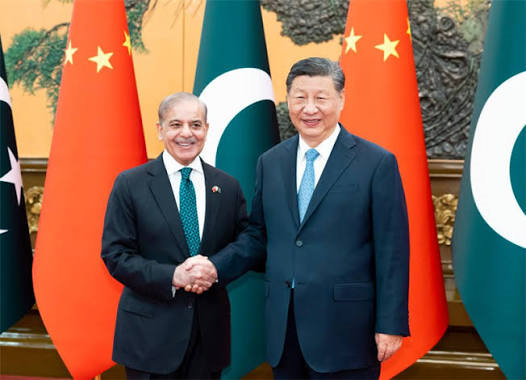
On September 17, 2026, Pakistan and China held the inaugural meeting of a Joint Boundary Commission in Islamabad. The event drew little ceremony, but carries real weight. It came within weeks of Prime Minister Modi and President Xi Jinping exchanging conciliatory language on respecting each other’s sensitivities. The timing was not accidental. It was a message, and one aimed as much at New Delhi as at any audience in Islamabad or Beijing.
The Ministry of External Affairs responded without hesitation, rejecting the commission and stating that Pakistan “has no locus standi” to enter into arrangements over Indian territory under illegal occupation. The statement reaffirmed that Jammu and Kashmir and Ladakh remain, in perpetuity, an inseparable part of India. This is the correct baseline, and it should not shift. But the more useful question for strategic analysis is not whether India’s position is right. It plainly is. The question is why China chose this moment to activate a clause that has remained untouched for sixty-three years, and what trap that activation lays for how India talks about it.

The Sino-Pakistan commission’s activation followed closely on the heels of warmer optics between Modi and Xi, and at least one assessment has read it as a deliberate puncture of that mood. Beijing appears to want New Delhi to understand that improved atmospherics along the LAC change nothing about China’s alignment with Pakistan on Kashmir
The Clause That Slept
The Sino-Pakistan Boundary Agreement of 1963 ceded Indian territory, a stretch of the Shaksgam Valley, roughly 5180 square kilometres, north of the Karakoram range, to Chinese administration. The agreement itself provided for a boundary commission to survey and formally demarcate the line. That commission was never convened. The reason lies in the treaty’s own text. The settlement was explicit that it stood provisionally, pending renegotiation with whichever sovereign eventually inherits the territory once the Kashmir dispute is resolved. Pakistan held no sovereign title to permanently dispose of what was, and remains, an Indian territory. A commission convened to fix a line under those conditions would have been an exercise built on borrowed legitimacy. For six decades, both Islamabad and Beijing appear to have understood this well enough to leave the clause alone.
What Actually Changed
The commission activated this week rests formally on the 2013 Agreement on the Boundary Management System between Pakistan and China, not a direct revival of the 1963 provision. The distinction is worth preserving for the legal record, even though the underlying geography and the signal are identical. Islamabad has described the commission’s mandate in deliberately modest terms: border management, joint surveys, trade facilitation, and connectivity tied to the China-Pakistan Economic Corridor. Beijing, for its part, has avoided any language suggesting formal delineation.
Governance in PoK and the Northern Areas has weakened, and the unrest has targeted Chinese nationals and CPEC infrastructure. A standing boundary mechanism gives Beijing an administrative and legal instrument to lock in its hold on Shaksgam, regardless of what happens to Islamabad’s grip on the surrounding territory. It is consolidation, framed as routine bilateral housekeeping
The caution on both sides is informative in itself. Neither government wants to be seen making the first explicit move towards permanent boundary settlement, because either could then be accused of altering, rather than merely managing, a live dispute.
The Motives
Strip away the diplomatic phrasing and two motives stand out.

The first is defensive. China’s position in the region has grown less comfortable, not more. Governance in Pakistan-occupied Kashmir and the Northern Areas has weakened, and unrest there has repeatedly targeted Chinese nationals and CPEC infrastructure. A standing boundary mechanism gives Beijing an administrative and legal instrument to lock in its hold on Shaksgam, regardless of what happens to Islamabad’s grip on the surrounding territory. It is consolidation, framed as routine bilateral housekeeping.
The second is signalling. The commission’s activation followed closely on the heels of warmer optics between Modi and Xi, and at least one assessment has read it as a deliberate puncture of that mood. Beijing appears to want New Delhi to understand that improved atmospherics along the Line of Actual Control change nothing about China’s alignment with Pakistan on Kashmir.

India gains nothing by allowing its boundary negotiations with China, however slow and modest their present progress, to be held hostage to Beijing’s Shaksgam theatre. The two tracks should be pursued and discussed publicly as entirely separate matters. Conflating them hands Beijing exactly the leverage this manoeuvre was designed to create
This is not a minor protocol point. Shaksgam sits adjacent to the Siachen Glacier and near territory west of the Actual Ground Position Line. Roads and infrastructure China has developed within this disputed pocket lie within reach of positions India holds at considerable cost and altitude. A functioning China-Pakistan boundary apparatus operating there is an operational concern for the Indian Army, not merely a diplomatic irritant.
The Trap in the Language
This is where Indian commentary needs discipline. The instinct, when a boundary commission makes headlines, is to discuss it using the vocabulary of border resolution, as though it were one more entry in the long ledger of settling India’s frontiers. That vocabulary is the trap, and it is worth naming precisely why.
China has spent decades seeking a foothold as a stakeholder in the Kashmir dispute, which is bilateral by explicit commitment under the Simla Agreement of 1972. Every time Indian discourse treats a China-Pakistan boundary move as part of a border resolution conversation, it concedes, even rhetorically, that China holds some standing in shaping that resolution. It does not, and it should not be permitted to acquire any by default. Pakistan’s cession of Shaksgam was invalid the moment it was signed, because Pakistan never held sovereign title to give the territory away. No commission, however many times it meets, can cure that defect.
The clearer framing keeps two conversations apart that Beijing has every incentive to blur. One is the genuine India-China boundary settlement process, conducted through the Special Representatives mechanism established in 2003, where Ajit Doval and Wang Yi have reported incremental progress this year towards stabilising the Line of Actual Control. That is a real, bilateral, government-to-government track, and India has good reason to keep pursuing it on its own terms.
Continued infrastructure and force absorption along the Shyok axis and towards the Saltoro Ridge remain the most credible answer to a legal instrument that Indian diplomacy alone cannot unwind. A note verbale changes nothing on a glacier. Terrain held changes everything
The other is the China-Pakistan Shaksgam arrangement, which is not a border settlement at all. It is a territorial fait accompli that China is now trying to formalise administratively, with Pakistan serving as a willing instrument. Letting the two blur allows Beijing to borrow the language of resolution for what is, in substance, the paperwork of occupation.
What Follows
Three responses suggest themselves, and none require India to escalate.
The first is legal discipline. Every Indian statement, at every level of government, should continue to describe the 1963 agreement as void ab initio, not merely disputed. That distinction shapes how the record reads in any future arbitration or diplomatic forum, and sloppy language now becomes a liability later.
The second is compartmentalisation. India gains nothing by allowing its boundary negotiations with China, however slow and modest their present progress, to be held hostage to Beijing’s Shaksgam theatre. The two tracks should be pursued and discussed publicly as entirely separate matters. Conflating them hands Beijing exactly the leverage this manoeuvre was designed to create.
The third is presence over protest. Continued infrastructure and force absorption along the Shyok axis and towards the Saltoro Ridge remain the most credible answer to a legal instrument that Indian diplomacy alone cannot unwind. A note verbale changes nothing on a glacier. Terrain held changes everything.
The Joint Boundary Commission is a provocation calibrated to test two things at once: Indian restraint, and Indian vocabulary. On restraint, New Delhi’s response so far has been sound. On vocabulary, the harder discipline lies ahead. It requires resisting the pull to discuss this as a border resolution question at all, and naming it instead for what it actually is: an attempt to legalise an illegal occupation, and a manoeuvre to insert a third party into what has always been, and must remain, a bilateral dispute between India and Pakistan.

The writer, a PVSM, AVSM, VSM has had an illustrious career spanning nearly four decades. A distinguished Armoured Corps officer, he has served in various prestigious staff and command appointments including Commander Independent Armoured Brigade, ADG PP, GOC Armoured Division and GOC Strike 1. The officer retired as DG Mechanised Forces in December 2017 during which he was the architect to initiate process for reintroduction of Light Tank and Chairman on the study on C5ISR for Indian Army. Subsequently he was Consultant MoD/OFB from 2018 to 2020. He is also a reputed defence analyst, a motivational speaker and prolific writer on matters of military, defence technology and national security. The views expressed are personal and do not necessarily carry the views of Raksha Anirveda





