


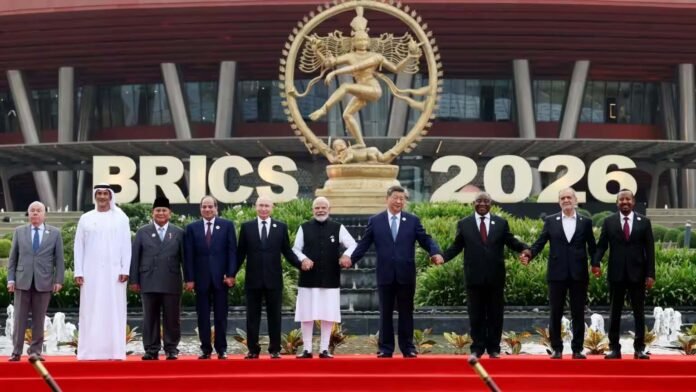
When the 18th BRICS Summit concluded at Bharat Mandapam on September 13, the headlines belonged to the diplomats: a consensus declaration wrung from 11 quarrelsome members, 15 bilaterals in three days, a rare Xi Jinping visit. But summits are security events too, and for India’s strategic establishment, New Delhi 2026 repaid close reading. Beneath the ceremony sat a cluster of outcomes that touch counter-terrorism, the China frontier, defence-industrial dependence, technology sovereignty and the quiet deterrence value of refusing to be cornered.
Start with the win that lands hardest in South Asia: the language on terrorism. The New Delhi Declaration condemned the April 2025 Pahalgam attack by name, reaffirmed a commitment against cross-border movement of terrorists, terror financing and safe havens, insisting on ‘zero tolerance’ and no ‘double standards’. For a document that carries China’s signature, this is not trivial. Beijing has spent years shielding Pakistan-based operatives at the United Nations; getting it to endorse language that so plainly indicts the Pakistani proxy model, alongside the BRICS Counter-Terrorism Working Group’s continuing machinery, is a diplomatic gain with security value. The honest caveat is that declaratory consensus is not enforcement. Pakistan is not named; the clauses bind no one to act. But norms accrete, and India has now written its threat perception into the founding text of an 11-nation bloc. That is the difference between shouting into the wind and building a record.

The New Delhi Declaration condemned the April 2025 Pahalgam attack by name, reaffirmed a commitment against cross-border movement of terrorists, terror financing and safe havens, insisting on ‘zero tolerance’ and no ‘double standards’. For a document that carries China’s signature, this is not trivial
The China frontier is the summit’s most delicate security file. The third consecutive Modi-Xi meeting, and the agreement to keep peace along the Line of Actual Control while ensuring differences do not become disputes, reads as stabilisation, not settlement. For a military planner, that is precisely the point. Managed calm on the northern border buys time, lowers the odds of an inadvertent two-front squeeze, and lets India concentrate resources. Yet the file must be read with cold eyes. Beijing tilted openly towards Pakistan during Operation Sindoor; its String of Pearls, ports, listening posts and dual-use infrastructure ringing the Indian Ocean, advances regardless of summit smiles. The correct posture is the one New Delhi appears to hold: engage to manage escalation, hedge against betrayal, and never mistake atmospherics for a settled border.
If China is the risk, Russia is the ballast. The Modi-Putin bilateral, spanning defence, energy, civil nuclear cooperation, critical minerals and technology, sustained a relationship that Western capitals have pressed India to abandon. The strategic logic is unsentimental. Russian systems and know-how underwrite Indian capabilities, including in the most sensitive tiers of the sea-based deterrent, and diversified supplier relationships are themselves a form of security. That India could deepen this partnership at the same table where it manages China, and while keeping its Quad and G20 equities intact, is the tangible face of strategic autonomy. Autonomy is not neutrality; it is the ability to say ‘yes’ and ‘no’ on one’s own terms, and it is a deterrent in its own right because it denies any single power decisive leverage over New Delhi.
Modi’s insistence that the Global South move from ‘rule-taker’ to ‘rule-shaper’ in AI, cyberspace, outer space and biotechnology is a security doctrine dressed as development policy. Whoever writes the standards for these domains writes the terms of future conflict and future dependence
The summit also sharpened India’s economic-security vocabulary. Prime Minister Modi’s warning against the weaponisation of critical minerals named a real vulnerability: the supply chains for defence electronics, batteries and clean-energy systems run through chokepoints an adversary can squeeze. The declaration’s push for resilient, diversified mineral supply chains, and the parallel work on local-currency settlement and cross-border payment interoperability, should be read as hardening against coercion rather than as anti-dollar theatre. India does not seek to dethrone the greenback; it seeks insulation from the day financial access becomes a weapon. Sanctions and secondary sanctions are instruments of statecraft, and a country that can trade and pay outside a single rail is harder to coerce. For a rising power that intends to keep buying Russian oil and Iranian goodwill without asking permission, that resilience is national security by other means.
Technology was the summit’s forward edge. New Delhi’s showcase, a 64-qubit quantum processor, AI systems in health and agriculture, semiconductor and satellite platforms among 37 deep-tech exhibits, was not a science fair. Modi’s insistence that the Global South move from ‘rule-taker’ to ‘rule-shaper’ in AI, cyberspace, outer space and biotechnology is a security doctrine dressed as development policy. Whoever writes the standards for these domains writes the terms of future conflict and future dependence. By pressing BRICS to co-author those rules and pitching its digital public infrastructure as an exportable template, New Delhi is competing for strategic depth where the next contests will be decided. The proposed Seafarers’ Emergency Support Network, prompted by attacks on merchant shipping near the Strait of Hormuz, points the same way, with India positioning itself as a provider of security public goods along the sea lanes its economy depends on.

India cannot and should not treat BRICS as a bloc to be marshalled against Islamabad. But by embedding its counter-terror narrative, hosting a summit that drew the Global South to Delhi, and displaying that it can convene Beijing, Moscow, Tehran and Riyadh in the same hall, India strengthened its claim as the region’s indispensable interlocutor
What does all this mean for regional security alignment in South Asia? Less a new alliance than a repositioning. BRICS is not a security pact; it is consensus-bound, internally divided, and includes Iran and the Gulf Arab states on opposite sides of a live war. India cannot and should not treat it as a bloc to be marshalled against Islamabad. But by embedding its counter-terror narrative, hosting a summit that drew the Global South to Delhi, and demonstrating that it can convene Beijing, Moscow, Tehran and Riyadh in the same hall, India strengthened its claim to be the region’s indispensable interlocutor. Pakistan, absent and unnamed, was nonetheless the negative space around which much of the terrorism language was built. That is soft-power deterrence: not the threat of force, but the steady narrowing of a rival’s diplomatic room.
The temptation for Indian readers will be triumphalism, and it should be resisted. A consensus paragraph is not a capability; a managed border is not a solved one; a technology exhibit is not a deployed system. Their value depends on follow-through, turning declaratory wins into procurement, doctrine and enforcement. Read soberly, though, New Delhi 2026 advanced a coherent security logic: manage the adversary you cannot avoid, anchor the partner you cannot replace, harden the rails an enemy would target, and compete to write the rules of the coming battlespace. For India’s national security, that is a summit worth having hosted.


The writer is an expert on geopolitics, national security, and counter-terrorism; and he regularly contributes his subject thought-leadership and academic commentary with several publications in newspapers, journals, and periodicals. He works with investigative agencies, regulatory bodies, financial institutions and enterprises, providing strategic and regulatory advisory. The views expressed are personal and do not necessarily carry the views of Raksha Anirveda





