

At the NDTV Defence Summit on September 27, Defence Secretary Rajesh Kumar Singh spoke of building an ‘AI spine’ for the armed forces rather than buying isolated applications. It sounds like a minor phrase, but it may be the most important thing said about Indian military modernisation this year. He indicated that the ministry wants a sovereign system built with domestic firms and has been wary of handing sensitive defence data to a foreign vendor. Put those choices side by side, and a larger point emerges. The force that wins the next war will be the one that can gather information, make sense of it, share it safely, and act on it before the other side can do the same.
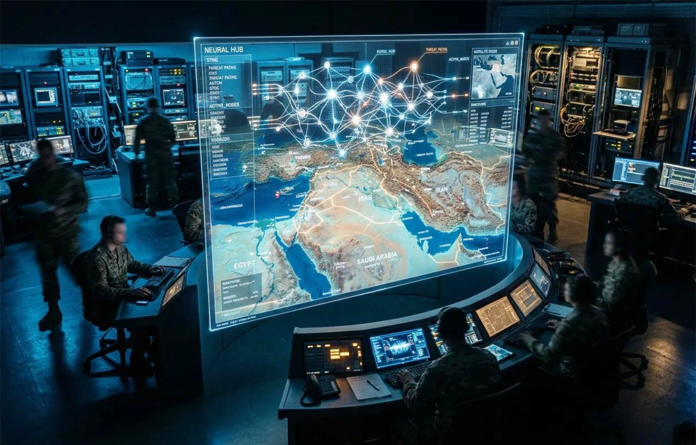
For decades, we have measured modernisation by platforms. A better tank, a faster fighter, a longer-range missile: each counted as a step up. That habit now misleads. A modern battlespace generates more information than any headquarters can process. Satellites spot patterns on the ground. Drones stream imagery without pause. Radars track aircraft and missiles. Electronic warfare units detect emissions that alter what a picture means. A soldier at the edge sees things no sensor will. Each source has its own value. The advantage comes when they merge into a single picture, fast enough to matter.

That is what a spine is for. It is not a single programme or a giant computer. Think of a secure nervous system that lets data from sensors, formations and services be found, matched and turned into something a commander can use. Its job is not to replace the commander. Its job is to take the drudgery of processing off human shoulders, surface patterns that would otherwise remain buried, and buy the commander time to think.
The hard part is data, not algorithms. Talk about military AI jumps straight to models and software, skipping the ground they stand on. Today, information sits in separate services, headquarters, weapon systems, and intelligence databases. It arrives in different formats, at different classification levels, and with varying degrees of reliability. A drone provides sharp imagery. A radar provides tracks. A satellite adds a third layer. An electronic warfare unit detects an emission that changes how the other two should be interpreted. If those streams stay apart, AI will simply give better answers within separate silos.
India needs computing in layers: large strategic centres for long-term analysis and model building, theatre-level nodes for planning and intelligence fusion, and small, hardened nodes at the tactical edge that keep working when the link to the rear goes dark. The spine must be built for resilience first and speed second
So India should treat data architecture as a strategic capability. That means common standards for tagging, storing, sharing and protecting data. It means ways to move information across service boundaries without leaking it. It means cleaning decades of historical records so they can be used to train and test systems. And it means that anything new entering service must be built to produce machine-readable data and talk to its neighbours. None of this makes a good photograph. It may still matter more than the next generation of any single platform. A force can buy thousands of sensors and remain half-blind if their outputs never meet.
The second requirement is computing power, and geography matters as much as capacity. Military AI needs heavy processing for imagery, signals, video and maps. But a contested battlespace brings jamming, cyberattacks, degraded links and deliberate attempts to cut the network. A system that works only when every connection is up will fail exactly when it is needed. India needs computing in layers: large strategic centres for long-term analysis and model building, theatre-level nodes for planning and intelligence fusion, and small, hardened nodes at the tactical edge that keep working when the link to the rear goes dark. The spine must be built for resilience first and speed second.

A spine without a brain is only wiring. At the centre of a sovereign architecture, there should be an indigenous large language model, or a family of defence-specific foundation models, that can read military information, connect scattered evidence, and help commanders analyse it in plain language
Then comes the part that determines whether India controls its own military mind. A spine without a brain is only wiring. At the centre of a sovereign architecture, there should be an indigenous large language model, or a family of defence-specific foundation models, that can read military information, connect scattered evidence, help commanders analyse it, and enable people to question vast operational data in plain language.
This cannot be a civilian chatbot with a new badge. It must be trained on authorised Indian defence data, doctrine, geography, equipment records and operational history, under proper governance. It must understand our vocabulary, organisation and threats. It must run on Indian computing and communications, including at the edge. Above all, its training data, architecture, security controls and upgrade cycle must be accountable to Indian authority.

Sovereignty means little if it stops at the server room. If the model interpreting India’s most sensitive information is controlled from outside, dependence has only shifted one layer down. The data may be ours, the servers ours, the applications ours, yet the system would still not be sovereign. India should think in terms of a full stack: data, secure compute, semiconductors, communications, foundation models, specialised military models, cybersecurity, and the freedom to upgrade all of it without asking permission.
None of these calls for isolation. The forces should continue working with global researchers, companies and friendly militaries wherever it speeds things up. But when India’s military asks its AI a question in a crisis, the engine that reads the question and forms the answer must be one India controls. That deserves the status of a national security project, with government, the services, Indian technology firms and universities all involved. It does not have to beat commercial models at everything civilians want. It has to be trusted where it counts.
The operational payoff is a shift from kill chains to kill webs. A chain runs in a line: detect, identify, assign, engage. A web is looser. Many sensors feed a single target picture, and many shooters are available, so the system can select the most reliable sensor and the best-placed weapon
The operational payoff is a shift from kill chains to kill webs. A chain runs in a line: detect, identify, assign, engage. A web is looser. Many sensors feed a single target picture, and many shooters are available, so the system can select the most reliable sensor and the best-placed weapon. That matters when the skies fill with drones, loitering munitions, decoys, electronic attackers and conventional weapons, all operating across several domains at once.
None of this removes the commander. Faster computation is not better judgement. AI can spot patterns, flag anomalies, rank information and propose options. It cannot own a political decision, a rule of engagement, or the consequences of a strike. Tomorrow’s commander will need to understand data, algorithms, cyber weaknesses and the limits of AI, as well as tactics, and know when not to trust the screen. A recommendation can look precise while resting on corrupted, incomplete, or planted data. An adversary will try to fool sensors, poison datasets and jam links. Where a decision risks escalation or civilian lives, a human must stay in the loop. The right model is teaming: the machine handles the complexity that swamps people, and the commander retains judgement, intent and action.
That changes how India should buy. Every major platform should be judged on what it adds to the whole force, not just on what it does alone. Can it share data securely? Can it ingest data from another service? Does it work when communications degrade? Can AI systems use its data? Can it feed a common operational picture? Will it still be useful alongside equipment from another generation? These questions should carry the weight that range, speed and payload carry today. A platform that cannot join the network is an expensive island.
The Defence Forces Vision 2047, released in March, names jointness as its central pillar. A spine is what makes jointness real at machine speed. So, the sequence matters. Build the spine before adding more limbs
The urgency shows in the shopping list. On July 3, the Defence Acquisition Council cleared proposals worth ₹52,000 crore at the acceptance-of-necessity stage, including the Akash Tarang anti-drone electronic warfare system, active protection systems for tanks, and jet-based kamikaze drones for the Army. These are sensible buys. Their full value depends on whether they can sense, understand, and respond as one force. The Defence Forces Vision 2047, released in March, already names jointness as its central pillar. A spine is what makes jointness real at machine speed.
So the sequence matters. Build the spine before adding more limbs. Connect the sensor to the commander, the commander to the effect, and the effect back to intelligence for rapid assessment and learning. Give it a sovereign brain, secure compute, communications that survive attack, shared data standards, and defences against manipulation. The aim is not to put AI in every weapon. It is to put intelligence across the whole force.
Wars will still be fought with weapons, platforms and soldiers. But the side that understands the battlespace first will decide and act first. India can build that advantage on its own terms, with a spine to carry the information, a brain it controls to read it, and a commander who keeps the final word. That is a military worth wanting: one where sovereign technology gives people clarity, speed and staying power, and machines never make the call.

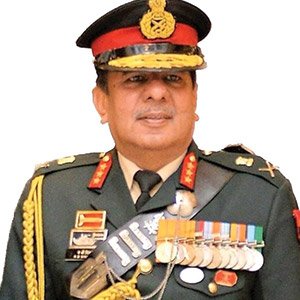
The writer, a PVSM, AVSM, VSM has had an illustrious career spanning nearly four decades. A distinguished Armoured Corps officer, he has served in various prestigious staff and command appointments including Commander Independent Armoured Brigade, ADG PP, GOC Armoured Division and GOC Strike 1. The officer retired as DG Mechanised Forces in December 2017 during which he was the architect to initiate process for reintroduction of Light Tank and Chairman on the study on C5ISR for Indian Army. Subsequently he was Consultant MoD/OFB from 2018 to 2020. He is also a reputed defence analyst, a motivational speaker and prolific writer on matters of military, defence technology and national security. The views expressed are personal and do not necessarily carry the views of Raksha Anirveda





