


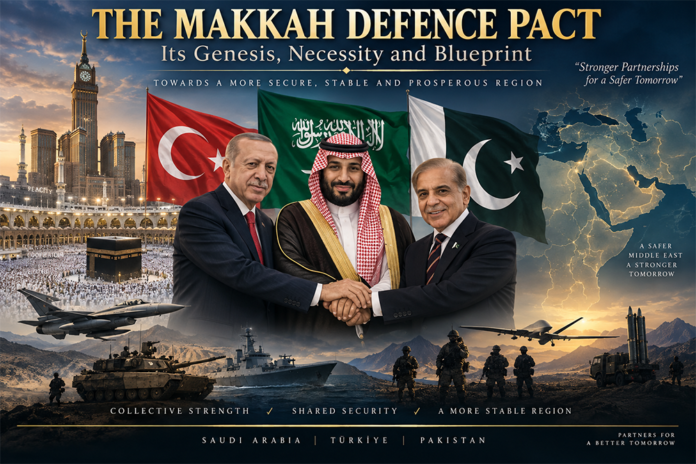
the Makkah Joint Defence Agreement signed by Saudi Arabia, Türkiye and Pakistan on August 7, 2026 marks an important development in the strategic architecture of the Middle East and South Asia.
It is more than an expansion of the long-standing Saudi-Pakistani defence relationship. The inclusion of Türkiye transforms what had traditionally been a bilateral security partnership into the nucleus of a potentially wider regional security arrangement.

The agreement was signed in Makkah by Saudi Crown Prince and Prime Minister Mohammad bin Salman, Turkish President Recep Tayyip Erdoğan and Pakistani Prime Minister Shehbaz Sharif.
Its central principle is straightforward: an armed attack against any one of the three states will be regarded as an attack against all three. The agreement also commits the three countries to strengthening defence cooperation and collective deterrence.
The significance of the arrangement, however, lies not merely in its language. Its real importance will depend upon whether the three countries can translate a political commitment into military interoperability, intelligence sharing, joint planning, defence-industrial cooperation, logistics arrangements and an institutional command-and-control mechanism.
This distinction is crucial. A defence treaty is only as credible as the military capability, political will and institutional machinery behind it. The Makkah arrangement therefore, should not yet be described as a Middle Eastern NATO. It is better understood as the foundation of a new trilateral security architecture whose ultimate form remains under construction.

The first indication that the pact was moving beyond symbolism came on August 31, 2026 when the foreign ministers, defence ministers and military chiefs of Saudi Arabia, Türkiye and Pakistan met in Istanbul under a newly established Strategic Political and Defence Committee.
The three governments agreed to establish a permanent Secretariat in Saudi Arabia, headed by a Secretary-General. Significantly, the first Secretary-General will be from Pakistan and will serve an initial three-year term. This is an important institutional development because it begins converting the Makkah Agreement from a declaration of intent into an organisation.

The Genesis of the Makkah Defence Pact
The roots of the agreement go back considerably further than the Makkah Summit itself. Saudi Arabia and Pakistan have maintained close defence relations for decades.
Pakistani military personnel have served in Saudi Arabia, Saudi personnel have received training in Pakistan, and the two countries have maintained cooperation in military training, defence production and security matters.
Signed in Makkah on August 7, 2026, the agreement transforms the longstanding Saudi-Pakistani defence relationship into a trilateral arrangement by adding Türkiye. Its central principle is collective defence: an armed attack against one member will be treated as an attack against all three
Pakistan has also historically regarded the security of Saudi Arabia and the protection of the Islamic holy places as matters of particular importance.
The September 2025 Strategic Mutual Defence Agreement between Saudi Arabia and Pakistan represented a major formalisation of this relationship. It stated that aggression against one would be regarded as aggression against both. The 2026 Makkah agreement essentially broadened this bilateral framework by adding Türkiye.
Türkiye’s inclusion is strategically significant. It possesses one of the most capable military establishments in the Islamic world, a sophisticated defence industry, substantial experience in unmanned systems, missiles, electronic warfare and naval operations and membership of NATO.
Pakistan contributes a large conventional military establishment, a nuclear deterrent, a growing missile programme, considerable experience in counter-insurgency and high-altitude operations, and a defence-industrial base that includes aircraft, missiles, armoured vehicles and other systems.
Saudi Arabia contributes substantial financial resources, advanced Western-origin weapon systems, geographical depth and control over critical Gulf and Red Sea approaches.
In simple strategic terms, the three countries bring complementary assets. Saudi Arabia brings strategic geography and financial capacity. Türkiye brings industrial and technological depth. Pakistan brings manpower, military experience, strategic deterrence and an established defence relationship with Saudi Arabia. The combination creates possibilities that none of the three countries possesses independently.
Why Was the Pact Necessary?
The principal strategic driver appears to be the changing security environment of the Middle East. For decades, Gulf security rested substantially upon an American security architecture involving US forces, air and missile defence, intelligence, naval power, arms transfers and extended deterrence.
Saudi Arabia remains deeply connected to this system. However, the last decade has encouraged Gulf states to diversify their security partnerships, rather than rely upon a single external guarantor.
The attacks on Saudi oil infrastructure in 2019, continuing missile and drone threats from Yemen, uncertainty surrounding US regional commitments and the growing sophistication of Iranian missile and drone capabilities have all contributed to this reassessment.
The emergence of the Makkah Pact therefore should not necessarily be interpreted as an attempt to expel the United States from the Middle East. It is more accurately understood as part of a broader trend towards strategic diversification.
The United States itself has not been excluded from this development. President Donald Trump subsequently welcomed the Makkah agreement and publicly described it as evidence that regional countries were assuming greater responsibility for their own defence.
That fact is important when assessing the frequently repeated assertion that Washington “created” the Makkah pact. There is currently no public evidence establishing that the United States was the architect of the agreement.
The historical Saudi-Pakistani defence relationship predates the current American administration by decades. The September 2025 Saudi-Pakistan agreement was itself a direct precursor to the 2026 trilateral arrangement. The Makkah agreement therefore has identifiable regional and bilateral origins.
At the same time, American policy has contributed to the strategic environment in which such an agreement became attractive. Washington’s changing regional posture, demands for greater burden-sharing and the desire of Gulf states to acquire additional security options are all relevant contextual factors.
The pact’s credibility will depend on more than political symbolism. It must be supported by intelligence sharing, joint planning, military interoperability, logistics, defence-industrial cooperation and command-and-control mechanisms. The creation of a permanent Secretariat in Saudi Arabia marks an important first step toward building such an organisation
The more accurate formulation is therefore that the United States did not publicly initiate the Makkah pact, but American policy and the evolution of the regional security environment have influenced the strategic conditions in which it emerged.
Is the Makkah Pact Country-Specific or Region-Specific?
This is one of the most important questions concerning the future of the arrangement. At present, the pact is country-specific in its legal and institutional membership.
The founding members are Saudi Arabia, Türkiye and Pakistan. Its collective-defence commitment applies to these three states. Its strategic purpose, however, is regional.
The agreement refers to regional peace, security and stability, while the Istanbul meeting described the arrangement in terms of regional security and cooperation.
Türkiye has also indicated that the arrangement remains open to participation or partnership by other countries in the region. This creates an interesting distinction.
The Makkah pact is presently a trilateral defence treaty, but it has the potential to become the nucleus of a wider regional security framework. Expansion, however, will not be straightforward.
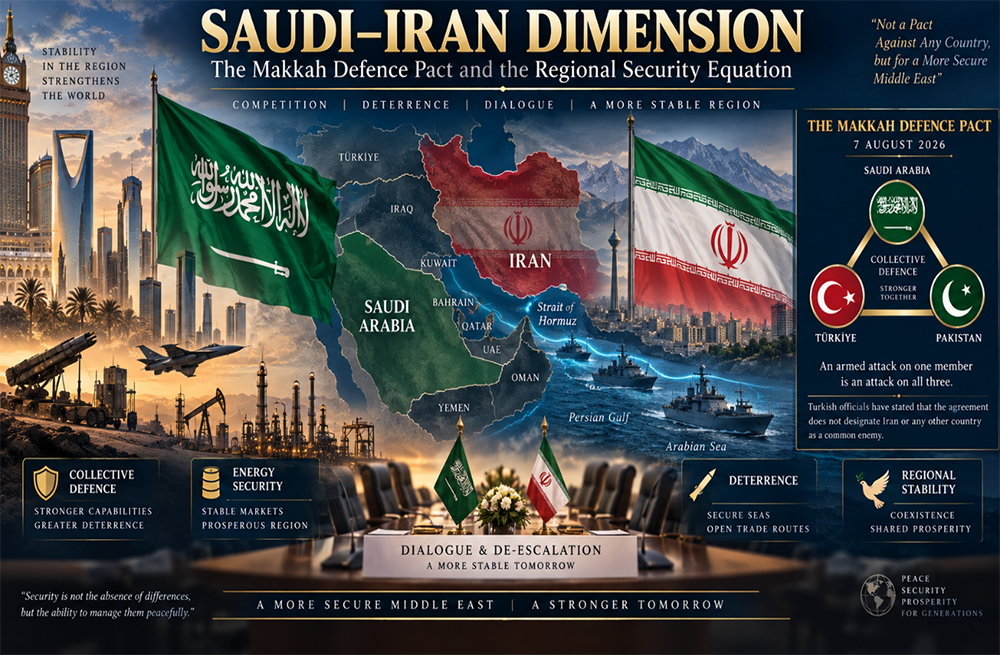
The addition of Egypt would provide major military weight and control of the Suez Canal. Jordan could contribute strategic depth and military professionalism. Qatar and the United Arab Emirates possess advanced air forces, missile defence systems and considerable financial resources. Oman could contribute diplomatic credibility and geographical access to the Arabian Sea and Strait of Hormuz.
But every additional member also introduces another national threat perception. For example, a country with particularly sensitive relations with Iran could create difficulties for another member seeking dialogue with Tehran.
Similarly, a state involved in an active territorial dispute could potentially expect partners to support its position. Consequently, expansion will probably be incremental rather than automatic. The founding three may first develop the institutional framework before inviting additional members.
The Saudi-Iran Dimension
The Makkah pact has inevitably been viewed through the prism of Iran. Saudi Arabia and Iran have experienced decades of strategic rivalry, although diplomatic relations were restored in 2023 through a China-mediated process.
Türkiye has maintained dialogue with Iran while simultaneously competing with it for influence in Syria, Iraq and the wider Middle East. Pakistan has historically sought to maintain workable relations with both Saudi Arabia and Iran because of its geographical position and domestic considerations.
This makes the Makkah arrangement unusual. It is not formally an anti-Iran alliance. Pakistan has explicitly described the pact as defensive and not directed against any particular country. The distinction may prove strategically valuable.
A collective defence arrangement that is explicitly anti-Iran would almost certainly intensify regional polarisation. A defensive pact whose purpose is deterrence against armed aggression provides its members greater strategic flexibility.
The current Houthi attacks against Saudi Arabia represent the first major practical test. Pakistan stated on September 10, 2026 that no military response under the Makkah pact had been discussed following recent Houthi attacks.
At the August 31 meeting in Istanbul, the three countries established a Strategic Political and Defence Committee and agreed to create a permanent Secretariat. Pakistan’s appointment of the first Secretary-General for a three-year term gives Islamabad an influential role in shaping the pact’s early development
Pakistan nevertheless reaffirmed its commitment to the agreement while pursuing diplomatic engagement. This episode illustrates the difference between treaty language and operational implementation.
An armed attack against a member may be politically recognised as an attack against all, but that does not automatically mean that Pakistani or Turkish troops will immediately enter the conflict.
The nature of the attack, its attribution, its scale, the request of the affected state and the response deemed appropriate by the three governments will matter.
What Does the Pact Mean for Pakistan?
For Pakistan, the agreement potentially represents the country’s most consequential formal defence commitment outside South Asia in recent decades. The immediate benefit for it is its strategic reach.
Pakistan’s armed forces have historically been heavily focused on the India-Pakistan strategic environment. The Makkah framework provides Islamabad with a formal security relationship linking South Asia with the Gulf and Eastern Mediterranean.
Pakistan’s military cooperation with Saudi Arabia is already extensive. The new framework could institutionalise training, exercises, intelligence exchange, air-defence cooperation, maritime surveillance and defence-industrial collaboration.
There is also a technological dimension. Türkiye has developed a substantial indigenous defence industry. Turkish UAVs, loitering munitions, electronic warfare systems, naval platforms and precision weapons have attracted international attention. Pakistan has already developed considerable cooperation with Türkiye in naval and aviation sectors.
A trilateral framework could therefore create opportunities for joint research, co-production and technology development. The Istanbul communiqué specifically identifies defence-industry cooperation, joint technology development and production as areas for strengthened collaboration.
For Pakistan, this could be particularly important because its defence industry requires access to technology, capital, markets and production partnerships. Saudi Arabia, meanwhile, has ambitions to expand domestic defence production as part of its broader economic transformation programme.
The three countries could potentially create a triangular defence-industrial ecosystem. Pakistan could provide engineering and manpower expertise. Türkiye could provide advanced defence technologies and production experience. Saudi Arabia could provide capital, industrial infrastructure and a large domestic market. If successfully implemented, this could be one of the most consequential long-term effects of the pact.
Does the Pact Increase Pakistan’s Military Strength?
The answer requires some qualification. It does not automatically increase Pakistan’s organic military strength. Pakistan’s number of aircraft, ships, missiles, soldiers or nuclear weapons does not increase simply because of the agreement.
What changes is Pakistan’s strategic access to external military resources. Collective defence arrangements can multiply military effectiveness when partners possess complementary capabilities.
The three members bring different but potentially complementary strengths. Saudi Arabia contributes financial resources, advanced Western-origin weapons and control of key Gulf and Red Sea approaches. Türkiye adds technological and industrial capabilities, while Pakistan offers military manpower, operational experience, strategic deterrence and an established defence relationship with Riyadh
For Pakistan, Turkish and Saudi capabilities could become relevant in areas such as air defence, maritime surveillance, logistics, intelligence, unmanned systems and defence production.
The strategic equation also works in reverse. Saudi Arabia gains access to Pakistan’s military experience and manpower. Türkiye gains another major defence partner and access to the Gulf. Pakistan gains strategic depth and a broader network of security relationships.
The pact could therefore create a form of collective military multiplier without creating a single integrated military force. Its ultimate value will depend on interoperability.
Without common communications systems, common operating procedures, joint exercises, intelligence-sharing protocols, logistics arrangements and agreed rules of engagement, the military value of collective defence will remain limited.
Is It Comparable to NATO?
The Makkah pact contains a NATO-like principle but is not presently comparable to NATO in institutional or military terms. NATO’s Article 5 states that an armed attack against one member is considered an attack against all.
However, NATO’s own explanation makes clear that each member determines the action it considers necessary; Article 5 does not automatically prescribe a particular military response.
The Makkah agreement therefore resembles NATO at the level of collective-defence philosophy. Additionally, the institutional difference is enormous.
NATO has existed since 1949. It has the North Atlantic Council as its principal political decision-making body, a Military Committee, an established international staff, integrated planning processes and permanent military commands.
Its Allied Command Operations is headquartered at SHAPE near Mons in Belgium and maintains standing command structures capable of planning and conducting multinational military operations.
The Makkah arrangement currently has a permanent Secretariat being established in Saudi Arabia. The first Secretary-General will be Pakistani for three years. That is an important beginning, but it is not equivalent to NATO’s command architecture.
The agreement did not emerge suddenly. Saudi Arabia and Pakistan have maintained defence ties for decades through military training, personnel deployments, security cooperation and defence production. The September 2025 Saudi-Pakistani Strategic Mutual Defence Agreement provided the immediate bilateral foundation for the broader 2026 framework
NATO also possesses decades of accumulated interoperability, standardisation, exercises and operational experience. The Makkah pact will have to build these capabilities almost from the beginning. The most appropriate comparison is therefore not “NATO versus Makkah” but “mature integrated alliance versus emerging collective-defence framework”.
The Proposed Organisational Structure
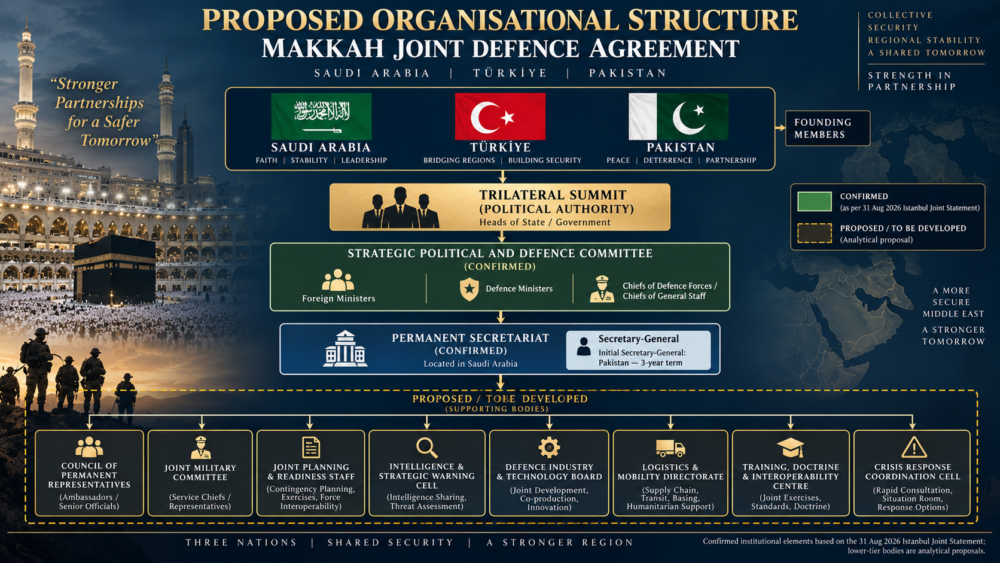
The Istanbul meeting provides the first indication of how the Makkah Pact’s organisational structure may develop. At the political level, there is likely to be a summit mechanism involving the political leadership of the three states.
Below this should sit the Strategic Political and Defence Committee consisting of foreign ministers, defence ministers and military chiefs.
The newly announced Secretariat in Saudi Arabia will provide permanent institutional support. The Secretary-General will become the central coordinating official.
The most logical next step would be the creation of a permanent military committee composed of the three countries’ chiefs of defence or their designated representatives.
Under this could eventually emerge specialised committees covering intelligence, air defence, maritime security, cyber operations, unmanned systems, logistics, military medicine, training and defence industry. A joint planning staff would be particularly important.
The organisation does not necessarily require a NATO-style permanent combat command immediately. Indeed, attempting to create one prematurely could generate unnecessary political and military complications.
A phased model would be more practical. The first phase should focus on political coordination and information exchange.
The second should establish joint planning and interoperability. The third could create permanent regional commands or mission-specific headquarters if the members conclude that such structures are necessary.
Where Should the Headquarters Be?
The decision to establish the Secretariat in Saudi Arabia has effectively answered part of this question. Saudi Arabia will host the permanent Secretariat. However, a Secretariat is not the same thing as a military headquarters. The distinction is important.
The Secretariat performs administrative, diplomatic, coordination and institutional functions. A military headquarters would conduct operational planning and command.
The pact reflects growing regional efforts to diversify security partnerships. Missile and drone threats, attacks on Saudi energy infrastructure, uncertainty over long-term US commitments and the expanding capabilities of regional rivals have encouraged Gulf states to seek additional defence options without necessarily abandoning their relationship with Washington
The three governments have not publicly announced a NATO-style integrated operational headquarters. Consequently, it would be premature to assume that a SHAPE-type structure will immediately emerge.
A possible future model would be a political headquarters in Riyadh supported by specialised regional military coordination centres. Saudi Arabia would naturally be suited to a Gulf and Red Sea coordination centre.
Türkiye could provide an eastern Mediterranean and northern Middle East planning capability. Pakistan could contribute a South Asian and Arabian Sea coordination dimension.
Such a distributed model would be more consistent with the geography of the three countries than concentrating all operational capabilities in one location.
Who Will Chair the Organisation?
At the founding summit, the political leadership was provided by Mohammad bin Salman, Recep Tayyip Erdoğan and Shehbaz Sharif. The first institutional meeting was conducted through the Strategic Political and Defence Committee in Istanbul.
The most concrete leadership decision announced so far, concerns the Secretariat: its first Secretary-General will be a Pakistani national for three years. The Secretary-General should not, however, be confused with a supreme military commander. The available public information does not establish a permanent Makkah equivalent of NATO’s SACEUR. That distinction will be critical.
A Secretary-General can coordinate political and administrative affairs, but operational military command would normally require a separate military authority answerable to the political leadership of the member states.
A future Makkah Pact structure could therefore have a Secretary-General at the political/institutional level and a rotating or designated Commander of Joint Defence Forces at the military level.
Whether the military commander is permanent, rotational or appointed according to the contingency would be a major decision for the founding members.
Pact’s Response to a Middle Eastern War?
The most difficult question is what happens if one member becomes involved in a major conflict. To better understand this, consider three broad scenarios.
If Saudi Arabia were subjected to a large-scale missile, drone or conventional attack by another state, Riyadh could request collective action. Türkiye and Pakistan would then have to determine the nature and scale of their response.
The agreement has inevitably been viewed through the Saudi-Iranian rivalry, but it is not formally directed against Tehran. Türkiye maintains dialogue with Iran, while Pakistan has traditionally sought workable relations with both Iran and Saudi Arabia. Describing the pact as defensive allows its members to strengthen deterrence without permanently closing diplomatic channels
This could include intelligence support, air-defence assistance, naval protection, logistics, ammunition, maintenance support or deployment of combat forces.
If Türkiye became involved in a conflict in the eastern Mediterranean or elsewhere, Saudi and Pakistani support would similarly have to be determined according to the circumstances.
The most complicated scenario would be a conflict involving Pakistan in South Asia. Would Saudi Arabia and Türkiye actually enter a war against a major South Asian adversary?
The treaty’s political language creates a collective-defence obligation, but the practical form of assistance remains an area requiring detailed institutionalisation.
This is precisely where the Makkah Pact differs from simplistic interpretations of an automatic military alliance. Collective defence does not necessarily mean identical military action.
One country could deploy aircraft. Another could provide intelligence. Another could provide logistics. Another could provide financial or diplomatic support. This flexibility could make the arrangement politically sustainable. But excessive flexibility could simultaneously weaken deterrence.
The Nuclear Question
Another unresolved issue is nuclear deterrence. Pakistan is a nuclear-armed state. Saudi Arabia does not currently possess an acknowledged nuclear arsenal, while Türkiye remains under NATO’s nuclear umbrella.
The Makkah Pact does not publicly establish a nuclear-sharing mechanism equivalent to NATO arrangements. This omission is strategically important. If Pakistan’s nuclear deterrent remains nationally controlled, the agreement should not be interpreted as extending Pakistan’s nuclear guarantee automatically to Saudi Arabia or Türkiye.
Likewise, Pakistan cannot assume that Saudi Arabia or Türkiye would respond to a nuclear crisis involving Pakistan in precisely the same manner as a nuclear alliance would.
Recent Houthi attacks provide an early test of the agreement’s meaning. Pakistan stated that no military response under the pact had been discussed while reaffirming its commitment and pursuing diplomacy. The episode demonstrates that collective-defence language does not automatically require immediate military intervention; attribution, scale, political decisions and the affected state’s request will remain crucial
The three countries will therefore need to maintain a clear separation between collective conventional defence and national nuclear deterrence. Strategic ambiguity may be useful politically, but excessive ambiguity could generate miscalculation.
The US Factor
The American role will remain one of the most interesting dimensions of the Makkah arrangement. Washington remains a major military actor in the Middle East. American air power, naval power, intelligence, missile defence and logistics cannot be replaced overnight.
The Makkah Pact, therefore, should not be interpreted as the immediate replacement of the American security architecture. Rather, it introduces an additional layer.
This could actually serve American interests if Washington wants regional partners to carry a greater share of the security burden. It could also complicate American strategic planning if the three members develop independent military responses to regional crises.
The United States will consequently have to manage a delicate balance: encouraging regional burden-sharing while ensuring that emerging security structures remain compatible with broader regional stability.
The Major Implementation Difficulties
The first difficulty will be threat perception. Saudi Arabia, Türkiye and Pakistan do not face identical threats. Saudi Arabia’s primary security concerns include missile and drone attacks, maritime security, Iran-related regional tensions and protection of critical infrastructure.
Türkiye faces challenges in Syria, Iraq, the eastern Mediterranean, terrorism and its wider regional strategic competition. Pakistan’s principal security concerns remain concentrated in South Asia, particularly its relationship with India, terrorism and instability along its western borders. A common threat perception will therefore be difficult to create.
The second difficulty is force availability. All three countries have finite military resources. Pakistan cannot simultaneously maintain maximum readiness on its eastern and western fronts while committing large forces to the Gulf without affecting its own force posture.
Türkiye similarly, has multiple operational commitments. Saudi Arabia has substantial financial resources but relies heavily on imported military systems and requires continued development of indigenous human and technical capacity.
The third challenge is interoperability. Different aircraft, missiles, communications systems, data links, command structures and operational doctrines can severely constrain coalition warfare.
The fourth challenge is political decision-making. A collective-defence pact is credible only if members know who can authorise action and how quickly.
The fifth is domestic constitutional and legal authority. Military deployments abroad may require different political or parliamentary procedures in each member state.
For Pakistan, the pact expands its strategic reach beyond South Asia and strengthens its formal security links with the Gulf and Eastern Mediterranean. It could lead to deeper cooperation in air defence, maritime surveillance, intelligence, training, joint exercises and logistics, while giving Islamabad greater strategic access and diplomatic relevance
The sixth is escalation control. A response to a missile attack could easily become a wider regional war. The Makkah organisation will therefore require not merely warfighting capabilities but crisis-management mechanisms, too.
The Houthi Test
The recent Houthi attacks against Saudi Arabia provide the first real-world test of the agreement. Pakistan’s decision not to initiate a military response under the pact, while maintaining its political commitment and pursuing diplomacy, is revealing.
It demonstrates that the pact is not functioning as an automatic trigger mechanism. This may actually be deliberate. An alliance designed to deter major interstate aggression does not necessarily require every drone, missile or proxy attack to trigger a multinational war.
The challenge is to define the threshold. What constitutes an armed attack? Does a missile strike on an oil facility qualify? Does a cyberattack qualify? What about a proxy attack? What if the identity of the attacker is disputed? These questions need to be incorporated into implementing protocols.
A Possible Blueprint for the Next Five Years
The Makkah Pact’s credibility will ultimately depend on institution-building. The first requirement should be a formal Charter or implementing protocol defining the obligations of its members.
The second should be the establishment of a permanent Secretariat in Riyadh under the Pakistani Secretary-General for the initial three-year term.
The third should be creation of a permanent Military Committee composed of the chiefs of defence forces.
The fourth should be a Joint Planning Staff capable of preparing contingency plans.
The fifth should be a secure intelligence-sharing mechanism. The sixth should be annual trilateral military exercises. The seventh should be common standards for communications, logistics, air defence and maritime surveillance.
The eighth should be a defence-industrial framework covering co-development and co-production. The ninth should be a joint crisis-response mechanism capable of meeting within hours during a major contingency.
The tenth should be an agreed enlargement procedure defining eligibility, political obligations and military commitments for new members.
Only after these mechanisms mature, should the organisation consider permanent operational commands.
The Future Expansion of the Pact
Expansion is possible, but enlargement should not be treated as an objective in itself. The central question should be whether a prospective member adds military capability, geographic value, political legitimacy and strategic coherence without making collective decision-making unmanageable.
The agreement could support a three-way defence-industrial partnership. Pakistan can contribute engineering expertise and military manpower, Türkiye can offer advanced technologies and production experience, and Saudi Arabia can provide capital, infrastructure and market access. Cooperation in drones, naval systems, aviation, missiles and electronic warfare could become a major long-term outcome
Egypt could add substantial military capability and strategic geography. The UAE could add advanced air and maritime capabilities. Jordan could contribute trained forces and geographical connectivity.
Oman could provide access to the Arabian Sea and proximity to the Strait of Hormuz. Qatar has advanced military infrastructure and important diplomatic relationships.
Iraq would represent a much more complicated case because of its internal political environment and external relationships.
Iran itself is unlikely to be a member of a pact designed partly around the security concerns of states that have historically competed with Tehran, although a mature Makkah organisation could eventually develop confidence-building arrangements with Iran.
The future organisation may therefore evolve into two concentric circles: a core collective-defence group and a broader regional security-partnership mechanism. That would be more sustainable than attempting to build a single rigid military alliance across the entire Middle East.
A New Security Equation
The most important consequence of the Makkah Defence Pact may ultimately not be the creation of a new military alliance but the emergence of a more distributed regional security system.
For decades, the Middle East depended heavily upon external security providers. The Makkah framework suggests that regional states are seeking greater agency.
Saudi Arabia wants additional strategic options. Türkiye seeks greater influence and strategic autonomy. Pakistan is expanding its defence relationship with the Gulf while strengthening its position as a regional security actor.
The pact therefore connects three strategic theatres: the Gulf, the eastern Mediterranean and South Asia. Its geographical significance is greater than its present military institutionalisation.
The pact shares NATO’s collective-defence principle but lacks NATO’s integrated commands, permanent military structures, standardised procedures and decades of operational experience. It is therefore better understood as an emerging security framework. Its future may include countries such as Egypt, Jordan, Qatar, the UAE or Oman, but expansion will likely be gradual because every new member would introduce additional strategic sensitivities
Overall, the Makkah Joint Defence Agreement is best understood as the beginning of an architecture rather than the completion of one. Its central principle – that an armed attack against one member will be regarded as an attack against all – provides the political foundation for collective deterrence.
Its subsequent institutionalisation through the Strategic Political and Defence Committee and the decision to establish a Saudi-based Secretariat, initially headed by a Pakistani Secretary-General, provide the first organisational pillars.
But the real test begins now. The Makkah Pact will have to move from political solidarity to military interoperability. It will need joint planning, intelligence sharing, exercises, defence-industrial cooperation, logistics arrangements and clear procedures for determining when and how collective defence is activated.
Its comparison with NATO should therefore be made carefully. NATO is a mature alliance with more than seven decades of institutional development, integrated military command structures, standardisation and operational experience. The Makkah framework is a young trilateral arrangement still developing its organisational machinery.
Its strength may ultimately lie in a different model. Rather than becoming an exact Middle Eastern replica of NATO, it could become a flexible regional security architecture combining collective defence with strategic autonomy, defence-industrial cooperation and crisis-management mechanisms.
The next five years will determine whether it remains a political declaration or develops into a functioning military institution. The first Secretary-General from Pakistan will therefore assume an unusually important institutional responsibility.
His task will not simply be administrative. He will have to help develop procedures that convert the political promise of collective defence into credible deterrence while ensuring that the organisation does not become an automatic mechanism for regional escalation.
The fundamental strategic proposition is simple: collective security is credible only when political commitment, military capability and institutional mechanisms converge. The Makkah Defence Pact now possesses the first of these. Its future will be determined by whether it can build the other two.

-The author retired as Major General, Army Ordnance Corps, Central Command, after 37 years of service. A management doctorate and expert on defence modernisation, he is the author of four books, including the Amazon bestseller “Breaking the Chinese Myth,” and a frequent media commentator. He is affiliated with several leading defence and strategic studies institutions in New Delhi. The views expressed are of the writer and do not necessarily reflect the views of Raksha Anirveda





