


A revolt over electricity bills, wheat prices and stolen seats in Pakistan-administered Kashmir has exposed the hollowness of Islamabad’s favourite cause.
For nearly 80 years, “Kashmir” in Pakistan’s political vocabulary has meant one thing: a grievance against India, a cause to be raised at the United Nations, a plebiscite forever promised and forever denied on the far side of the Line of Control.

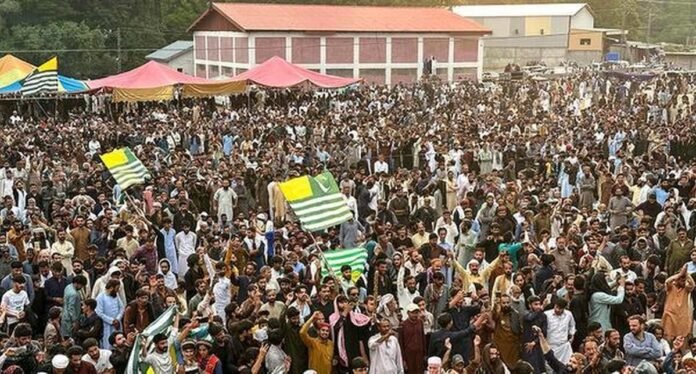
This summer the word acquired an inconvenient second meaning. In the part of Kashmir that Pakistan itself administers, tens of thousands of people took to the streets, not to demand a change of flag, but to demand cheaper electricity, affordable wheat, honest local government and the right to elect their own legislature. Islamabad answered with bullets. By the count of the protest leaders, more than 80 people have been killed since June.
The uprising is led by the Joint Awami Action Committee, a coalition of traders, lawyers, students and civic groups formed in Rawalakot in 2023. What makes the JAAC dangerous to the establishment is precisely what makes it legitimate: it is not a separatist front, not the instrument of any political party, and not, whatever Islamabad now claims, a terrorist organisation.
Tens of thousands across Pakistan-administered Kashmir marched to protest skyrocketing electricity tariffs, soaring wheat prices and stripped-away subsidies linked to IMF austerity programmes
Its demands are the demands of ordinary citizens anywhere. Kashmir’s rivers power some of Pakistan’s largest hydroelectric projects, yet residents pay among the highest tariffs to light their own homes.
They have watched subsidies stripped away with each IMF programme while ministers and bureaucrats keep their perks. And they have asked, reasonably, why a legislature of 53 seats reserves 12 for “refugees” from Indian Kashmir who live elsewhere in Pakistan, seats that conveniently dilute the local vote and let whichever party rules in Islamabad shape the assembly.

This is the heart of it. The revolt in Pakistan-administered Kashmir is not a contest over sovereignty. It is a contest over citizenship, over whether the people there are citizens with rights, or subjects dependent on the centre’s goodwill. That is far more threatening to the Pakistani state than any pro-India slogan could ever be, because it cannot be answered with the usual script.
Led by the Joint Awami Action Committee (JAAC) – a broad coalition of traders, lawyers and students formed in Rawalakot – the movement operates as an independent rights front, rather than a political party or separatist group
Consider how Islamabad has responded. In June it banned the JAAC under anti-terrorism law, and ahead of regional elections, launched a crackdown in which a federal minister airily dismissed the dead as “militants.”

A journalist who had spent years documenting the region, and who lately had been interviewing the families of those killed, was placed on an anti-terror watch-list without charge or trial.
Communications were cut, trucks carrying food and medicine were held back, and the assembly elections went ahead in July with turnout collapsing to around half, well below the 60 per cent of previous polls, as the JAAC called a boycott and the third phase had to be postponed amid the unrest.
The ruling party of Pakistan duly emerged with the largest bloc of seats. India, unsurprisingly, called the exercise a farce.
The deeper problem for Pakistan is not electoral optics. It is the contradiction the whole episode lays bare. For decades, Islamabad’s Kashmir policy has rested on a single moral claim: that Kashmiris possess a right of self-determination, that their wishes must be honoured and that India’s denial of those wishes is a standing offence against international law.
Pakistan has invoked Security Council Resolution 47 and the promise of a plebiscite in every forum it can reach. Yet the standard it demands of India, it will not meet in the sliver of Kashmir under its own control.
Regional assembly elections in July saw voter turnout drop to around 60 per cent following a widespread JAAC boycott, highlighting deep local alienation from a legislature heavily influenced by Islamabad
Elected institutions there answer to a chief secretary and a police chief appointed from Islamabad; real authority over security rests with the army’s 12th Division at Murree. You cannot credibly campaign for a plebiscite abroad while denying your own Kashmiris a fair vote at home.
That contradiction has not gone unnoticed. In late August, more than 70 British parliamentarians, led by the chair of the All-Party Group on Kashmir, wrote to the UN Secretary-General urging intervention over the bloodshed, the arrests, the communications blackout and the disruption of essential supplies.
The UN’s own human rights chief had already called for calm, restored internet access and impartial investigations into the deaths, and Kashmiri diaspora groups have demonstrated outside the UN in Geneva. For a state that has spent generations trying to internationalise Kashmir, this is a bitter irony: the world is finally paying attention to Kashmir, the wrong Kashmir, from Islamabad’s point of view.
The irony sharpened further last week. When the United States’s Ambassador to India, Sergio Gor, called Jammu and Kashmir “an important part of India” during a visit to Srinagar, Pakistan’s Foreign Office summoned Washington’s envoy within hours and issued a strong demarche over a single sentence about the region’s status.
That reflex, instant, practiced, fluent, is worth setting beside the silence on 80 dead in Muzaffarabad and Rawalakot. Islamabad can mobilise its entire diplomatic apparatus over a diplomat’s choice of words, but has nothing to offer its own Kashmiris beyond relief cheques and riot police. Vocabulary is defended; lives are not.
While Islamabad continues its traditional international advocacy on Kashmir, the crisis has drawn sharp criticism from the UN and over 70 British parliamentarians, spotlighting domestic rights abuses in Pakistan occupied Kashmir
None of this should tempt observers in Delhi into easy triumphalism. The grievances driving the JAAC, inflation, joblessness, unaccountable government, the sense of being ruled rather than represented, are not unique to one side of the Line, and a movement that has kept its discipline and its focus on rights deserves to be seen on its own terms, not merely as ammunition in someone else’s argument.
The point is not that India wins. The point is that the people of Pakistan-occupied Kashmir have called Islamabad’s bluff, and the bluff was eight decades in the making.
For Pakistan, the lesson is uncomfortable but simple. Stability bought with a one-off subsidy, as it was after the long march of 2024, buys only time. Stability imposed by force breeds the very alienation it means to crush.
What the people of the region are asking for, is not secession or sedition. It is bread they can afford, bills they can pay and a government that answers to them. A state that cannot grant that much to the Kashmiris it holds, has forfeited the right to lecture anyone about the Kashmiris it does not.
The writer is an expert on geopolitics, national security, and counter-terrorism; and he regularly contributes his subject thought-leadership and academic commentary with several publications in newspapers, journals, and periodicals. He works with investigative agencies, regulatory bodies, financial institutions and enterprises, providing strategic and regulatory advisory. The views expressed are personal and do not necessarily carry the views of Raksha Anirveda





