

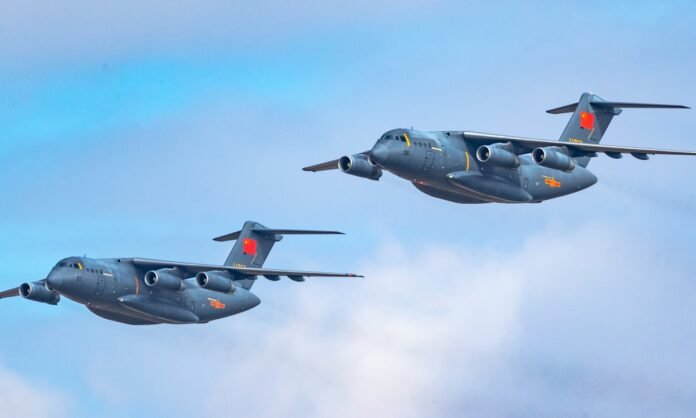
Astrategic trap may be taking shape on India’s western frontier, and it is being assembled not through declarations but through cargo manifests. Over roughly sixty hours, Pakistani skies reportedly saw a dense sequence of arrivals: Chinese Y-20 transporters at Nur Khan and Masroor air bases, followed by Turkish A400Ms heading towards Murid, the operational heart of Pakistan’s drone enterprise.
Reports have linked these movements to a range of military equipment, including drones, radar, air defence systems, munitions and command-support infrastructure.

The individual consignments matter less than the possibility of their convergence. The pertinent question is therefore not simply what has arrived, but why this pattern is emerging now.
Operation Sindoor reshaped the grammar of deterrence in South Asia. India signalled, through action rather than rhetoric, that terrorism and its state sponsors would no longer be treated as separate categories, and that Pakistan’s nuclear posture could no longer be assumed to serve as an automatic shield against conventional retaliation.
Islamabad appears to have drawn its own lesson from this: deterrence without defensive depth is a brittle proposition. What is being observed now may be the material response to that conclusion, a hedging exercise conducted in the open, under the cover of routine military logistics.
Recent airlifts of Chinese and Turkish military hardware to Pakistani airbases hint at a convergence of capability aimed at building defensive depth post-Operation Sindoor
The Geometry Beneath the Cargo
Pakistan need not be admired to remain strategically useful to others. A fortified Pakistan, despite its internal fragilities, can compel India to divide its attention, capital and military bandwidth between two active fronts.

This is where the parallel with Ukraine becomes analytically useful, not because the two conflicts are equivalent in scale or character, but because the underlying logic of attrition translates well across theatres.
The comparison should not be stretched too far. India’s strategic circumstances, geography, nuclear environment and economic trajectory are fundamentally different from those of Ukraine.

The useful lesson lies elsewhere: a competitor can impose strategic costs not only by defeating an adversary but also by forcing it to devote disproportionate attention and resources to managing persistent insecurity.
The mechanics of such entanglement are not difficult to imagine. A major terror attack, followed by Indian retaliation and a Pakistani counter-response, has the structural potential to stretch days into weeks and weeks into months.
External powers may profit by supporting a fortified Pakistan, utilising passive entanglement to consume India’s strategic bandwidth and economic resources
In this context, the goal might not be territory but strategic exhaustion, keeping India preoccupied with its western horizon rather than building its Indo-Pacific weight or creating an economy that prioritises development.
The Ukraine conflict has shown how it extends beyond the battlefield, involving economies, alliances and national bandwidth in the struggle, far more than territory.
The more searching question, then, is not who harbours affection for Pakistan, but who stands to gain from a Pakistan capable of keeping a rising India occupied.
The Case for Caution
A critical analysis, however, should not fall into the trap of the “big story”! There are simpler explanations to be considered on an equal footing until it is certain.
First, military modernisation on this scale often has its own logic. Pakistan’s air defence and drone inventories have been ageing, and a cluster of deliveries could simply reflect the arrival of previously contracted equipment, timed by production schedules and shipping logistics rather than any coordinated strategic signal.
Second, Pakistan’s threat perception, shaped by its western border with Afghanistan and periodic tensions with the Tehreek-e Taliban Pakistan (TTP), gives it independent reasons to strengthen air defence and surveillance capacity that have nothing to do with India.
Third, China and Turkey each have their own commercial and strategic interests in deepening defence ties with Pakistan, interests that do not require a unified conspiracy to keep India distracted so much as parallel, self-interested transactions that happen to converge.
The key metric for Indian intelligence is not inventory volume, but how effectively Pakistan integrates these sensors, drones and air defences into a networked strike architecture
None of this diminishes the seriousness of what is being observed. But it does imply that when a deliberate trap is laid, language needs to be used with precision, not as a reflexive blanket for all the uptick in procurement in Pakistan.
It’s difficult to accept strategic analysis when everything is viewed through the lens of alarm. The discipline is to distinguish what is genuinely changing from what is merely background movement, while remaining alert to the possibility that apparently routine activity may acquire significance when several indicators point in the same direction.
What India Should Actually Watch
Even allowing for more mundane explanations, three indicators warrant sustained attention rather than episodic alarm.
The first is capability integration. Isolated deliveries of drones or radar systems matter less than evidence that Pakistan is integrating these systems into a coherent, networked air defence and strike architecture, particularly around Murid and other drone-centric nodes.
Integration, not inventory, is the true marker of intent. A warehouse full of capable systems does not by itself create combat power. Combat power emerges when sensors, shooters, communications, electronic warfare, command networks and logistics are trained, connected and exercised as a system.
India should therefore watch for evidence of integration under realistic conditions, not merely count aircraft, drones or radar sets.
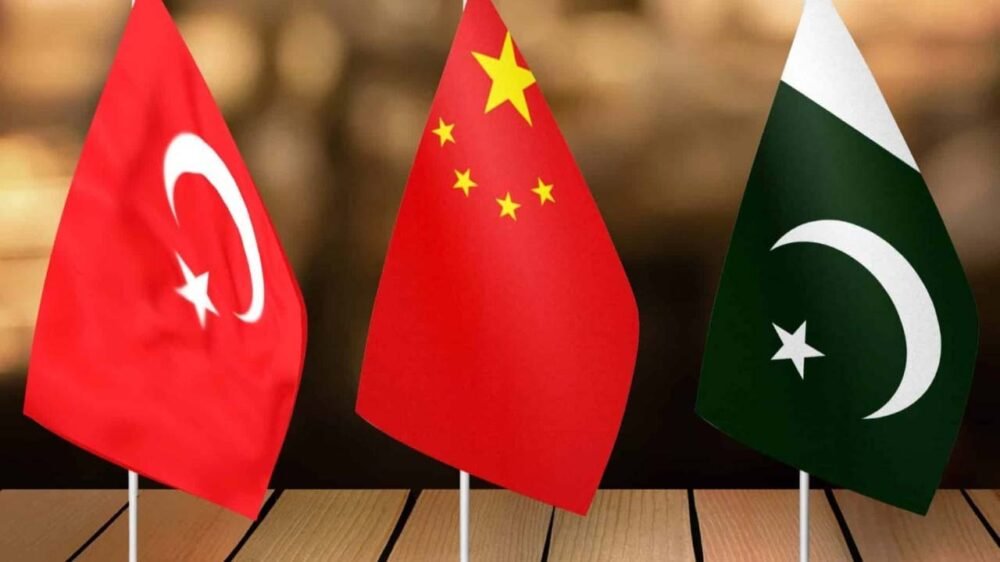
Growing defence ties among Islamabad, Beijing and Ankara demand close monitoring, particularly if transactions shift from purchases to joint technology transfer
The second is the tempo and character of activity along the Line of Control and in Kashmir. A genuine shift toward defensive depth would likely be accompanied by changes in forward posture, exercise patterns and infiltration attempts rather than remaining confined to airbase cargo manifests.
The third is the trilateral texture of the China-Pakistan-Turkey relationship itself. If defence cooperation deepens into joint production, technology transfer or shared command architecture rather than transactional sales, that would mark a qualitatively different phase, one where Pakistan’s capability is not merely being replenished but being architected by external partners with their own stakes in Indian distraction.
The Measured Response
For India, the appropriate posture is neither complacency nor overreaction. Operation Sindoor established that punitive costs can be imposed without triggering uncontrolled escalation, and that precedent remains India’s strongest deterrent.
The task now is to preserve that credibility while denying adversaries the satisfaction of a reactive, resource-draining response to every procurement cycle across the border.
India must balance strong deterrence with measured responses, investing in indigenous counter-drone capabilities while avoiding a resource-draining strategic trap
This means continued investment in indigenous air defence, counter-drone systems and multi-domain surveillance, not as a response to any single shipment but as a standing requirement, regardless of what Pakistan does.
It means diplomatic engagement with Beijing and Ankara that acknowledges the reality of their defence relationships with Islamabad without treating every transaction as an act of hostility.
And it means resisting the pull towards strategic overextension, the very trap that a war of attrition is designed to spring.
The fire has not yet been lit. Yet the chessboard is being rearranged, and several pieces are moving at once. Their purposes may not be identical, and not every move should be read as preparation for conflict.
India’s task is therefore neither to dismiss the pattern nor to exaggerate it. It is to watch the board closely, strengthen its own resilience, and ensure that, if the contest sharpens, India enters it with more options than its adversaries.

The writer, a PVSM, AVSM, VSM has had an illustrious career spanning nearly four decades. A distinguished Armoured Corps officer, he has served in various prestigious staff and command appointments including Commander Independent Armoured Brigade, ADG PP, GOC Armoured Division and GOC Strike 1. The officer retired as DG Mechanised Forces in December 2017 during which he was the architect to initiate process for reintroduction of Light Tank and Chairman on the study on C5ISR for Indian Army. Subsequently he was Consultant MoD/OFB from 2018 to 2020. He is also a reputed defence analyst, a motivational speaker and prolific writer on matters of military, defence technology and national security. The views expressed are personal and do not necessarily carry the views of Raksha Anirveda





