


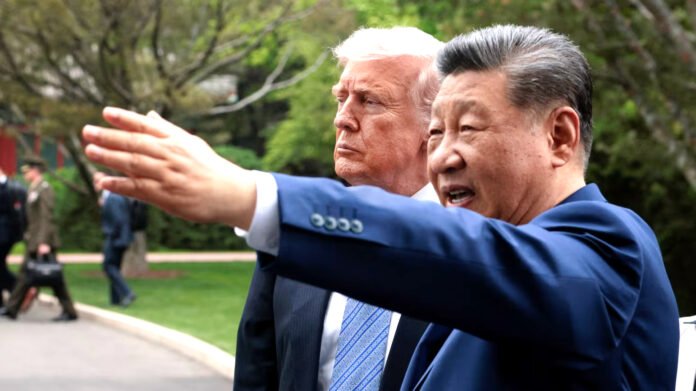
The spring air in Beijing carried a weight that transcended the seasonal humidity. As Air Force One touched down at Beijing Capital International Airport on May 14, 2026, the world held its breath. This was not merely a diplomatic visit; it was an attempt to rewire the most consequential bilateral relationship on the planet. President Donald Trump, returning to the world stage with his characteristic blend of disruption and deal-making, was met with a reception that combined the rigid formality of the Chinese state with the high-stakes theater of a global summit.
The Great Hall of Strategy
The core of the summit took place within the cavernous halls of the Great Hall of the People. The imagery was stark: two leaders, often characterised as polar opposites in temperament and ideology, seated before their respective national flags. The opening remarks set a tone of cautious pragmatism. President Xi Jinping, leaning into his role as a student of history, invoked a concept that has haunted scholars for a decade: the Thucydides Trap.

The term refers to the historical tendency toward war when an emerging power threatens to displace an existing one. Xi was direct, telling Trump that this trap “is not inevitable” if both nations seek a “new vision” for ties based on mutual respect and “constructive strategic stability.” Trump, in his own fashion, focused on the “great chemistry” between the two men; while simultaneously remarking on the “unfortunate decline” he perceived in American influence under previous administrations – a comment that sent ripples through Washington but was met with a stoic nod from the Chinese leader.
The core of the summit took place within the cavernous halls of the Great Hall of the People. The imagery was stark: two leaders, often characterised as polar opposites in temperament and ideology, seated before their respective national flags. The opening remarks set a tone of cautious pragmatism. President Xi Jinping, leaning into his role as a student of history, invoked a concept that has haunted scholars for a decade: the Thucydides Trap
Economic Grandstanding and the Open Door
While the political leaders debated history, the economic undercurrents were equally powerful. In a parallel session with global CEOs, Xi Jinping delivered a clear message: “China’s door will only open wider.” This statement was a strategic counter-point to the “America First” rhetoric that has defined Trump’s trade policy.
The summit comes at a time when global markets are reeling from volatility. By signaling a willingness to liberalise certain sectors, China is attempting to court American capital even as the US government considers further tech restrictions. For Trump, the economic goal remains clear: reducing the trade deficit and securing “the biggest deal in history.” However, the complexities of 2026 – including the rise of AI-driven economies and decentralised finance – make the old “tariff-first” playbook harder to execute.
The Iran Shadow and Regional Stability
Beyond bilateral trade, the specter of the Middle East loomed large over the Beijing talks. With tensions between Washington and Tehran at a boiling point, the role of China as a primary buyer of Iranian oil and a strategic partner to the Islamic Republic became a central bargaining chip.

The summit comes at a time when global markets are reeling from volatility. By signaling a willingness to liberalise certain sectors, China is attempting to court American capital even as the US government considers further tech restrictions. For Trump, the economic goal remains clear: reducing the trade deficit and securing “the biggest deal in history.” However, the complexities of 2026 – including the rise of AI-driven economies and decentralised finance – make the old “tariff-first” playbook harder to execute
Reports from the summit suggest that Trump is seeking Xi’s assistance in curbing Iran’s regional ambitions and nuclear programme in exchange for concessions on technology exports. The “Iran-US-China” triangle is perhaps the most volatile element of the current global security architecture. If Beijing can act as a mediator, it would solidify its status as a global peacemaker; if the talks fail, the path to a regional conflict in the Middle East seems increasingly inevitable.
Taiwan: The Fragile Core
No discussion of US-China relations is complete without the mention of Taiwan. The Guardian and the BBC reported that the “red lines” were drawn clearly. Xi reiterated that Taiwan remains China’s “first red line” that must not be crossed. Trump, meanwhile, maintained a strategic ambiguity that has become his hallmark, balancing the defence of democratic principles with a transactional approach to geopolitical flashpoints. The “new chapter” sought by both leaders depends entirely on whether this delicate balance can be maintained without a miscalculation in the Taiwan Strait.

The “Cold” India Factor
As Trump and Xi “cosied up” in Beijing, a sense of unease began to permeate New Delhi. Historically, India has leveraged US-China tensions to bolster its own strategic standing. However, a potential “G2” arrangement – where the US and China settle their differences over the heads of other regional powers – could leave India “out in the cold.”
The concern for Indian policymakers is that a Trump-Xi grand bargain might involve the US scaling back its focus on the “Indo-Pacific” in favour of a bilateral “Strategic Stability” pact. This would fundamentally alter the security calculus for the Quad (US, India, Japan, Australia) and force India to recalibrate its own relationship with a resurgent Beijing
The concern for Indian policymakers is that a Trump-Xi grand bargain might involve the US scaling back its focus on the “Indo-Pacific” in favour of a bilateral “Strategic Stability” pact. This would fundamentally alter the security calculus for the Quad (US, India, Japan, Australia) and force India to recalibrate its own relationship with a resurgent Beijing.
The Narrative of Decline
One of the most controversial moments of the first day was Trump’s candid discussion of American “decline.” In a move that drew sharp criticism from his domestic opponents, Trump used the Beijing summit to contrast his vision of a “rebuilding America” against the “weakness” of the Biden years.
To the Chinese hosts, this narrative of American instability is often used to validate the “East is rising, West is declining” mantra. By engaging in this discourse on Chinese soil, Trump has effectively shifted the diplomatic leverage, creating a scenario where he presents himself as the only individual capable of “saving” the American position through personal diplomacy with Xi.
One of the most controversial moments of the first day was Trump’s candid discussion of American “decline.” In a move that drew sharp criticism from his domestic opponents, Trump used the Beijing summit to contrast his vision of a “rebuilding America” against the “weakness” of the Biden years
A High-Wire Act
As the summit moves into its final phases, the results remain a mix of hope and skepticism. The “New Vision” for ties is currently a skeletal framework of high-level agreements and vague promises of “strategic stability.”
Whether this leads to a genuine de-escalation of the New Cold War or simply provides a temporary truce in an ongoing rivalry remains to be seen. What is clear, however, is that the world of 2026 is no longer unipolar. The Beijing summit is a testament to a world where the “Thucydides Trap” is the backdrop, and the two most powerful men on Earth are trying to figure out if they can share the stage without burning it down.
The 2026 Beijing Summit will be remembered either as the moment the world avoided a catastrophic collision or as the last failed attempt to bridge an unbridgeable divide. As the two leaders concluded their first round of talks, the only certainty was that the geopolitical map was being redrawn in real-time.

-The writer is a New Delhi-based senior commentator on international and strategic affairs, environmental issues, an interfaith practitioner, and a media consultant. The views expressed are personal and do not necessarily carry the views of Raksha Anirveda





