


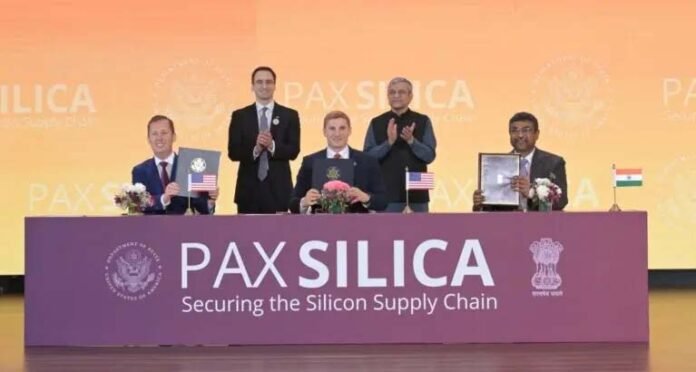
New Delhi: India has formally acceded to the Pax Silica Declaration, marking a significant step in its strategic alignment with the United States on artificial intelligence and supply chain security.
The signing took place on February 20, on the sidelines of the Global AI Impact Summit here.

The ceremony was attended by key dignitaries, including US Ambassador to India Sergio Gor, Jacob Helberg, the United States Under Secretary of State for Economic Growth, Energy, and the Environment, and India’s Union Minister for Information Technology, Ashwini Vaishnaw.
Ambassador Gor emphasised India’s resolve and the broadening horizon of bilateral cooperation. In his remarks, he welcomed India into the Pax Silica initiative, framing it as a collective choice to prevail in the global technological arena.
He stated that the partnership revolves around whether free societies will dominate the commanding heights of the world economy. Gor contrasted innovation hubs like Bangalore and Silicon Valley with surveillance states that deploy technology for monitoring and control.
“We choose freedom, We choose partnership, We choose strength,” Gor declared. With India’s entry into Pax Silica, he asserted, the allies have opted to win.

Jacob Helberg echoed these sentiments, hailing India’s participation as a testament to how economic security underpins national security. He positioned the move as a bulwark against coercion and blackmail that threaten national prosperity.
This development underscores the US-led Pax Silica as the Department of State’s flagship endeavour in AI and supply chain resilience. It seeks to forge a new economic security consensus among allies and trusted partners.

At its core, the Pax Silica Declaration stresses the vital role of dependable supply chains in safeguarding mutual economic interests. It positions artificial intelligence as a pivotal force driving sustained prosperity.
The timing of India’s formal joining is noteworthy, coming soon after its engagement at the Critical Minerals Ministerial. That event, convened by US Secretary of State Marco Rubio earlier in February, saw representation from India’s External Affairs Minister, S Jaishankar.
The Global AI Impact Summit 2026 itself holds historic importance as the inaugural such gathering hosted in the Global South. It has convened policymakers, industry leaders, academics, and civil society to address responsible AI governance and equitable technological progress.
India’s commitment to Pax Silica aligns with its burgeoning role in international technology forums. It reflects New Delhi’s strategy to bolster indigenous AI capabilities while fostering alliances that counterbalance geopolitical pressures, particularly from assertive powers in the region.
For the defence and aerospace sectors, where the user maintains deep expertise, this pact carries strategic implications. Secure AI supply chains could enhance India’s advancements in missile systems, UAVs, and space missions, such as those under ISRO, by ensuring access to critical semiconductors and computing resources.
Moreover, it dovetails with India’s push for indigenous manufacturing through entities like HAL, BEL, and Tata Advanced Systems. Reliable supply lines for AI hardware will support military modernisation, including hypersonic technologies and AI-integrated defence platforms.
Geopolitically, Pax Silica positions India and the US against supply chain vulnerabilities exploited by adversaries. This is especially relevant amid tensions in South Asia and the Indo-Pacific, where economic coercion via critical technologies remains a tactic.
The declaration’s focus on “free societies” implicitly critiques state-driven models, resonating with India’s Aatmanirbhar Bharat initiative. It promises collaborative R&D, potentially accelerating quantum technologies and AI applications in strategic domains.
As the summit progresses, further announcements may emerge, solidifying India-US ties in emerging technologies. This move not only elevates India’s global stature but also fortifies its defence posture through technological sovereignty.






