


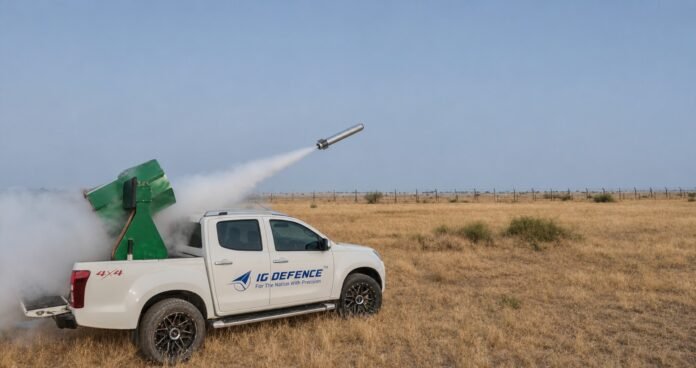
New Delhi: In a landmark development for India’s indigenous defence industry, IG Defence has successfully test-fired JWALA MK-1 at Pokhran, Rajasthan. The company describes it as India’s first autonomous Counter-Unmanned Aircraft System (CUAS) Micro-Missile System, marking a significant milestone in the development of next-generation indigenous counter-drone technologies.
With an operational range of up to 5 kilometres, JWALA MK-1 has been developed as an indigenous, autonomous and cost-effective solution to address the rapidly evolving threat posed by hostile unmanned aerial systems.

The proliferation of unmanned aerial systems is fundamentally transforming modern military operations. Recent international conflicts, including the US-Iran confrontation, have highlighted the growing deployment of relatively inexpensive attack drones and the economic challenges of countering them using high-cost conventional air-defence interceptors.
This emerging battlefield reality has exposed a critical cost imbalance: low-cost aerial threats can compel militaries to deploy significantly more expensive interception systems, placing pressure on interceptor inventories, ammunition sustainability and the economics of modern warfare. For India, with its complex security environment and evolving aerial threats, developing affordable, scalable and indigenous counter-UAS technologies is a strategic necessity.
JWALA MK-1 has been developed as an integrated autonomous counter-drone micro-missile system with a stated operational range of 5 kilometres. According to IG Defence, the system is designed to identify potential hostile drone targets, classify them and facilitate their airborne neutralisation through an integrated mission autonomy architecture.
A defining feature of JWALA MK-1 is its integration with GRID, IG Defence’s proprietary AI-powered Mission Autonomy and Battle Management System, which acts as the intelligence backbone coordinating the system’s operational kill chain.

GRID brings together sensor integration, target detection, identification, classification, mission decision-making and engagement management within a unified architecture, enabling coordinated mission execution.
Speaking about the development, Bodhisattwa Sanghapriya, Founder and CEO of IG Defence, said, “GRID is not just a standalone Mission Autonomy and Battle Management System; it is the intelligence backbone managing the entire kill chain of JWALA MK-1. From sensor integration and target detection to identification, classification, mission decision-making and engagement management, GRID’s AI-driven orchestration brings the entire operational chain together within a unified architecture.”

He added, “Our vision is to build indigenous defence systems where hardware and software are developed together, with autonomy and intelligence at their core. India must not simply manufacture weapons; we must build the intelligence, technology and integrated systems that power the future battlefield. That is the capability we are building at IG Defence.”
Commenting on the operational significance of the development, Wing Commander Anoop Sharma, Associate Vice President, IG Defence, stated, “The character of warfare is evolving rapidly, and the growing proliferation of unmanned aerial threats demands a new approach to air defence. Countering low-cost drones with expensive conventional systems is a challenge that modern militaries can no longer overlook. India needs indigenous, reliable and cost-effective solutions that can address these emerging threats at scale.”
“JWALA MK-1 represents an important step in that direction. Our focus is on developing an integrated counter-drone capability that combines advanced technology, mission autonomy and operational effectiveness. Such indigenous systems are essential for strengthening India’s preparedness for future battlefield challenges and advancing our defence self-reliance,” he added.
The successful test at Pokhran marks another milestone in India’s expanding private defence manufacturing ecosystem. As the country accelerates its defence indigenisation efforts, indigenous missile technologies, autonomous systems and AI-powered battle management platforms will play an increasingly important role in strengthening national security.
JWALA MK-1 reflects IG Defence’s ambition to move beyond conventional defence manufacturing towards developing integrated, intelligent and indigenous defence capabilities. By bringing together micro-missile technology, autonomous mission management and proprietary AI-powered battle management, the company aims to contribute to India’s next generation of counter-drone solutions.The achievement reinforces a larger national objective: reducing critical defence import dependencies, strengthening indigenous technological capabilities and building a self-reliant Indian defence ecosystem.
India must not merely prepare for the future of warfare. India must build the technologies that will define it.