


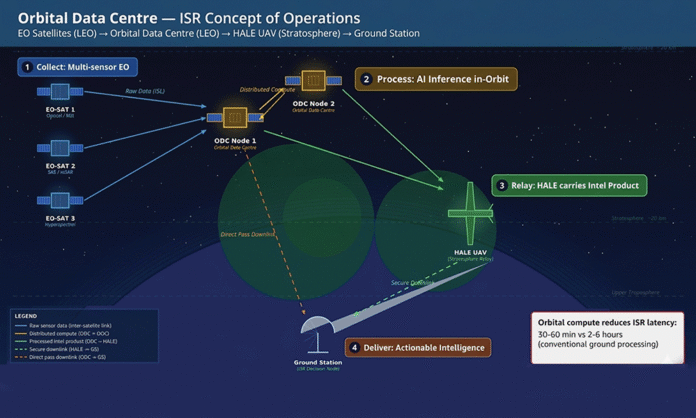
In modern ISR, the satellite is not the bottleneck. The pipeline is. India operates an increasingly capable constellation of Earth Observation (EO) satellites – optical, SAR, hyperspectral – collecting imagery of extraordinary fidelity across its strategic geography. Yet despite the sensor quality, a frustrating latency persists between the moment a satellite captures an image of interest and the moment a commander receives an actionable intelligence product. That gap – measured in hours in the conventional architecture – is where operational advantage is lost. Orbital Data Centres exist to close it.
The Pipeline Problem
The conventional remote sensing ISR chain is sequential and ground-dependent. A satellite collects raw data and stores it onboard. It waits for a pass over a ground station – which may be minutes away or hours away depending on orbital geometry. It downlinks the raw data, which for a high-resolution SAR or optical pass can be several hundred gigabytes. That data enters a ground-based processing pipeline: radiometric correction, geometric calibration, AI inference, analyst review, and finally dissemination. Each step introduces delay. The aggregate latency from collection to intelligence product routinely runs from one to several hours.

The volume problem compounds the latency problem. As EO constellations grow, the data generated per day increasingly outpaces the capacity of terrestrial infrastructure to absorb and process it. A significant fraction of collected imagery is never processed at all – not for lack of intelligence value, but because processing queues are congested and downlink bandwidth forces triage. In ISR, unprocessed data is the same as no data.
An adversary with knowledge of satellite pass schedules and downlink gaps can time activities to exploit the blind spots between collection and intelligence delivery. Pipeline latency is not merely an inconvenience – it is a vulnerability
For India specifically, the challenge is compounded by geography. Surveillance requirements span two contested land borders, a vast maritime domain across both the Arabian Sea and the Bay of Bengal, and an extended area of interest across the Indian Ocean Region. Ground station contact windows are finite. An adversary with knowledge of satellite pass schedules and downlink gaps can time activities to exploit the blind spots between collection and intelligence delivery. Pipeline latency is not merely an inconvenience – it is a vulnerability.
What an Orbital Data Centre Does Differently
An Orbital Data Centre is a space-based compute node – a satellite platform hosting AI accelerators, storage, and high-bandwidth inter-satellite link capability – designed to process sensor data in orbit rather than relay it raw to the ground. It is, in essence, a data centre co-located within the same orbital environment as the sensors it serves.
The operational logic is direct. An EO satellite completes a collection pass and transfers raw data via an inter-satellite link to the Orbital Data Centre node orbiting in proximity. The node runs onboard AI inference – change detection, object classification, multi-sensor fusion, threat flagging – and produces a structured intelligence product. That product, orders of magnitude smaller in data volume than the raw imagery, is then passed down the chain to a ground receiver. The ground receives not raw pixels but processed intelligence: a target list, a change map, an anomaly alert.

The reduction in what must travel to the ground is transformative. A detection and classification output for objects of interest in a large-area SAR collection might be expressible in kilobytes – compared to hundreds of gigabytes for the raw image. This does not merely reduce downlink time; it reduces the bandwidth requirement at every link in the chain, making reliable delivery possible over communication links that would be entirely inadequate for raw data transfer.
An EO satellite completes a collection pass and transfers raw data via an inter-satellite link to the Orbital Data Centre node orbiting in proximity. The node runs onboard AI inference – change detection, object classification, multi-sensor fusion, threat flagging – and produces a structured intelligence product
Multi-Sensor Fusion: Where the Real Advantage Lies
No individual sensor provides complete situational awareness. Optical sensors are constrained by cloud cover. SAR provides all-weather, day-night penetration but produces imagery requiring specialist interpretation. Hyperspectral sensors reveal material composition and defeat camouflage. The intelligence value of combining these streams in near-real-time is substantially greater than the sum of any individual feed.

In the ground-processing pipeline, multi-sensor fusion is inherently delayed because data from different satellites arrives at different times, travels through separate pipelines, and must be co-registered before fusion algorithms can run. An Orbital Data Centre receiving data from multiple co-orbiting EO satellites via inter-satellite links can perform fusion as data arrives – maintaining a continuously updated, multi-layer intelligence picture. An AI model onboard can correlate a SAR-detected anomaly with a hyperspectral change indicator, producing a fused threat assessment that no single sensor could generate – and doing so before the data ever reaches the ground. This capability is particularly consequential for tracking time-sensitive targets: mobile missile assets, naval vessels under electronic deception, or covert logistics operations employing camouflage and concealment.
For defence ISR, data sovereignty is non-negotiable. In a conventional pipeline, raw collected intelligence must traverse terrestrial networks and processing centres – each a potential node for interception or compromise. An Orbital Data Centre keeps the most sensitive step of the ISR chain – the processing of raw collection – within a controlled, sovereign space asset
Sovereignty, Resilience, and the HALE Advantage
For defence ISR, data sovereignty is non-negotiable. In a conventional pipeline, raw collected intelligence must traverse terrestrial networks and processing centres – each a potential node for interception or compromise. An Orbital Data Centre keeps the most sensitive step of the ISR chain – the processing of raw collection – within a controlled, sovereign space asset. Raw imagery never touches commercial or foreign infrastructure. Intelligence products are generated in orbit, encrypted at the point of production, and relayed via a sovereign HALE platform to authorised receivers.
The HALE layer adds a further resilience dimension. In a contested environment, fixed ground stations and terrestrial data centres may be targeted. A mobile, airborne relay that can reposition to maintain connectivity with both the orbital node and a forward ground receiver provides continuity of ISR delivery that a fixed ground architecture cannot guarantee. The combination of orbital compute and stratospheric relay creates an ISR pipeline that remains functional across a range of degraded-environment scenarios.
The Need of the Hour
The technology enabling this architecture has matured rapidly. AI accelerators have been miniaturised to spacecraft-compatible form factors. Radiation-hardened computing is available. Inter-satellite optical and RF link technology is proven in operational constellations. HALE platforms with stratospheric endurance are an established capability. The space environment itself offers engineering advantages that terrestrial data centres cannot replicate: the vacuum enables radiative thermal dissipation without water-cooling infrastructure, and unattenuated solar irradiance provides a stable, scalable power source. The engineering path to an Orbital Data Centre is demanding but entirely within reach of India’s emerging new-space industrial base.
The engineering path to an Orbital Data Centre is demanding but entirely within reach of India’s emerging new-space industrial base. What is required is a deliberate architectural commitment. Orbital compute, paired with stratospheric relay, is the most direct architectural response available
What is required is a deliberate architectural commitment. ISR capability is not only a question of how many satellites India procures, but how the entire data chain from sensor to decision-maker is engineered. The latency gap in that chain exists today. Every hour that raw EO data waits for a ground station pass, every hour it sits in a processing queue – is an hour in which an adversary operates beyond effective Indian ISR coverage. Orbital compute, paired with stratospheric relay, is the most direct architectural response available.

-The writer is Founder and CTO of Big Bang Boom Solutions Pvt. Ltd





