


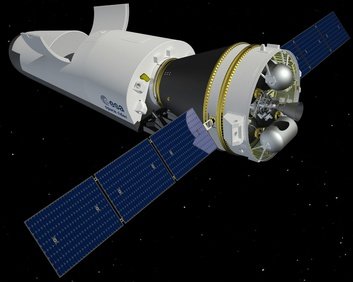
The European Space Agency (ESA) is edging closer to launching its first reusable spacecraft, Space Rider, after a series of successful tests aimed at validating the vehicle’s thermal protection and autonomous landing capabilities. The programme, which has been under development for several years, represents Europe’s most serious attempt yet to establish an independent reusable space transportation system comparable in concept – though smaller in scale – to the reusable vehicles operated by the United States and China.
Space Rider, formally known as the Space Reusable Integrated Demonstrator for Europe Return, is an uncrewed orbital laboratory designed to remain in low-Earth orbit for nearly two months before returning to Earth carrying scientific experiments and commercial payloads. ESA officials say the spacecraft will be capable of multiple missions with refurbishment between flights, dramatically lowering operational costs for European space missions.

The latest breakthrough came after engineers completed high-temperature plasma tests on the spacecraft’s heat shield and aerodynamic flaps. These tests simulated the intense temperatures and stress the vehicle will experience during atmospheric re-entry. According to ESA, the thermal protection system performed successfully under conditions replicating real orbital return scenarios.
In another major achievement, ESA and its industrial partners assembled the first full-scale landing demonstrator of the spacecraft. The mock-up, matching the exact size, mass, and aerodynamic structure of the final vehicle, will be used in helicopter drop tests over Sardinia later this year. These trials are intended to validate one of Space Rider’s most innovative features – its fully autonomous parafoil landing system.
Unlike conventional capsules that descend by parachute into oceans or remote desert zones, Space Rider is designed to glide toward a runway under a giant steerable parafoil. ESA believes this precision-landing technology could significantly improve payload recovery and reduce refurbishment costs. If successful, Space Rider would become one of the first operational spacecraft to employ such a landing system.
Unlike conventional capsules that descend by parachute into oceans or remote desert zones, Space Rider is designed to glide toward a runway under a giant steerable parafoil. ESA believes this precision-landing technology could significantly improve payload recovery and reduce refurbishment costs. If successful, Space Rider would become one of the first operational spacecraft to employ such a landing system
The reusable spacecraft traces its roots to ESA’s Intermediate eXperimental Vehicle (IXV), a prototype launched in 2015 to test reentry technologies. Lessons learned from IXV were integrated into the current programme under the PRIDE initiative – Programme for Reusable In-orbit Demonstrator in Europe. Since then, ESA, the Italian Space Agency, Avio, and Thales Alenia Space have collaborated closely to develop the orbital platform.

Space Rider is expected to launch aboard the upgraded Vega-C rocket from Europe’s Guiana Space Centre. The mission profile envisages the spacecraft orbiting Earth for up to 60 days, conducting scientific and technological experiments before returning to a runway landing, currently planned for Santa Maria Island in Portugal’s Azores archipelago.
ESA describes the vehicle as an “orbital laboratory,” capable of hosting experiments in biotechnology, pharmaceutical research, materials science, in-orbit manufacturing, and satellite technology validation. Scientists are especially interested in exploiting the microgravity environment aboard Space Rider to conduct research difficult or impossible on Earth.

The spacecraft’s cargo bay is expected to support a wide range of commercial and institutional payloads. European aerospace analysts say the programme could help create a new market for reusable orbital research missions, enabling universities, startups, and private firms to fly experiments at lower costs.
Beyond its scientific role, Space Rider carries strategic importance for Europe. In recent years, reusable launch and return systems have become central to the global space race. The success of reusable rockets pioneered by private American companies significantly reduced launch costs and altered the economics of space transportation. China has also accelerated work on reusable orbital systems, while Russia and Japan continue exploring similar concepts. Europe, however, has lagged behind in operational reusability
Beyond its scientific role, Space Rider carries strategic importance for Europe. In recent years, reusable launch and return systems have become central to the global space race. The success of reusable rockets pioneered by private American companies significantly reduced launch costs and altered the economics of space transportation. China has also accelerated work on reusable orbital systems, while Russia and Japan continue exploring similar concepts. Europe, however, has lagged behind in operational reusability.
ESA officials view Space Rider as a critical step toward technological autonomy in reusable spaceflight. The spacecraft is part of a broader European effort to modernise launch and orbital systems, including projects such as the reusable Themis rocket demonstrator and the Prometheus reusable engine programme.
The broader objective is not merely scientific prestige but ensuring Europe retains independent access to space in an increasingly competitive geopolitical environment. Reusable systems promise faster mission turnaround, lower operational expenditure, and greater flexibility in responding to both civilian and strategic space requirements.
Industry experts note that Europe’s space sector has faced growing pressure after delays to Ariane 6, disruptions in international launch partnerships, and increasing competition from private launch companies worldwide. Reusability is now widely regarded as essential for maintaining competitiveness in the global launch market.
Space Rider’s development has also highlighted Europe’s growing emphasis on collaborative aerospace innovation. Italian research institutions, Romanian aerospace engineers, Portuguese landing infrastructure teams, and ESA technology centres across Europe have contributed to the project.
The spacecraft itself measures roughly eight metres in length and resembles a compact lifting-body spaceplane. ESA says its modular design could eventually support missions beyond scientific research, including satellite servicing, cargo return operations, and future in-orbit logistics.
ESA’s long-term vision extends beyond a single spacecraft. The technologies being developed for Space Rider could form the foundation for future reusable European crewed systems and advanced orbital transportation vehicles. Some analysts even view the programme as a stepping stone toward Europe eventually developing its own autonomous human-rated reusable spacecraft capability
Recent thermal shield tests also provided encouraging evidence about the durability of Space Rider’s ceramic composite materials. Researchers subjected the spacecraft’s protective tiles to plasma exposure simulating damage caused by micrometeoroids or orbital debris. According to the Italian Aerospace Research Centre (CIRA), the materials successfully maintained structural integrity even after severe stress conditions.
ESA’s long-term vision extends beyond a single spacecraft. The technologies being developed for Space Rider could form the foundation for future reusable European crewed systems and advanced orbital transportation vehicles. Some analysts even view the programme as a stepping stone toward Europe eventually developing its own autonomous human-rated reusable spacecraft capability.
Although the spacecraft’s inaugural orbital mission has been delayed several times and is currently expected later in the decade, ESA maintains that the programme remains on track technologically. Engineers say the upcoming drop tests and re-entry validation campaigns will be among the final major steps before flight qualification begins.
For Europe, Space Rider represents more than a technological experiment. It reflects an attempt to redefine the continent’s future role in the rapidly evolving global space economy. If the spacecraft succeeds, ESA will not only gain a reusable orbital platform but also strengthen Europe’s claim to strategic independence in space transportation – an ambition increasingly viewed as essential in the twenty-first century space race.

-The writer is a New Delhi-based senior commentator on international and strategic affairs, environmental issues, an interfaith practitioner, and a media consultant. The views expressed are personal and do not necessarily carry the views of Raksha Anirveda





