



New Delhi: As India accelerates toward becoming a global Space power, the Government of India’s Research, Development & Innovation Fund (RDIF) has extended ₹105 crore to Hyderabad-based Dhruva Space for Project Garud, a next-generation flat-pack 500 kg-class communications satellite platform programme designed to enable constellation-scale sovereign and strategic satellite deployments for India and global markets, while strengthening the Nation’s indigenous Space infrastructure capabilities.
The 500 kg-class architecture is positioned to bridge the gap between smaller experimental satellites and larger traditional systems, offering an optimised balance of payload capacity, scalability, launch efficiency, and multi-mission adaptability for constellation-scale deployment requirements.

Dhruva Space is among the first batch of companies to be awarded support under the RDIF initiative, marking a significant milestone in India’s push toward building a globally competitive commercial Space ecosystem. The 500 kg-class platform is being developed as a standardised, production-oriented spacecraft capable of supporting diverse applications across Telecommunications, National Security, Earth Observation, and emerging data-driven use cases, while enabling faster deployment cycles and greater manufacturing repeatability.
Through this grant, Dhruva Space will undertake the development and commercialisation of a next-generation satellite architecture designed to address a critical gap in India’s Space ecosystem. The initiative focuses on enabling a standardised, production-oriented system that can support a wide range of applications across Telecommunications, National Security, and emerging data-driven use cases.
Project Garud is structured to transition satellite development from bespoke, mission-specific builds to a repeatable and manufacturing-ready model. The platform introduces a flat-pack architecture that enables efficient launch stacking, faster system integration, and improved deployment timelines, making it suitable for large-scale satellite deployments.
Project Garud is intended to serve as a foundational layer in building India’s next-generation Space manufacturing ecosystem, with long-term applicability across LEO, MEO, and future GEO mission architectures.

The project is aimed at addressing the need for an indigenous, production-ready satellite platform in the 300 – 500 kg class that is optimised for scalable deployment. Existing systems are typically custom-built, resulting in extended development cycles and limited reusability. By establishing a Made-in-India architecture, Project Garud reduces reliance on foreign satellite platforms and subsystems while strengthening supply chain resilience for Communications and Intelligence infrastructure.
As part of the programme, Dhruva Space will also establish the infrastructure, tooling, and industrial processes required for high-volume satellite manufacturing at scale. The roadmap is designed around a production cadence capable of supporting up to 2 satellites per day, enabling an annualised manufacturing potential of approximately 500 – 600 satellites across multiple mission configurations. This manufacturing-first approach is intended to support the growing demand for sovereign and secure satellite constellations globally, while strengthening India’s position as a competitive OEM and spacecraft production hub within the global Space economy.

Commenting on the development, Abhay Egoor, CTO & Co-founder, Dhruva Space, said, “Project Garud represents the industrialisation of satellite manufacturing from India. The global market is rapidly moving toward constellation-scale deployments, but the supply side for reliable, production-ready spacecraft platforms remains constrained. Through RDIF, Dhruva Space is building an indigenous satellite communications platform and manufacturing ecosystem capable of supporting high-volume deployment requirements across communications, intelligence, and strategic applications.”
“Our objectives are to build satellites for our own missions, and to position Dhruva Space as a globally competitive spacecraft OEM and subsystem supplier. The RDI programme strengthens India’s Space technology stack across Platform Architecture, Avionics, Power systems, and scalable manufacturing capabilities. Project Garud also speaks of our long-term vision toward enabling spacecraft solutions for higher orbital regimes, including MEO and GEO-class missions in the future,” added Abhay Egoor.
The grant was formalised during the inaugural Enterprise Technology Evaluation (ETE) agreement signing and first fund disbursement under the Government of India’s ₹1 lakh crore RDI Scheme, held on May 13, 2026 in New Delhi. Chaitanya Dora Surapureddy accepted the recognition on behalf of Dhruva Space.
The ceremony was conducted in the presence of Minister for Science & Technology Dr Jitendra Singh; Principal Scientific Advisor to Government of India, Prof Ajay Kumar Sood; Secretary, Department of Science & Technology, and Chairperson, Technology Development Board (TDB), Prof Abhay Karandikar; Chairman – Mission Governing Board, National Quantum Mission Dr Ajai Chowdhry; and Chairperson, Investment Committee – TDB Padma Dr Saurabh Srivastava.
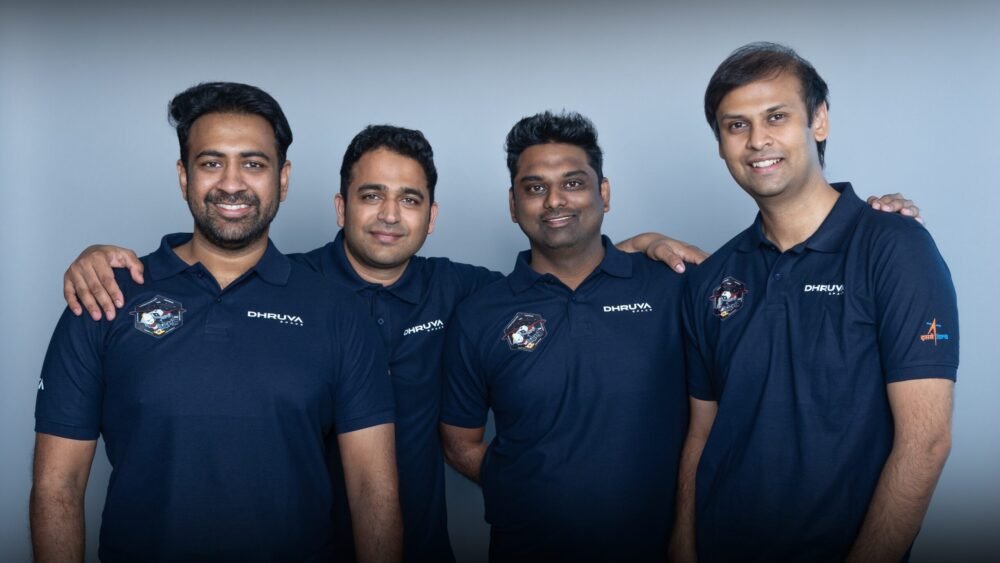
The RDI initiative builds on Dhruva Space’s existing work across spacecraft platforms and subsystems, extending proven capabilities from smaller satellite classes toward higher-mass systems and reinforcing its long-term vision of building the OEM backbone for India’s Space economy. The programme is expected to advance multiple subsystems toward flight-qualified readiness, supporting both platform deployment and subsystem-level commercialisation across domestic and global markets.
The Research, Development & Innovation (RDI) Scheme is aimed at encouraging private sector involvement in cutting-edge research and innovation, while accelerating the development of strategic technologies critical to India’s long-term growth and global competitiveness. The initiative focuses on mission-critical sectors including energy security and transition, climate action, Deep Technologies such as Quantum Computing, Robotics and Space, Artificial Intelligence and its applications to Indian challenges, Biotechnology and Biomanufacturing, medical technologies, and the digital economy.
Aligned with the national vision of Aatmanirbharta, the scheme is also intended to foster self-reliance and economic security by supporting indigenous technologies where domestic capability development is strategically essential. The framework additionally retains flexibility to support emerging sectors and technologies considered vital for public interest and National priorities.






