


“In the midst of chaos, there is also opportunity.” – Sun Tzu
From the trenches of Eastern Europe to the dense urban battlefields of the Middle East, modern warfare is evolving at a speed rarely seen in history. The ongoing Russia-Ukraine War and the continuing conflicts involving the Israel Defence Forces across the Middle East have revealed a new reality: wars are no longer fought only with tanks, artillery, and infantry formations. Algorithms, autonomous systems, and real-time intelligence networks increasingly shape them.

On these battlefields, drones identify targets, satellites track troop movements, and artificial intelligence (AI) systems analyse vast streams of intelligence in seconds. Soldiers are no longer isolated actors navigating uncertainty alone; they are increasingly supported by intelligent digital systems that anticipate threats before they materialise.
For centuries, soldiers have operated under what the Prussian strategist Carl von Clausewitz described as the ‘fog of war’ — a battlefield environment defined by confusion, limited visibility, and incomplete information. Today, Artificial Intelligence (AI) offers the possibility of dramatically thinning that fog.
Beyond its often-discussed role in enhancing military power, AI carries a deeper and more humane promise: protecting soldiers by transforming how risk, intelligence, and decision-making operate in war. In effect, AI is enabling the creation of an invisible digital shield around the soldier.
For centuries, soldiers have operated under what the Prussian strategist Carl von Clausewitz described as the ‘fog of war’, a battlefield environment defined by confusion, limited visibility, and incomplete information. AI offers the potential of thinning the fog
From the Fog of War to Algorithmic Awareness
Clausewitz argued that uncertainty is intrinsic to warfare. Commanders must make decisions under immense pressure, often with incomplete information and limited situational awareness.

Modern battlefields generate unprecedented volumes of data. Satellites capture high-resolution imagery, surveillance drones patrol contested areas, ground sensors detect movement, and electronic intelligence systems monitor communications across the electromagnetic spectrum.
The challenge today is not the absence of information — it is the overwhelming abundance of it.

Artificial Intelligence addresses this challenge by rapidly analysing large datasets and identifying patterns that are invisible to human analysts. Machine learning systems can detect unusual troop movements, identify concealed weapons systems, analyse terrain vulnerabilities, and predict potential enemy actions.
Instead of responding to danger after it appears, AI enables commanders and soldiers to anticipate threats and avoid them altogether.
In this sense, AI represents one of the most important advances in military history — not simply because it enhances combat capability, but because it reduces uncertainty and improves the survivability of soldiers.
The Rise of the Cognitive Battlefield
Modern warfare increasingly unfolds within what military strategists call the cognitive battlefield — a domain where information superiority and decision speed are as decisive as physical firepower. Artificial intelligence acts as a cognitive force multiplier, integrating intelligence across land, sea, air, space, and cyber domains.
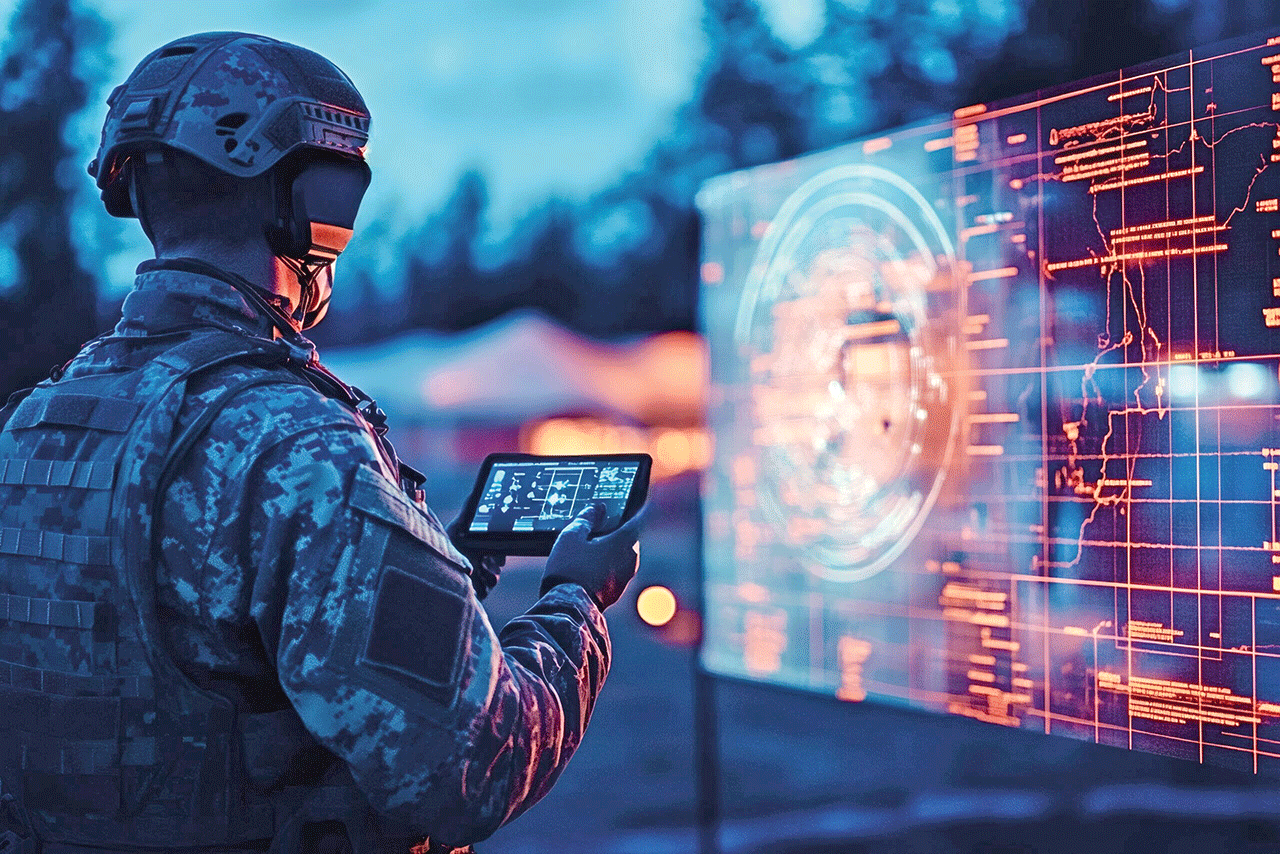
For soldiers on the ground, this intelligence may soon be delivered through AI-enabled tactical systems such as smart helmets, augmented reality displays, and digital battlefield interfaces. These technologies can highlight safe routes, identify hostile positions, and provide continuous updates on battlefield conditions.
Modern warfare increasingly unfolds within what military strategists call the cognitive battlefield — a domain where information superiority and decision speed are as decisive as physical firepower. AI acts as a cognitive force multiplier, integrating intelligence across land, sea, air, space, and cyber domains
Imagine a soldier navigating unfamiliar terrain while an AI system continuously analyses satellite imagery, drone feeds, and ground sensors. The system alerts the soldier to potential ambush points, sniper locations, or hidden explosive devices.
In such scenarios, AI functions as a constant digital sentinel, dramatically improving situational awareness and reducing battlefield risk.
Autonomous Systems: Delegating Risk to Machines
Perhaps the most immediate way artificial intelligence saves soldiers’ lives is by delegating the most dangerous tasks to machines. AI-powered drones, robotic vehicles, and autonomous surveillance platforms are increasingly capable of performing missions traditionally carried out by soldiers in hazardous environments.
These missions include reconnaissance in hostile areas, explosive ordnance disposal, urban surveillance, and logistics transport through contested territory. Robotic systems can enter buildings suspected of containing explosives. Autonomous drones can scout enemy positions before troops advance. AI-driven vehicles can transport supplies without exposing human drivers to ambush.
Each such deployment represents a fundamental shift in military risk management. Machines absorb danger so that soldiers do not have to.
Strategic thinker Andrew Marshall often argued that revolutions in military affairs occur when technology fundamentally alters the balance between risk and advantage. Artificial intelligence exemplifies this shift by enabling militaries to accept operational risk while protecting human lives.
AI and the Transformation of Battlefield Medicine
Artificial intelligence is also reshaping combat medicine, significantly improving survival rates for injured soldiers.
Wearable biosensors embedded in military gear can continuously monitor vital parameters, including heart rate, oxygen saturation, blood pressure, and trauma indicators. If a soldier is wounded, AI systems can immediately detect abnormalities and alert medics.
Algorithms can assess injury severity, recommend treatment protocols, and coordinate rapid evacuation. Autonomous drones equipped with medical supplies may soon deliver blood units, medications, or trauma kits directly to wounded soldiers in remote combat zones.
AI-enabled triage systems can assist medical teams in prioritising treatment during mass-casualty events.
These capabilities dramatically improve survival during the critical “golden hour” following injury.
Perhaps the most immediate way AI saves soldiers’ lives is by delegating the most dangerous tasks to machines. AI-powered drones, robotic vehicles, and autonomous surveillance platforms are increasingly capable of performing missions traditionally carried out by soldiers in hazardous environments
Global Military AI: Lessons from Israel and the United States
Several countries have already integrated artificial intelligence into operational warfare. Two of the most prominent examples are Israel and the United States.
Israel: AI in Operational Warfare
The Israel Defence Forces have aggressively adopted AI-driven intelligence platforms to improve situational awareness and decision-making. One example is the Gospel AI targeting system, which analyses large-scale intelligence datasets — including satellite imagery, communications intelligence, and surveillance feeds — to identify threats rapidly.
Another system, the Fire Weaver battlefield network, integrates sensors, intelligence platforms, and combat units into a unified battlefield network. AI algorithms rapidly match detected threats with appropriate response systems, significantly shortening the time between detection and response.
For soldiers on the ground, these systems translate into faster intelligence, earlier warnings, and greater battlefield awareness.
United States: Algorithmic Warfare and Multi-Domain Integration
The United States Department of Defence has made artificial intelligence a central pillar of its modernisation strategy. One major initiative is Project Maven, which uses machine learning algorithms to analyse massive volumes of imagery collected by surveillance drones.
Given India’s complex security environment, from the Himalayan frontier to the Indian Ocean, AI-driven surveillance and predictive intelligence systems could significantly enhance operational effectiveness while reducing risks faced by soldiers deployed in extreme conditions
Beyond individual systems, the United States is developing Joint All-Domain Command and Control (JADC2) — an ambitious effort to connect military assets across land, sea, air, space, and cyberspace into a unified decision network.
This approach enables the fusion of intelligence from satellites, aircraft, ships, and ground units in real time, thereby improving operational coordination and situational awareness.
India’s Strategic Opportunity
For India, artificial intelligence represents a powerful opportunity to strengthen national security while safeguarding soldiers.
Organisations such as the Defence Research and Development Organisation are actively developing AI-enabled technologies for surveillance, robotics, and battlefield decision support.
Innovation initiatives such as Innovations for Defence Excellence (iDEX) foster collaboration among startups, technology firms, and the armed forces to accelerate indigenous defence innovation.
AI is already being explored for border monitoring, drone reconnaissance in high-altitude environments, maritime domain awareness, and cyber defence.
Given India’s complex security environment — from the Himalayan frontier to the Indian Ocean — AI-driven surveillance and predictive intelligence systems could significantly enhance operational effectiveness while reducing risks faced by soldiers deployed in extreme conditions.
Despite its immense promise, artificial intelligence raises important ethical considerations. Autonomous systems capable of lethal action must operate within clear legal and ethical frameworks. Human judgement must remain central to military decision-making
Ethics and Responsible Deployment
Despite its immense promise, artificial intelligence also raises important ethical considerations. Autonomous systems capable of lethal action must operate within clear legal and ethical frameworks. Human judgement must remain central to military decision-making.
Maintaining human-in-the-loop oversight, in which commanders retain ultimate authority over operational decisions, is essential to ensure the responsible deployment of AI technologies. Technology should augment human judgement — not replace moral responsibility.
A New Covenant Between Technology and the Soldier
Every nation asks its soldiers to accept extraordinary risks in defence of national security. Artificial intelligence offers an opportunity to redefine how societies honour that sacrifice.
By deploying intelligent surveillance networks, predictive analytics, autonomous systems, and AI-enabled medical technologies, militaries can create battlefields where soldiers are better informed, better protected, and better supported than ever before.
The true measure of technological progress in warfare should not be the destructive power of weapons alone, but the number of lives preserved through intelligent innovation.
If harnessed wisely, artificial intelligence may become the most powerful protective force ever introduced into warfare — an invisible shield standing between soldiers and the chaos of battle.
Ultimately, AI will not replace the soldier. Instead, it will ensure that more soldiers return home safely.

–The writer is an internationally experienced leader in R&D and product innovator with a proven track record of building and transforming global organisations to accelerate innovation, reduce costs, and drive growth across the healthcare sector. As a thought leader in global affairs, he offers unique perspectives at the intersection of technology, healthcare, and international strategy. The views expressed are personal and do not necessarily reflect the views of Raksha Anirveda





