


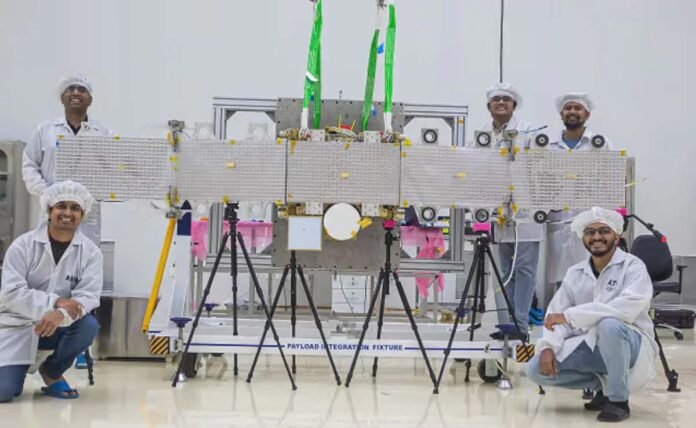
New Delhi: On a quiet afternoon in early May 2026, far from India’s bustling cities, a rocket rose into the Californian sky carrying with it more than metal, circuits, and fuel. It carried a new way of seeing the Earth—one that refuses to blink, even in darkness or storms. At the heart of this mission was ‘Drishti’, a satellite built not by a government giant, but by a young Indian startup determined to change the rules of space observation.
The story begins in Bengaluru, where engineers at GalaxEye imagined a problem that had long limited satellites: their vision capability. Traditional Earth observation satellites rely heavily on optical imaging, which means they are blind at night and nearly useless under thick cloud cover. For a country like India—where monsoons blanket landscapes and strategic needs demand constant surveillance—this limitation was more than inconvenient; it was critical.

Drishti was designed to solve exactly that.
Unlike conventional satellites, Drishti combines optical imaging with synthetic aperture radar (SAR)—a powerful technology that uses radar waves instead of visible light. This allows it to “see” through clouds, smoke, and darkness, capturing high-resolution images regardless of weather or time.
What makes Drishti truly groundbreaking is that both its optical and radar systems operate at the same resolution—about 1.5 metres, ensuring uniform, high-quality data across all conditions.
For its creators, this was not just a technical feat—it was a philosophical shift.

A New Vision for Space
“We had to think differently,” said the founders, who saw the satellite not just as a machine, but as a platform for continuous, reliable intelligence. The idea was simple: a satellite that never sleeps, never blinks, and never waits for clear skies.
Weighing roughly 190 kilograms, Drishti is the largest privately built Earth observation satellite from India, marking a major milestone in the country’s growing private space sector.

Its journey to space was equally symbolic. Instead of launching aboard an Indian rocket, Drishti rode into orbit on a SpaceX Falcon 9, lifting off from California on May 3, 2026.
The launch was precise, almost routine for global observers—but for India’s startup ecosystem, it was anything but ordinary. It marked a turning point where private innovation stepped confidently onto the global stage.
Seeing What Others Cannot
Once in orbit, Drishti began its silent work—circling the Earth, capturing images of landscapes hidden from ordinary satellites.
Its dual-sensor system allows it to perform what experts call “fusion imaging”—combining optical clarity with radar penetration. This means it can track changes on the ground even during heavy rainfall, dense fog, or pitch darkness.
For a country with diverse terrains—from Himalayan glaciers to dense forests and vast coastlines—this capability is transformative.
It has immediate applications in:
- Disaster management, where real-time data during floods or cyclones can save lives,
- Agriculture, by monitoring crops regardless of seasonal cloud cover,
- Urban planning, offering consistent data for infrastructure development, and
- National security, enabling round-the-clock surveillance of sensitive regions.
In fact, experts suggest that such technology could significantly enhance India’s ability to monitor its borders, providing insights even when adversaries rely on weather or darkness for cover.
A Strategic Leap
Beyond its technological brilliance, Drishti represents something deeper: technological sovereignty.
Its core technology—an integrated OptoSAR system—is not imported but developed and patented in India. This is crucial in a world where access to advanced satellite data is often controlled by a handful of nations.
By building its own capabilities, India is reducing dependence on foreign data while positioning itself as a potential provider of such services to other countries.
The startup behind Drishti has even hinted at a broader vision—a constellation of satellites that could offer continuous global coverage, not just for India but for clients worldwide.
The Rise of Private Space India
Drishti’s journey also reflects a larger shift in India’s space ecosystem. For decades, space exploration in the country was led almost entirely by government agencies. But recent reforms have opened the sector to private players, unleashing a wave of innovation.
Startups like GalaxEye are now pushing boundaries—experimenting with new technologies, faster development cycles, and commercially viable solutions.
Drishti stands at the forefront of this movement.
It proves that cutting-edge space technology is no longer the exclusive domain of state-run agencies. With the right mix of talent, vision, and support, startups can build systems that compete on a global scale.
Challenges Beyond the Horizon
Yet, the journey is far from over.
Launching a satellite is only the beginning. The real test lies in data delivery, reliability, and commercial viability. GalaxEye plans to begin rolling out satellite data within weeks, with defence and security sectors expected to be its first major clients.
Competition is also fierce. Around the world, companies are racing to build advanced Earth observation systems, each promising better resolution, faster updates, and lower costs.
To stay ahead, Drishti must not only perform—it must outperform.
The Unblinking Future
As Drishti circles the Earth, it represents more than a technological milestone. It is a statement of intent—a declaration that India is ready to lead in the next frontier of space-based intelligence.
In a world increasingly shaped by data, the ability to observe the planet continuously, accurately, and independently is a powerful advantage.
And somewhere high above, moving silently across the night sky, Drishti is doing exactly that—watching, recording, and redefining how we see our world.
It is, quite literally, an eye that never closes.






