


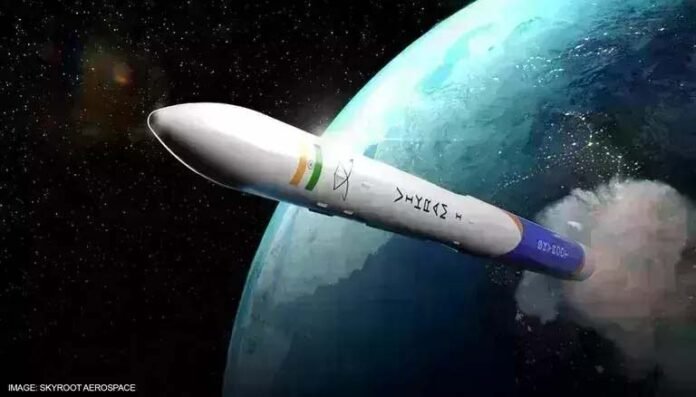
India’s commercial space sector achieved a historic breakthrough on May 7, as Hyderabad-based Skyroot Aerospace became the country’s first space-technology unicorn after raising nearly $60 million in a major funding round led by global investors. The fresh investment has pushed the company’s valuation to approximately $1.1 billion, placing it among a select group of Indian deep-tech startups to achieve unicorn status.
The funding round was co-led by Sherpalo Ventures, founded by Silicon Valley veteran and early Google investor Ram Shriram, and Singapore’s sovereign wealth fund GIC. Other investors included funds managed by BlackRock, Greenko Group founders, Arkam Ventures, Playbook Partners, Shanghvi Family Office, and existing institutional backers.

The investment comes at a critical moment for the company as it prepares for the launch of Vikram-1, India’s first privately developed orbital launch vehicle. The mission is expected to become a defining milestone in India’s evolving private space ecosystem.
Founded in 2018 by former Indian Space Research Organisation (ISRO) scientists Pawan Kumar Chandana and Naga Bharath Daka, Skyroot Aerospace emerged during a period when India was gradually opening its space sector to private participation. Until then, the country’s space activities were almost entirely dominated by ISRO, which had built a reputation for cost-efficient missions but offered limited opportunities for private launch ventures.
The liberalisation of India’s space sector in 2020 changed that landscape significantly. The Indian government established the Indian National Space Promotion and Authorisation Centre (IN-SPACe) to facilitate private sector participation and grant startups access to ISRO infrastructure, testing facilities, and launch support systems. Skyroot became one of the earliest startups to formally collaborate with ISRO under the new policy framework.
The funding round was co-led by Sherpalo Ventures, founded by Silicon Valley veteran and early Google investor Ram Shriram, and Singapore’s sovereign wealth fund GIC. Other investors included funds managed by BlackRock, Greenko Group founders, Arkam Ventures, Playbook Partners, Shanghvi Family Office, and existing institutional backers
The company first gained international attention in November 2022 when it successfully launched Vikram-S, India’s first privately built rocket to reach space. The suborbital mission demonstrated the viability of private launch services in India and helped position Skyroot as a frontrunner in the country’s emerging commercial space race.

Now, with the planned Vikram-1 mission approaching, Skyroot is attempting a far more ambitious objective – placing satellites into orbit using a fully private launch vehicle. Industry analysts believe the success of Vikram-1 could fundamentally alter India’s role in the global satellite launch market.
The Vikram series rockets are designed specifically for the rapidly growing small satellite market. Around the world, governments, telecommunications firms, Earth observation companies, and defence agencies are increasingly relying on small satellites for communication, imaging, navigation, and surveillance purposes. This has generated massive demand for dedicated and affordable launch services.

Global consulting firms estimate the space economy could exceed $1 trillion by the 2040s, driven largely by satellite communications, broadband internet constellations, Earth observation services, and commercial launch operations. India, despite its strong engineering capabilities and low-cost launch expertise, has so far captured only a small fraction of the global commercial space market.
The liberalisation of India’s space sector in 2020 changed the existing landscape significantly. The Indian government established the Indian National Space Promotion and Authorisation Centre (IN-SPACe) to facilitate private sector participation and grant startups access to ISRO infrastructure, testing facilities, and launch support systems. Skyroot became one of the earliest startups to formally collaborate with ISRO under the new policy framework
Skyroot’s emergence as a unicorn therefore carries significance beyond the company itself. Analysts view the development as evidence that global investors are increasingly confident about India’s ability to build globally competitive deep-tech and aerospace companies. Unlike consumer internet startups, space-tech ventures require substantial capital, long development cycles, and advanced engineering expertise, making investor participation especially notable.
The involvement of major international investors such as GIC and BlackRock also signals growing international interest in India’s space ecosystem. Ram Shriram’s participation has drawn additional attention because of his reputation as one of Silicon Valley’s most influential early-stage technology investors. Shriram, who famously backed Google during its formative years, is also expected to join Skyroot’s board following the investment.
According to company executives, the newly raised capital will primarily support the completion of Vikram-1 testing, manufacturing expansion, launch infrastructure, and workforce development. The company has already established one of India’s largest private rocket development facilities near Hyderabad’s Rajiv Gandhi International Airport. Known as “MAX-Q,” the integrated complex supports rocket design, testing, and manufacturing operations.
The company’s growth also reflects broader momentum in India’s startup-driven aerospace sector. Over the past five years, several Indian space startups – including Agnikul Cosmos, Pixxel, Dhruva Space, Bellatrix Aerospace, and SatSure – have attracted venture capital investments and international partnerships. Together, these firms are helping create a domestic ecosystem spanning launch services, satellite manufacturing, propulsion systems, and space-based analytics.
Experts say India possesses several advantages in the global commercial launch market. The country offers comparatively lower engineering and manufacturing costs, a large pool of technical talent, and decades of institutional expertise developed through ISRO’s programmes. Additionally, India’s geographic position and established launch infrastructure at Sriharikota provide operational advantages for satellite deployment missions.
Skyroot’s emergence as a unicorn therefore carries significance beyond the company itself. Analysts view the development as evidence that global investors are increasingly confident about India’s ability to build globally competitive deep-tech and aerospace companies. Unlike consumer internet startups, space-tech ventures require substantial capital, long development cycles, and advanced engineering expertise, making investor participation especially notable
However, substantial challenges remain. The commercial launch industry is intensely competitive, with established players in the United States, Europe, China, and New Zealand already operating reusable rockets and advanced satellite deployment systems. Companies such as SpaceX have significantly reduced launch costs through reusable technologies, raising competitive pressure on newer entrants worldwide.
Indian startups must therefore compete not only on affordability but also on reliability, launch frequency, turnaround efficiency and technological innovation. Industry observers believe that long-term success for companies like Skyroot will depend on achieving consistent launch performance while scaling manufacturing capabilities rapidly enough to meet global demand.
The timing of Skyroot’s funding success is also strategically important for India. Geopolitical tensions, the militarisation of space technologies, and growing demand for sovereign satellite capabilities have increased the strategic importance of domestic launch ecosystems. Many governments are now prioritising independent launch access and resilient satellite deployment infrastructure.
India’s policymakers increasingly view private space companies as essential partners in strengthening national technological self-reliance. In recent years, New Delhi has promoted initiatives encouraging collaboration between public research institutions and private aerospace firms. The government has also streamlined regulations to facilitate commercial launches and foreign investment in the sector.
Despite the optimism, industry experts caution that the true test lies ahead. Achieving a billion-dollar valuation is only the beginning; operational success in orbital launches, customer acquisition, and sustained commercial viability will determine whether India’s private space sector can evolve into a globally competitive industry
The rise of India’s space-tech startups is further reshaping public perceptions about the country’s innovation economy. Traditionally, Indian startups attracted attention primarily in e-commerce, fintech, and software services. Deep-tech sectors such as aerospace, semiconductors, robotics, and artificial intelligence received comparatively less venture capital interest because of their higher risks and longer timelines.
Skyroot’s unicorn status may therefore encourage increased investment in advanced engineering and frontier technology sectors across India. Venture capital firms are already showing growing interest in startups working on propulsion systems, drone technologies, defence aerospace applications, and satellite-based infrastructure.
The company’s progress has also generated significant symbolic value. For many Indian engineers and scientists, Skyroot represents the emergence of a new generation of domestic aerospace entrepreneurship capable of competing globally. The founders themselves often describe their mission as democratising access to space while building India into a major commercial launch destination.
Despite the optimism, industry experts caution that the true test lies ahead. Achieving a billion-dollar valuation is only the beginning; operational success in orbital launches, customer acquisition, and sustained commercial viability will determine whether India’s private space sector can evolve into a globally competitive industry.
Still, Skyroot’s rise marks a defining moment in India’s technological journey. From a country once dependent on foreign launch systems, India is now witnessing the rise of private firms aiming to compete in one of the world’s most sophisticated and strategically important industries. With Vikram-1 nearing launch readiness and investor confidence continuing to grow, India’s private space age appears to have decisively lifted off.

-The writer is a New Delhi-based senior commentator on international and strategic affairs, environmental issues, an interfaith practitioner, and a media consultant. The views expressed are personal and do not necessarily carry the views of Raksha Anirveda





