


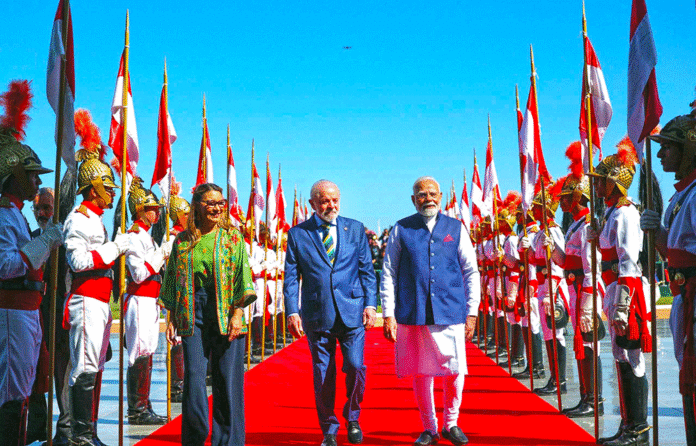
The February 18–22, 2026, State Visit by Brazilian President Luiz Inácio Lula da Silva to India has solidified a robust defence and security partnership. The visit saw the signing of several landmark aerospace partnerships involving Mahindra, Adani, and Embraer, alongside a trilateral maritime cooperation agreement concerning Scorpene-class submarines. It also included the launch of a strategic digital partnership aimed at strengthening the security of critical infrastructure.
The State Visit has fundamentally redefined the bilateral security architecture, shifting it from a historical diplomatic friendship into a high-technology strategic alliance. While the two nations have maintained a formal defence agreement since 2003, this latest summit represents a transition toward deep industrial integration that extends far beyond simple buyer–seller relationships. Both nations, recognising their roles as leading voices of the Global South, have pivoted toward a “self-reliant” defence philosophy. Their endeavour is to align India’s Aatmanirbhar Bharat initiative with Brazil’s established aerospace and naval industrial base to create resilient, alternative supply chains that are less dependent on traditional Western powers.

Prime Minister Narendra Modi encapsulated this synergy during the joint press statement on February 21, 2026. “Our cooperation in the defence sector is steadily expanding… it stands as a strong example of mutual trust and strategic alignment between our two countries,” he remarked. The partnership is no longer just about transactional procurement. It is about the co-development of sovereign technologies that can serve not only both nations’ armed forces but also the wider international market, positioning India and Brazil as net providers of security in their respective regions.
Spurring the Aerospace Revolution
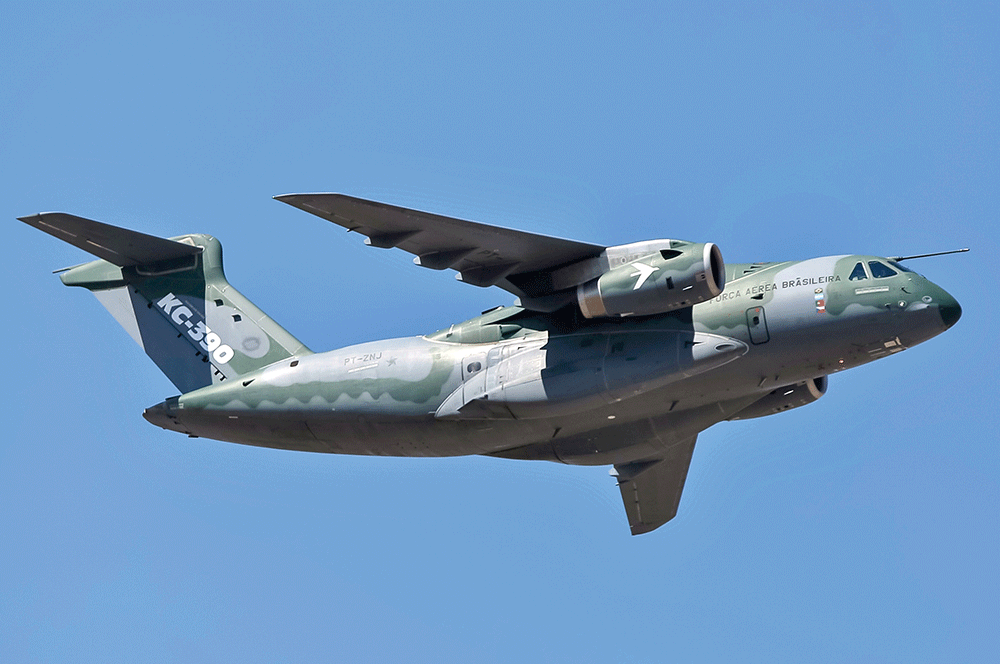
A defining pillar of this renewed cooperation is the aerospace sector, specifically the partnership surrounding the Embraer C-390 Millennium multi-mission transport aircraft. On February 19, 2026, the Mahindra Group and Embraer announced plans to establish a dedicated Maintenance, Repair and Overhaul (MRO) hub in India for the C-390. This facility is designed to support the Indian Air Force (IAF) Medium Transport Aircraft programme , offering comprehensive base and heavy maintenance, structural testing, and technical training. The MRO hub, likely to be located at a strategic airbase in central India, is expected to become operational by late 2027. It will serve as the primary maintenance centre for the entire future IAF C-390 fleet, which is anticipated to number between 40 and 60 aircraft.
The partnership is no longer just about transactional procurement. It is about the co-development of sovereign technologies that can serve not only both nations’ armed forces but also the wider international market, positioning India and Brazil as net providers of security in their respective regions
Bosco da Costa Junior, President and CEO of Embraer Defense & Security, emphasised the long-term intent, stating, “Embraer is committed to delivering not only the aircraft but also a robust support ecosystem tailored to India’s requirements.” Beyond mere maintenance, the two groups are exploring a roadmap to integrate Indian suppliers into Embraer’s global supply chain, positioning India as a regional sustainment node for C-390 operators throughout the Indo-Pacific. This could eventually see Indian-made components, such as wiring harnesses or avionics sub-assemblies, installed on Brazilian aircraft exported to other nations.
Industrial Synergies in Regional Aviation
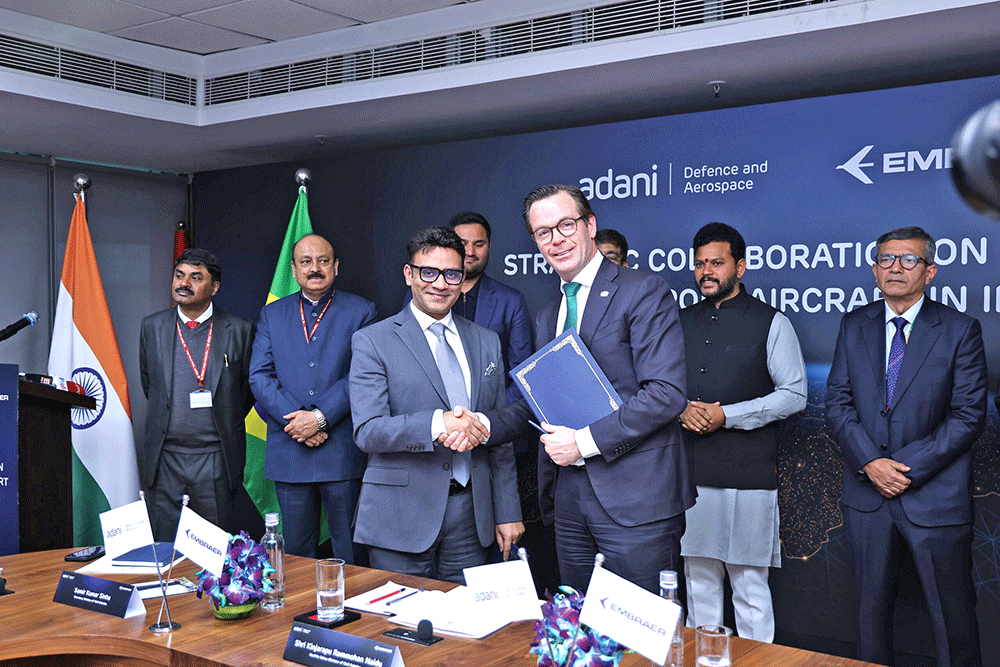
The aerospace momentum extends into the civil–military dual-use domain through an enhanced Memorandum of Understanding (MoU) signed between Adani Defence & Aerospace and Embraer on February 21, 2026, in the presence of President Lula and Union Minister Piyush Goyal. This partnership aims to establish a Final Assembly Line (FAL) for the E175 regional jet, creating an indigenous Regional Transport Aircraft (RTA) ecosystem.

This FAL, potentially located at Adani’s Aerospace Park in Nagpur, represents an investment of over ₹1,000 crore and is projected to create hundreds of high-skilled jobs. It will not only assemble aircraft for the booming Indian commercial market but could also be configured for military roles such as troop transport, signals intelligence, and electronic warfare, offering an indigenous solution for the armed forces’ own regional airlift requirements.
Jeet Adani, Director of Adani Defence, noted that “the need for an indigenous regional aviation ecosystem has become critical” as initiatives like UDAN (Ude Desh ka Aam Nagrik) transform connectivity across Tier-2 and Tier-3 cities.

Collaboration in Managing Maritime Assets
In the maritime domain, the cooperation has reached new depths with the trilateral MoU signed between Mazagon Dock Shipbuilders Limited (MDL), the Indian Navy, and the Brazilian Navy on December 9, 2025. This ten-year agreement establishes a framework for technical expertise exchange and life-cycle support for Scorpene-class submarines, which both countries operate.
By sharing maintenance philosophies for these French-designed platforms, India and Brazil are ensuring higher operational availability for their undersea fleets while advancing India’s vision of emerging as a trusted defence partner for friendly nations. The initial focus will be on streamlining the procurement of spares and standardising maintenance procedures, potentially reducing maintenance downtime by up to 20 per cent. Future phases could involve joint mid-life refits and upgrades, with MDL potentially bidding to service Brazilian submarines in South Atlantic naval facilities.
Strengthening Digital and Strategic Infrastructure
The 2026 summit also saw the launch of a comprehensive Joint Declaration on Digital Partnership for the Future, acknowledging that modern defence is as much about code as it is about hardware. During his remarks, Prime Minister Modi highlighted this shift, stating, “Technology and innovation cooperation holds significance not only for our two countries but for the entire Global South.”
Both nations have pledged to collaborate on the security of Digital Public Infrastructure (DPI) and the protection of strategic industrial corridors. This includes establishing a Centre of Excellence for DPI in Brazil and launching the Open Planetary Intelligence Network (OPIN) to leverage digital tools for climate action. Critically, the partnership will focus on hardening the digital perimeters of their respective defence industrial bases. It will entail the sharing of threat intelligence in real time and developing common security standards for 5G and future 6G networks to be used in military applications.
By merging their industrial strengths—from the assembly lines of Embraer to the dry docks of MDL—and setting an ambitious bilateral trade target of $30 billion by 2030, India and Brazil are demonstrating that a South–South defence cooperation can become a new cornerstone of global strategic stability
Furthermore, the visit also led to the signing of an agreement on Critical Minerals and Rare Earths on February 21, 2026. Described by the Indian government as a “major step towards building resilient supply chains,” it will pave the way for the high-tech components required by modern defence systems, from permanent magnets in missile seekers to advanced batteries in next-generation submarines.
Key Takeaways
The final layer of the 2026 defence partnership is the synchronisation of global security doctrines and the commitment to reform. Prime Minister Modi and President Lula reaffirmed their commitment to a “people-centric and humanity-first approach” as India prepares to chair the 18th BRICS Summit in late 2026. Both leaders called for the urgent reform of the United Nations Security Council (UNSC). They reiterated their mutual support for each other’s permanent membership on the Council.
Furthermore, they agreed to coordinate their votes and diplomatic strategies more closely on key United Nations peacekeeping mandates and on defining emerging norms for warfare, including the use of lethal autonomous weapons systems and the militarisation of outer space.
President Lula’s visit, accompanied by eleven Cabinet ministers and a large mission of entrepreneurs, underscored a shared belief that “when India and Brazil work together, the voice of the Global South becomes stronger and more confident.” By merging their industrial strengths—from the assembly lines of Embraer to the dry docks of MDL—and setting an ambitious bilateral trade target of $30 billion by 2030, India and Brazil are demonstrating that a South–South defence partnership can become a new cornerstone of global strategic stability. The growing India-Brazil relationship may serve as a blueprint for a multipolar world where power and innovation are increasingly shared among nations.

The author retired as a Senior Technical Officer at the Central Salt and Marine Chemicals Research Institute, Bhavnagar (Gujarat), and currently contributes articles to research journals and magazines. The views expressed are personal and do not necessarily carry the views of Raksha Anirveda.





