


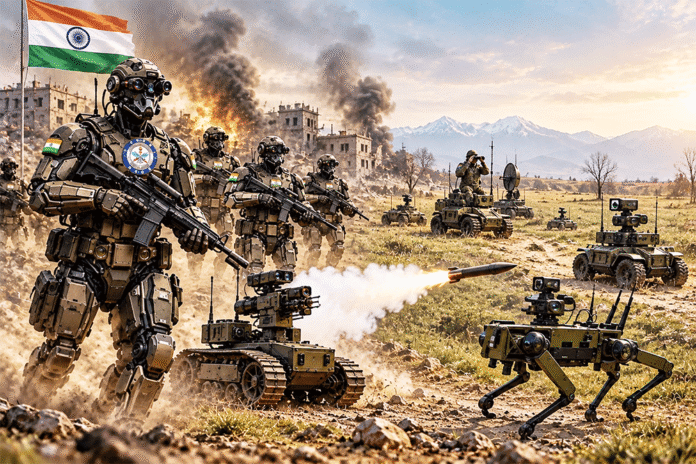
The battlefield front line, once a fixed geographic feature, is blurring. For two centuries, it meant a place: a trench, a ridge, or a river line where armies met. Recent operations in Ukraine show the line has become a depth zone stretching ten kilometres or more behind visible contact, patrolled not by soldiers but by machines that never sleep, panic, or need evacuation. Armies still planning around a fixed front line are preparing for a war that no longer exists.
The Vampire’s Shadow
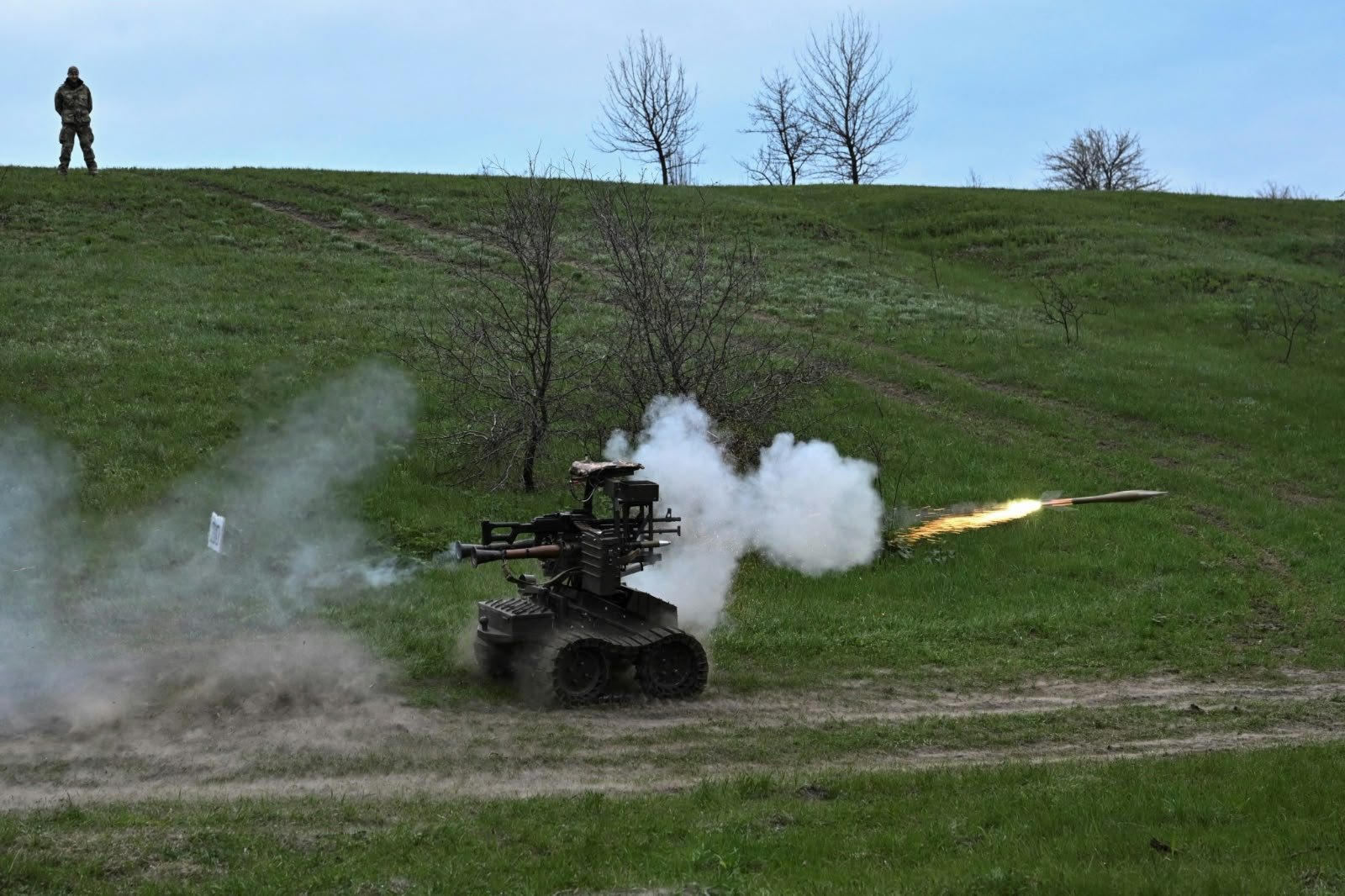
Large carrier drones of the Vampire and Baba Yaga classes now airdrop small kamikaze robots deep into contested rear areas, sometimes ten kilometres behind the point of contact. These unmanned ground vehicles set up ambushes on logistics routes and command-and-control centres, conduct night surveillance of resupply paths, and strike enemy positions directly. Field reports from Ukraine’s northern Donetsk Oblast (Lyman Sector) indicate that most counter-strikes now target ground robots and their carriers, not infantry.

The logic is simple and brutal. A ground robot costs a fraction of what the soldier it replaces does and can be produced in numbers no battalion could ever match. It need not win every engagement. It only needs to be cheap enough that losing ten costs less than losing one trained operator or one resupply convoy. This is not attrition warfare. It is arithmetic warfare, and the side that masters the arithmetic sets the terms of the fight.
From Army of Drones to an Army of Robots
Ukraine’s own trajectory shows what happens when a nation treats this shift as doctrine rather than novelty. Its 2022 Army of Drones programme expanded the unmanned manufacturing base to more than seven hundred companies and pushed unmanned strikes to more than 95 per cent of engagements. The newly announced Army of Robots extends the same logic to ground systems: casualty evacuation, ammunition resupply, mining and demining, reconnaissance, and position defence. None of the above is exclusive. In fact, drone-mounted UGVs are today a reality.
Ukraine’s trajectory shows what happens when this shift is treated as doctrine. Its 2022 Army of Drones programme expanded the unmanned manufacturing base to over 700 companies and pushed unmanned strikes to 95% of engagements. The newly announced Army of Robots extends the same logic to ground systems
What matters most is not the technology list. It is the design principle: not one flagship company building one exquisite platform, but an ecosystem of manufacturers and combat units feeding data back into design cycles measured in weeks, not years. No defence procurement system built for peacetime can match that tempo, and that is the point. The procurement cycle must keep pace with the technology cycle, and the technology cycle with the dynamics of the battlespace. War has always rewarded the side that adapts faster. What has changed is that adaptation speed is now a manufacturing metric, not just a tactical one.

Why India Cannot Simply Buy Its Way In
India’s borders present a different geography from the plains of eastern Ukraine, but the underlying problem is identical. The Line of Actual Control runs through some of the most inhospitable terrain on earth, where altitude and cold already punish the soldier before the enemy does. A ground robot that can hold a forward listening post through a Himalayan winter night, or an aerial carrier that can resupply an isolated picket without exposing a mule train to observed fire, is a force multiplier where India is most exposed.
Most procurement systems tempt you to buy a small number of expensive platforms and call the requirement met. That is the wrong lesson from Ukraine. Its value lies not in the individual robot but in manufacturing depth that lets you replace a destroyed unit within days, and a feedback loop that fixes a design flaw before the next batch ships. A squadron of imported ground robots, however advanced, will not survive contact long enough to matter without domestic capacity to replace losses at the pace they occur.

Three Non-Negotiables for Indian Force Design
Open architecture over vendor lock-in: Robotic and autonomous systems must communicate with each other and with existing command networks via open, non-proprietary interfaces. A platform that cannot be swapped between manufacturers at short notice becomes a liability the day its supplier cannot deliver, whether due to sanctions, war, or business failure.
The soldier’s role shifts from performing the most dangerous tasks to supervising and making the judgment calls a machine cannot yet make. Formations that design this teaming, rather than bolting robots onto structures built for a different era, will absorb the capability faster
Human-machine teaming, not human replacement: The soldier’s role shifts from performing the most dangerous tasks to supervising and making the judgment calls a machine cannot yet make. Formations that deliberately design this teaming, rather than bolting robots onto structures built for a different era, will absorb the capability faster.
Edge autonomy for a contested spectrum: Navigation and targeting decisions must run on the platform itself, because the electromagnetic environment along a contested border cannot guarantee a live data link when it is needed most. Centralised aggregation still matters, but only for predictive maintenance and doctrine refinement between engagements, not for split-second decisions under fire.
The Fault Lines Nobody Wants to Discuss
Every networked robotic endpoint is also a potential intrusion point, and a compromised ground robot behind one’s own lines is functionally an enemy asset. A zero-trust architecture is therefore a survivability requirement, not an information technology preference. The human cost of change is equally underestimated. Fielding robotic systems at scale demands retrained maintainers and rewritten operating procedures at a pace most peacetime bureaucracies are not built to sustain. Technology adoption fails more often for organisational reasons than technical ones, and this transition will be no exception unless planned as institutional change, not a procurement line item.
The Bottom Line
Robotics on the battlefield is no longer a future capability to plan for; it is a present reality to compete in. The force that dominates the next decade will not be the one fielding the single most advanced platform. It will be the one that builds the manufacturing depth and doctrine to field robots by the thousand and replace them within the week.
For India, the question is no longer whether to invest in unmanned ground and aerial systems. Circumstance has made that decision. The question is whether the ecosystem being built today, across the armed forces, the defence public sector, and the private industry that increasingly drives this technology, can scale at the pace a live front line will eventually demand. Ukraine did not win the argument for robotic warfare through a white paper. India would do well to learn that before the next flare-up.

The writer, a PVSM, AVSM, VSM has had an illustrious career spanning nearly four decades. A distinguished Armoured Corps officer, he has served in various prestigious staff and command appointments including Commander Independent Armoured Brigade, ADG PP, GOC Armoured Division and GOC Strike 1. The officer retired as DG Mechanised Forces in December 2017 during which he was the architect to initiate process for reintroduction of Light Tank and Chairman on the study on C5ISR for Indian Army. Subsequently he was Consultant MoD/OFB from 2018 to 2020. He is also a reputed defence analyst, a motivational speaker and prolific writer on matters of military, defence technology and national security. The views expressed are personal and do not necessarily carry the views of Raksha Anirveda





