


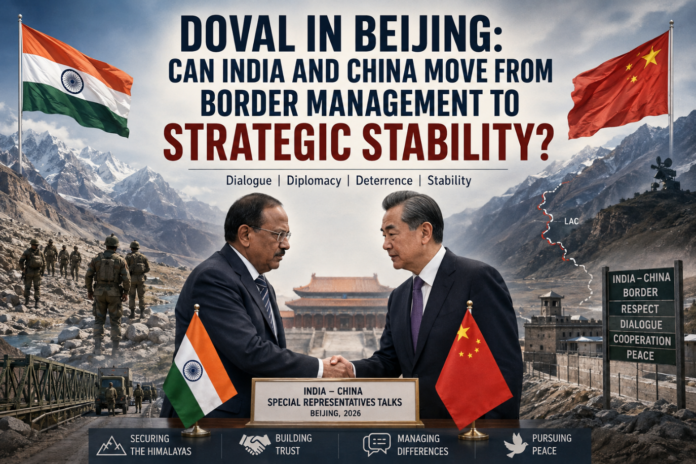
The visit of National Security Adviser Ajit Doval to Beijing on August 24-25, 2026, comes at a particularly consequential moment in India-China relations. Doval is in Beijing for the 25th round of talks between the Special Representatives of India and China on the boundary question, where he is meeting Chinese Foreign Minister and China’s Special Representative Wang Yi. Beijing has officially confirmed the meeting.
The timing is significant. India and China have moved away from the extreme military confrontation that followed the Galwan clash of 2020, but they have not moved towards a settlement of the boundary dispute.

The two sides have achieved disengagement at the remaining friction points in eastern Ladakh and restored patrolling arrangements in Depsang and Demchok.
Yet, the larger Line of Actual Control remains un-demarcated, perceptions of its alignment continue to differ, military infrastructure on both sides has expanded and China continues to contest India’s sovereignty over Arunachal Pradesh.
Doval’s visit therefore should not be interpreted merely as another round of boundary negotiations. It is better understood as an attempt to define the next phase of India-China relations: whether the two countries can establish a more stable modus vivendi while leaving the boundary dispute unresolved, or whether unresolved territorial competition will periodically return as a source of military confrontation.
The immediate objective is likely to be consolidation. The larger strategic objective is much more difficult: ensuring that normalisation does not become a euphemism for accepting a new status quo created through incremental Chinese military and infrastructure advances.

From Galwan to a Fragile Normalisation
The central fact governing the Sino-Indian relationship is that the 2020 crisis changed India’s perception of China. Prior to Galwan, the two countries had developed an elaborate architecture of confidence-building measures, military flag meetings and diplomatic mechanisms designed to prevent incidents along the LAC from escalating. The agreements had produced relative stability despite the absence of a settled boundary.
Doval’s visit seeks to establish whether India and China can maintain a stable relationship despite an unresolved boundary, or if border friction will continually trigger broader military confrontations
Galwan demonstrated the limits of that architecture. The crisis resulted in casualties, large-scale mobilisation and the deployment of tens of thousands of troops and substantial military equipment in eastern Ladakh. For India, the lesson was stark: confidence-building mechanisms have value only when both sides are willing to observe the underlying rules.

The eventual October 2024 agreement on patrolling in Depsang and Demchok represented an important breakthrough. India and China agreed to restore patrolling in these areas according to longstanding practices, and the Indian government subsequently stated that disengagement from all the friction points created since 2020 had been achieved. But disengagement is not de-escalation, and de-escalation is not resolution.
This distinction will be crucial in Beijing. The present situation is considerably better than the military confrontation of 2020, but the two armies remain heavily deployed along the broader frontier.
Moreover, disengagement has created buffer arrangements in some areas where the two sides previously patrolled. The future of these areas, and the question of whether normal patrolling patterns can eventually be restored, remains an important component of the larger border-management problem. India therefore has to ensure that the language of “normalisation” does not obscure the military realities on the ground.
The First Issue: What Happens to Patrolling?
Among the most important issues before Doval will be the future of patrolling along the LAC. The October 2024 agreement restored patrolling rights in Depsang and Demchok. This was important because the denial of access to traditional patrol points had become one of the most contentious elements of the eastern Ladakh crisis. But the problem is larger than Depsang and Demchok.
The two sides need to establish whether the present arrangements are temporary confidence-building measures or the beginning of a more comprehensive border-management regime.
India will be particularly interested in ensuring that patrolling rights cannot again be restricted through unilateral construction, temporary deployments, physical barriers or competing interpretations of the LAC. The underlying problem is that the LAC has never been mutually delineated on maps across its entire length. Consequently, Indian and Chinese patrols can enter areas that each side regards as being within its own perception of the boundary. That ambiguity is manageable only when there is political and military restraint.
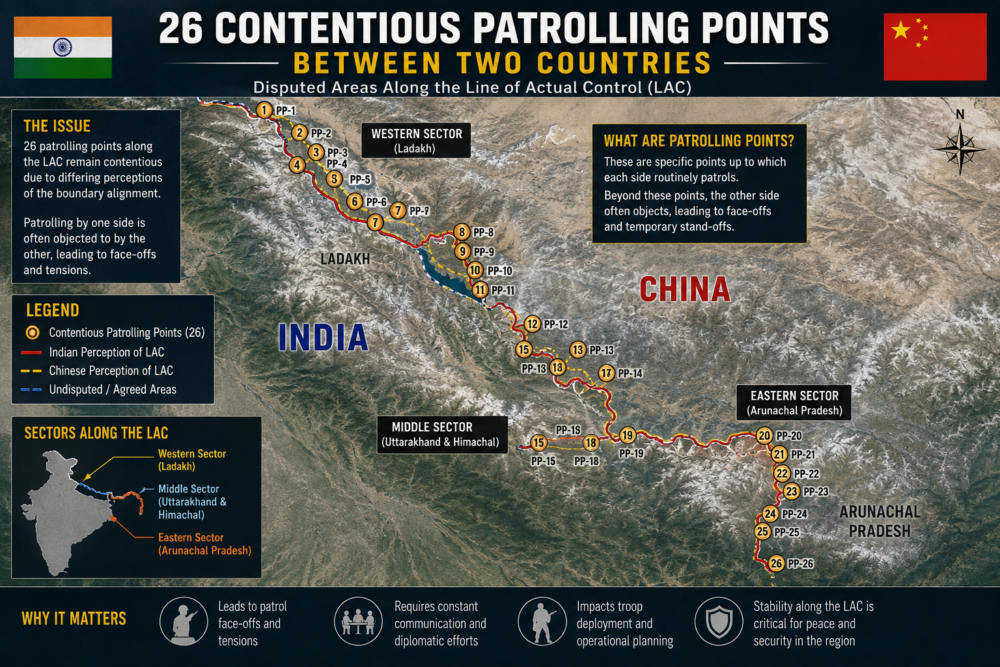
The recent controversy in Arunachal Pradesh demonstrates the danger. Reports of a Chinese incursion near Taksing generated considerable concern, although Indian authorities rejected claims of a 60-kilometre Chinese intrusion as unsubstantiated.
Union Minister Kiren Rijiju nevertheless acknowledged that there is a genuine problem caused by the absence of clear boundary delineation. This is precisely why patrolling mechanisms matter.
A patrol confrontation may begin as a local tactical incident but rapidly acquire national and political significance. India should therefore push for greater predictability in patrolling, communication and incident management rather than simply restoring patrols to their pre-2020 pattern.
Achieving disengagement at Depsang and Demchok has restored calm, but disengagement does not equal de-escalation, leaving heavy troop deployments along the frontier intact
The Arunachal Pradesh Question
If eastern Ladakh represents the military legacy of 2020, Arunachal Pradesh represents the long-term political core of the boundary dispute. China continues to claim Arunachal Pradesh, referring to it as “Zangnan” or southern Tibet. India rejects the claim unequivocally and regards Arunachal Pradesh as an integral and inalienable part of the country. The dispute is therefore not simply about an unmarked frontier. It involves competing claims of sovereignty.
The timing of Doval’s visit makes this particularly important. Only weeks before the talks, India formally standardised the names of 27 locations and geographical features in Arunachal Pradesh on Survey of India maps. The move followed repeated Chinese attempts to assign its own names to places in the state. Beijing has rejected India’s action, while New Delhi has reiterated that nomenclature cannot alter sovereignty.
This “mapping war” is not merely symbolic. Maps are instruments of statecraft. Naming a village, mountain or geographical feature creates an administrative and cartographic assertion of sovereignty. China’s repeated renaming of locations in Arunachal Pradesh is therefore part of a broader effort to reinforce its territorial narrative. India’s counter-action signals that New Delhi is no longer willing to allow Beijing’s cartographic campaign to go unanswered.
The danger is that the political contest over Arunachal could increasingly spill into military behaviour. The Taksing episode is a warning. Even when reports of a major incursion are rejected, persistent ambiguity, local perceptions of Chinese presence and competing claims can create pressure for stronger military responses. Thus, Doval’s challenge will be to make Beijing understand that Arunachal Pradesh cannot become another arena for incremental pressure.
China’s Expansion in Doklam
Doklam will also be an important strategic consideration, even though it is primarily a Bhutan-China territorial issue. The 2017 Doklam confrontation demonstrated that the India-China boundary problem cannot be understood exclusively through the India-China LAC. Geography connects the three countries – India, Bhutan and China – and developments on the Bhutanese side of the tri-junction can directly affect India’s security.
China’s infrastructure development around Doklam has remained a major concern. Independent assessments have documented road expansion, military facilities, helicopter landing areas and other infrastructure in and around the Doklam region. The strategic concern is the Chumbi Valley and the approaches towards the Jampheri Ridge.
A core priority for India is securing predictable patrolling arrangements across the entire Line of Actual Control (LAC) to prevent unilateral restrictions caused by construction or temporary deployments
The Doklam plateau overlooks an area of enormous strategic significance for India. Any Chinese military advantage that enables Beijing to dominate the approaches south of the Chumbi Valley could increase pressure on the Siliguri Corridor or the Chicken Neck corridor.
The corridor is India’s principal land connection with the Northeast. Its narrow geography makes it an obvious strategic vulnerability. China does not necessarily have to physically attack the corridor to impose strategic pressure.
The ability to threaten it, monitor it or create uncertainty about its security can itself produce military and political effects. This is why India’s response to Chinese activity around Doklam cannot be confined just to diplomatic protests.
India has increasingly recognised the importance of infrastructure, mobility and logistics in the eastern theatre. Roads, bridges, railways, airfields, communications and logistics nodes are becoming instruments of deterrence. India’s development of road connectivity near the Bhutanese border and renewed momentum for rail connectivity towards the Siliguri-Doklam region reflect this broader strategic logic.
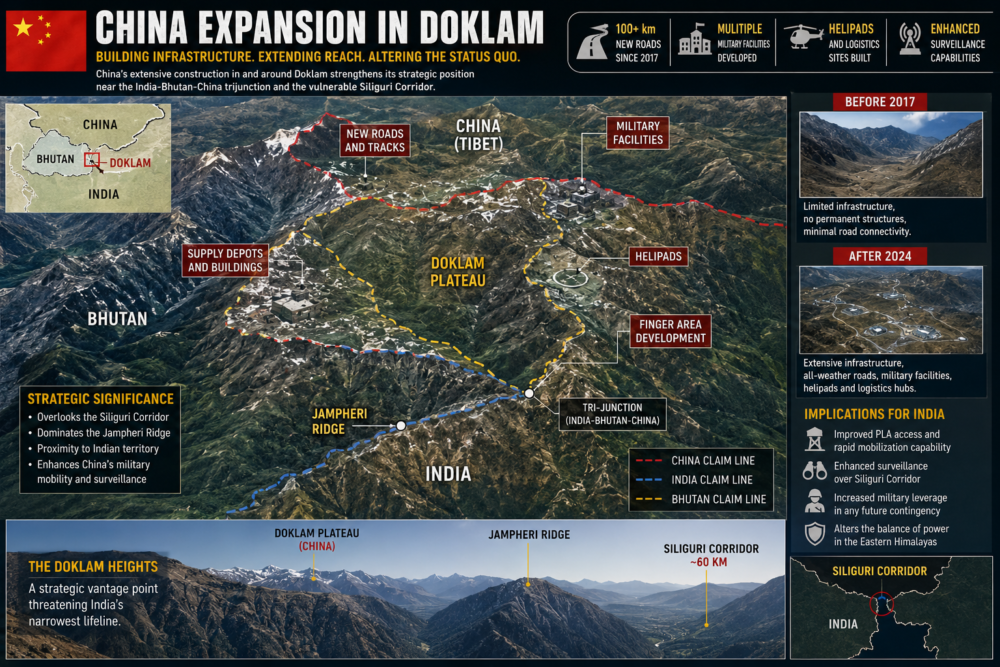
Doval is unlikely to obtain a Chinese commitment to halt its infrastructure expansion in Doklam. But India can make clear that continued Chinese alteration of the ground situation will directly influence India’s own military infrastructure and deployment decisions.
Bhutan: The Third Dimension
The Bhutan factor deserves particular attention. China and Bhutan have been engaged in negotiations over their boundary for decades. Any eventual China-Bhutan boundary settlement could have direct consequences for India’s security interests, especially around the Doklam area.
India’s position must therefore be carefully calibrated. New Delhi should respect Bhutan’s sovereignty and its right to negotiate its boundary with China. At the same time, India cannot ignore developments that fundamentally alter the military geography of its own Siliguri corridor.
Beijing’s cartographic assertions and place-renaming campaigns in Arunachal Pradesh underline persistent sovereignty disputes that risk escalating into localised military standoffs
The strategic question is not whether Bhutan chooses China or India. It is whether any future boundary arrangement creates a military geography that enables the PLA to acquire an unacceptable advantage over India’s northern approaches. This is an issue that requires quiet diplomacy rather than public confrontation.
The Larger LAC: Beyond Ladakh
The tendency to view the India-China boundary dispute primarily through eastern Ladakh is strategically misleading. The LAC extends from Ladakh through Himachal Pradesh, Uttarakhand, Sikkim and Arunachal Pradesh. Each sector has different geographical and operational characteristics.
In Ladakh, the terrain is relatively open and mechanised warfare is more feasible. In Arunachal Pradesh, the terrain is mountainous, heavily forested and characterised by river valleys, ridgelines and narrow approaches. In Sikkim and the Doklam region, control of heights and mobility corridors becomes critical.
China’s infrastructure expansion has therefore changed the military equation. The extensive road, rail, airfield and dual-use infrastructure constructed in Tibet has enhanced the PLA’s ability to mobilise and sustain forces near India’s borders. Research on China’s post-Doklam infrastructure development highlights the scale of this effort and its implications for Chinese military reach along the northern frontier.
India has made significant progress in closing the infrastructure gap, but the competition is far from over. The future contest will increasingly be one of logistics. Who can move troops faster? Who can sustain them longer? Who can reinforce threatened sectors? Who has better surveillance? Who can establish air superiority locally? Who can move artillery, missiles and unmanned systems rapidly? Who can maintain resilient communications when infrastructure is attacked? These questions may prove more consequential than the traditional debate over the exact alignment of the LAC.
Military Confidence-Building Measures Need a Reset
The old confidence-building architecture was designed for a different strategic environment. The experience of 2020 has demonstrated that India and China need stronger mechanisms for crisis prevention.
Hotlines between commanders need to be reliable and routinely tested rather than activated only during crises. Corps Commander-level meetings need greater institutionalisation. Border personnel meetings need clearly defined escalation procedures. There must be mutually understood protocols for patrol encounters, construction activity, UAV operations and temporary deployments.
Chinese military and logistical expansion near the Doklam plateau continue to pose a long-term threat to the Siliguri Corridor, necessitating robust Indian counter-infrastructure
A particularly important issue is transparency regarding military exercises close to the LAC. Exercises involving large formations, artillery or missiles can be misread as preparations for offensive action. Advance notification and communication mechanisms could reduce this danger without compromising operational security.
India should also press for a mechanism whereby any significant alteration of the status quo – new roads, major permanent military facilities, barriers or other structures close to sensitive areas – is notified and discussed through established channels. The objective should not be to freeze development. It should be to prevent infrastructure development from becoming a mechanism for unilateral alteration of the military balance.
The Pakistan Dimension
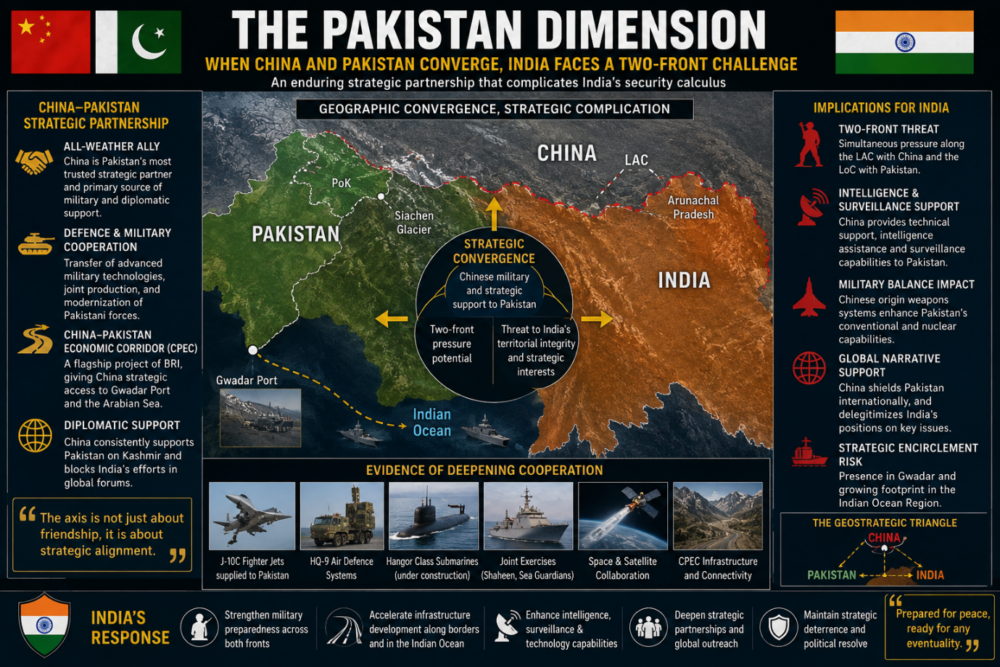
Doval will also have to look at China through the prism of Pakistan. China-Pakistan military cooperation has deepened substantially over the years. Pakistan’s armed forces depend heavily on Chinese-origin platforms, including fighter aircraft, air-defence systems, unmanned systems and other military technologies.
For India, this creates a strategic complication. A crisis with Pakistan cannot automatically be treated as independent of China. Beijing does not necessarily need to open a second front along the LAC to influence India’s military calculations. Intelligence support, military supplies, diplomatic backing, technology transfers or strategic signalling can complicate India’s response.
The lesson for India is that the China and Pakistan challenges must increasingly be analysed as an interconnected strategic problem, even when the two theatres remain operationally distinct. Doval’s discussions with Wang Yi will inevitably take place against this wider strategic background.
Economic Relations: Normalisation Without Vulnerability
The border is not the only issue. India and China have enormous economic interdependence despite their strategic rivalry. Indian manufacturing continues to rely on Chinese supply chains in several sectors, while both countries have an interest in maintaining economic stability. There is a huge imbalance of trade favouring China to the extent of 110 billion dollars.
Legacy border protocols have proven inadequate post-2020; a modernised framework with reliable hotlines, exercise notifications and infrastructure transparency is urgently required
There is therefore a strong argument for selective economic normalisation. But economic normalisation cannot mean strategic vulnerability. India’s objective should be diversification rather than decoupling. Critical sectors – electronics, pharmaceuticals, telecommunications, rare earths, power equipment, industrial machinery and defence components – require resilient supply chains.
The lesson of the pandemic, the Ukraine conflict and recent geopolitical disruptions is that economic security has become an integral component of national security. India can trade with China while simultaneously reducing excessive strategic dependence upon China. That is not contradiction. It is strategic risk management.
Can India and China Really Normalise?
This is perhaps the central question surrounding Doval’s visit. India and China clearly have incentives to reduce tensions. China faces economic challenges and strategic competition with the United States. India is seeking greater economic growth, technological development and strategic space. Neither country benefits from an uncontrolled military confrontation along the Himalayas.
Yet, incentives for cooperation coexist with structural rivalry. China’s rise, its territorial claims, its relationship with Pakistan, its presence in the Indian Ocean and its infrastructure expansion around India’s northern borders ensure that competition will remain. India therefore, should not seek a romantic “reset” with China.
It should seek a stable relationship with China. There is a crucial difference. A reset implies that the relationship can return to the pre-2020 model. A stable relationship recognises that the strategic environment has changed permanently.
What Should India Seek from the Beijing Talks?
India’s objective should be to move from crisis management to structured strategic competition. The first requirement is preservation of peace and tranquillity along the LAC.
The second is restoration and institutionalisation of predictable patrolling arrangements.
While bilateral trade remains substantial, India’s objective focuses on supply chain resilience and diversification in critical sectors rather than outright decoupling
The third is stronger mechanisms for preventing tactical incidents from escalating.
The fourth is discussion of troop deployments and force posture after disengagement, with the long-term objective of reducing the possibility of sudden mobilisation.
The fifth is a serious dialogue on the broader boundary question, even if a final settlement remains distant.
The sixth is ensuring that China’s infrastructure development does not become a vehicle for unilateral alteration of the status quo.
The seventh is addressing the Arunachal Pradesh issue firmly, making clear that India’s sovereignty over the state is non-negotiable while remaining open to dialogue on practical border management.
The eighth is maintaining communication on Doklam and Bhutan without compromising Bhutan’s sovereignty or India’s core security interests.
The Strategic Message from New Delhi
The most important message Doval can carry to Beijing is that India is no longer approaching China from a position of strategic hesitation. India has strengthened its border infrastructure, improved logistics, increased surveillance capabilities and demonstrated greater willingness to absorb economic costs when national security is involved. At the same time, India does not seek confrontation with China.
This combination – military preparedness with diplomatic engagement – is the appropriate posture. India should neither underestimate China nor exaggerate every Chinese move. The Arunachal controversy illustrates the distinction.
A claim of a 60-kilometre Chinese incursion was rejected by Indian authorities, but the underlying concern about unclear delineation remains real. The appropriate response is therefore neither complacency nor alarmism, but enhanced surveillance, stronger local infrastructure and robust diplomatic engagement.
From Border Management to Border Resolution
The ultimate limitation of the Special Representatives mechanism is that 25 rounds of talks have still not produced a boundary settlement. Perhaps that is not surprising. The boundary question involves sovereignty, strategic geography, Tibet, historical claims and domestic political considerations. Neither side is likely to make major territorial concessions in the foreseeable future.
True normalisation cannot serve as a cover for incremental territorial changes; peace and reciprocity on the border remain essential foundations for long-term stability
The immediate goal should therefore be more modest but strategically meaningful: make the unresolved boundary less dangerous. A mature India-China relationship should be able to coexist with an unresolved boundary provided the two sides agree on rules of behaviour.
But rules must be reciprocal. India cannot accept a situation in which diplomatic normalisation proceeds while military infrastructure, cartographic assertions and incremental territorial pressure continue. Peace on the border must be the foundation for normalisation, not its afterthought.
Doval’s Real Test
Ajit Doval’s Beijing visit is important not because it is likely to produce a dramatic breakthrough on the boundary question. It is important because it may determine the framework within which India and China manage their rivalry for the next several years.
The Galwan crisis demonstrated the consequences of strategic mistrust. The 2024 disengagement demonstrated that sustained diplomacy and military pressure can eventually produce results.
The latest Arunachal developments, however, show that the underlying dispute remains alive. China’s continuing infrastructure expansion around the Doklam region demonstrates that strategic competition is not confined to the LAC.
Doval therefore has to negotiate at two levels simultaneously. At the tactical level, he must seek predictable patrolling, effective communication, crisis-management mechanisms and avoidance of confrontations.
At the strategic level, he must ensure that normalisation does not legitimise unilateral changes to the status quo. The objective should not be peace at any price. Nor should it be perpetual confrontation.
India needs peace with preparedness, engagement without strategic dependence, and normalisation without compromising sovereignty. The most realistic outcome from Beijing would therefore not be a grand settlement.
It would be a more disciplined and predictable relationship in which competition is managed, military risks are reduced and neither side is allowed to convert ambiguity into unilateral advantage.
The Himalayan frontier will remain contested for years, perhaps decades. The real measure of diplomacy will be whether that contest remains political – or once again becomes military. Doval’s visit is an opportunity to ensure that it remains the former.
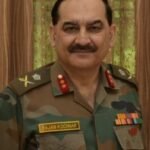
-The author retired as Major General, Army Ordnance Corps, Central Command, after 37 years of service. A management doctorate and expert on defence modernisation, he is the author of four books, including the Amazon bestseller “Breaking the Chinese Myth,” and a frequent media commentator. He is affiliated with several leading defence and strategic studies institutions in New Delhi. The views expressed are of the writer and do not necessarily reflect the views of Raksha Anirveda





