Description
As we enter the final quarter of 2026, one pressing question continues to dominate global discussions: Will normalcy return to the international order? The prevailing outlook remains discouraging, with little indication of an imminent return to stability. As great-power competition undergoes significant transformation, the debate over the future global order—whether it will remain bipolar or evolve into a multipolar system—continues to intensify. The United States and China are exploring a competitive middle ground, seeking to manage their strategic rivalry while temporarily avoiding direct confrontation. Meanwhile, emerging and established middle powers are increasingly asserting their influence, pursuing independent strategic interests, and seeking a more prominent role in shaping the evolving international order.
The Russia–Ukraine war continues with varying intensity, increasingly serving as a testing ground for advanced weapon systems and emerging military technologies. Both countries have experienced extensive destruction, while recent reports suggest substantial damage to Russia’s oil-refining infrastructure. Despite numerous diplomatic initiatives, mediation efforts have failed to produce a lasting resolution. Against this backdrop, Europe finds itself at a strategic crossroads, attempting to overcome decades of defence complacency by strengthening indigenous military production, expanding defence capabilities, and securing greater control over critical technologies. Whether an unexpected geopolitical development or an ‘October Surprise’ could significantly alter the course of events remains uncertain.

The Iran–United States confrontation also remains unresolved, further complicating an already fragile regional security environment. Tehran maintains that meaningful negotiations are difficult following repeated military attacks, while Washington continues to leave the possibility of diplomacy open, albeit under President Donald Trump’s contentious demands and strategic conditions. Iran presents its actions as necessary for national defence and the protection of its regional interests, particularly concerning the strategically vital Strait of Hormuz. Meanwhile, Gulf nations face increasing risks of regional spillover, and threats from the Houthis to expand their involvement in the Red Sea could further destabilise important international maritime trade routes and energy supply chains.
Amid these geopolitical uncertainties, India’s engagement with BRICS—originally comprising Brazil, Russia, India, China, and South Africa—and the Shanghai Cooperation Organisation (SCO) demonstrates its ability to maintain dialogue and cooperation across competing geopolitical interests. However, these multilateral platforms also underline the limitations of assuming consensus among nations with differing strategic priorities. Consequently, India’s most practical approach remains one of pragmatic multi-alignment, balancing its diplomatic engagements while protecting its national security, energy requirements, and economic interests. Maintaining open communication channels, encouraging de-escalation, and avoiding rigid geopolitical alignments will be essential for preserving India’s strategic autonomy.
As global geoeconomic disruptions become increasingly central to international relations, India must exercise considerable caution while pursuing its ambitious Vision 2047. Achieving long-term economic prosperity and sustainable national development will require a renewed domestic social compact focused on inclusive growth, equitable opportunities, and stronger institutional foundations. Greater investment in education, healthcare, skill development, and early-stage capacity building will be essential for improving upward social mobility. Equally important will be the seamless integration of domestic economic strengths with global markets, supply chains, technological networks, and investment opportunities to sustain India’s emergence as a major economic and strategic power.
In a significant development, Defence Minister Rajnath Singh recently released the ‘RAKSHA’ document outlining India’s defence diplomacy framework. The initiative signals India’s growing ambition to project military strength while contributing to stability in an increasingly uncertain geopolitical environment. By integrating diplomatic objectives with national security priorities, the ten-year policy blueprint seeks to establish defence diplomacy as a central pillar of India’s foreign policy. However, the success of this ambitious framework will depend on effective implementation, sustained institutional coordination, and the ability to translate strategic partnerships and diplomatic goodwill into measurable, long-term national advantages.

India is also accelerating the modernisation of its armed forces through indigenous technological development, with increasing emphasis on artificial intelligence, autonomous systems, and advanced military drones. The creation of an indigenous ‘AI spine’ and expansion of the domestic drone ecosystem are expected to reduce dependence on foreign defence imports while strengthening operational capabilities. Supported by the Make in India initiative, domestic procurement of unmanned systems is projected to increase substantially in the coming years. Military modernisation is increasingly shifting towards algorithm-driven combat capabilities designed to shorten sensor-to-shooter cycles, accelerate tactical decision-making, and improve battlefield effectiveness. Priority areas include the large-scale induction of autonomous loitering munitions with deep-strike capabilities, coordinated drone swarms, AI-enabled counter-drone technologies, cost-effective hard-kill and soft-kill electronic warfare solutions, high-speed interceptors, and integrated defence grid frameworks. Together, these technological advancements could significantly transform India’s military preparedness and operational effectiveness in future conflicts.
Nevertheless, serious concerns persist regarding India’s broader innovation ecosystem and its ability to convert ambitious technological initiatives into tangible results. The government’s ₹1 lakh crore Innovation Fund, envisioned as a major catalyst for research, entrepreneurship, and future technology development, has reportedly faced implementation delays and institutional challenges. The slow pace of progress highlights the urgent need for corrective measures, streamlined procedures, greater accountability, and improved coordination among government agencies, research institutions, and industry stakeholders. Addressing these obstacles will be critical to ensuring that India’s investments in innovation translate into commercially viable technologies, indigenous capabilities, and long-term strategic competitiveness.

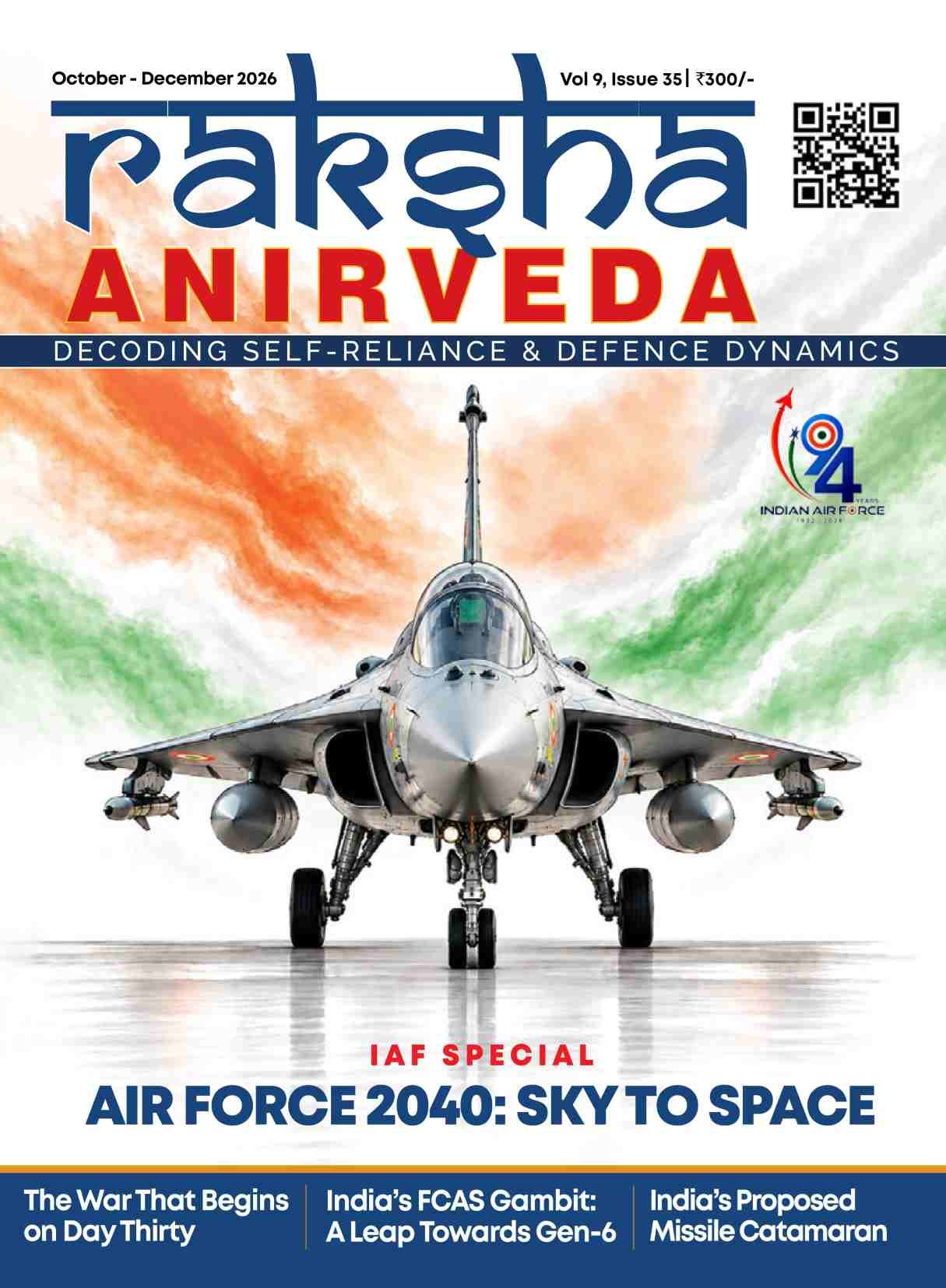
Against this dynamic geopolitical and technological backdrop, *Raksha Anirveda’s October–December 2026 edition* presents a special focus on the Indian Air Force, complemented by its regular features, comprehensive analyses, and diverse editorial offerings. This special edition celebrates the remarkable capabilities, operational excellence, and unwavering dedication of the Indian Air Force—an institution that embodies the spirit of being **Infallible, Impervious, and Precise**. Through insightful coverage of its achievements, evolving challenges, modernisation priorities, and future aspirations, we hope to engage our esteemed readers and encourage meaningful discussions among defence professionals, policymakers, strategic thinkers, industry leaders, and other stakeholders. With profound gratitude, admiration, and respect, Team Raksha Anirveda proudly salutes the brave guardians of India’s skies on the occasion of the **94th Indian Air Force Day**.
**Happy Reading! Jai Bharat!**