


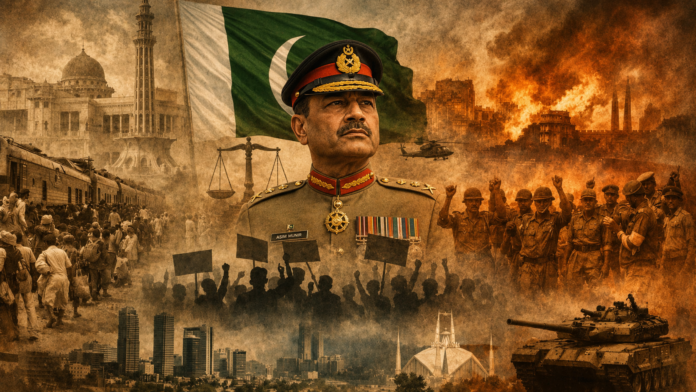
Pakistan’s military leadership has recently started projecting a global image, by increasing diplomatic engagement in regional and international affairs. Army Chief General Asim Munir’s interactions with major global powers and regional stakeholders have reinforced the perception that Islamabad seeks a larger role in shaping developments beyond its borders.
Yet, the reality confronting Pakistan at home tells a different story. The country’s most pressing challenges remain internal, particularly the resurgence of insurgent violence, political instability and growing unrest in its western regions.

The contrast is striking. While Pakistan attempts to position itself as a stakeholder in regional diplomacy, it continues to face serious security threats from the Tehrik-e-Taliban Pakistan (TTP), the Balochistan Liberation Army (BLA), and persistent unrest along its border with Afghanistan. These challenges have not only undermined internal stability but have also imposed significant economic and political costs on the Pakistani state.
The insurgency in Balochistan remains a major concern. The BLA has repeatedly targeted Pakistani security forces, infrastructure and Chinese interests associated with the China-Pakistan Economic Corridor (CPEC).
Driven by Baloch nationalism and grievances over resource exploitation, the Balochistan Liberation Army (BLA) poses a distinct security threat to the federal government. Frequent BLA attacks targeting security forces, infrastructure and Chinese CPEC projects significantly inflate security costs and deter vital foreign investment
Recent attacks, including the bombing of a passenger train in Balochistan that reportedly killed dozens, underscore the group’s continued operational capability despite sustained counter-insurgency efforts by Pakistan.
The BLA’s objectives differ from those of Islamist militant organisations. BLA’s primary focus is Baloch nationalism and opposition to what many Baloch groups perceive as the exploitation of the province’s natural resources without adequate local benefit.

Chinese projects have increasingly become targets because they are viewed by insurgents as symbols of external control over local resources. Over the past several years, attacks on Chinese nationals and infrastructure have become a recurring feature of the conflict, discouraging investment and raising security costs for both Islamabad and Beijing.
An even more formidable challenge comes from the TTP. With a significantly larger cadre of fighters, the organisation seeks to establish its own Islamic emirate in Pakistan’s north-western regions. The group considers the Pakistani state insufficiently Islamic and portrays it as overly dependent on external financial institutions and foreign powers.

Unlike in its earlier years, when it was often fragmented and poorly organised, the TTP has evolved into a more disciplined and capable insurgent movement. Following Pakistani counter-terrorism operations over the last decade, the organisation adapted its tactics and rebuilt its networks.
Tensions between Pakistan and Afghanistan have escalated over cross-border TTP sanctuaries and Pakistan’s deportation of Afghan refugees. The Afghan Taliban remains reluctant to confront the TTP due to ideological ties and fears of losing fighters to rival extremist factions
TTP has increasingly focused on attacks against security personnel and law enforcement agencies in an effort to enhance its legitimacy among supporters, while avoiding some of the indiscriminate violence that previously alienated sections of the population.
The persistence of the TTP also reflects deeper socio-economic problems. High unemployment, limited economic opportunities and weak state presence in remote areas have created conditions that facilitate recruitment.
Security operations may suppress violence temporarily, but they cannot address the structural grievances that sustain insurgencies over time.
Pakistan’s relations with Afghanistan have further complicated the situation. Islamabad has repeatedly accused the Afghan Taliban of providing sanctuary to TTP fighters. These accusations have led to cross-border strikes by Pakistan against alleged militant camps and ammunition depots inside Afghanistan.
However, the relationship between the Afghan Taliban and Pakistan has become increasingly strained for broader reasons. Pakistan’s decision to deport large numbers of Afghan refugees and restrictions affecting cross-border trade have generated resentment in Kabul. Trade disruptions have also affected an important source of revenue for Afghanistan’s Taliban-led government.
At the same time, the Afghan Taliban appear reluctant to move decisively against the TTP. One reason is ideological affinity developed over years of cooperation. Another is the fear that a confrontation with the TTP could push militants into the ranks of rival extremist organisations that are themselves hostile to the Taliban regime.
Widespread protests led by the Joint Awami Action Committee (JAAC) highlight deep political and economic grievances in PoK and Gilgit-Baltistan. Demonstrators demand fair electricity pricing, subsidised wheat and the abolition of 12 migrant assembly seats manipulated by Islamabad to control local governance
The result is a dangerous cycle. Pakistani military pressure on Afghanistan has not eliminated the TTP threat, while tensions between Kabul and Islamabad continue to grow. Ordinary Afghan civilians have borne a significant share of the costs through displacement, casualties and economic disruption.
Pakistan has often attributed unrest in Balochistan to external interference. Yet the durability of the insurgency points to deeper domestic causes. Political alienation, economic grievances, uneven development and long-standing distrust between local communities and state institutions have all contributed to the persistence of violence.
History suggests that insurgencies rooted in local grievances are rarely resolved through force alone. Military operations can degrade militant capabilities, but lasting stability generally requires political accommodation, economic inclusion and institutional reforms. The experience of Balochistan and Pakistan’s tribal regions demonstrates the limits of a purely security-centric approach.
Another major problem cropping up for Pakistan is the recent protests in Pakistan occupied Kashmir (PoK). Heart of problem in PoK is 12 seats reserved for migrants from J&K to different parts of Pakistan.
It all started in 2023 from rising electricity bills and shortage of subsidised wheat. Significant hydropower is generated from Mangla project in PoK but people of PoK pay hefty electricity bills.
Another issue is political representation of PoK. Biggest sticking point is 12 seats in PoK assembly reserved for Jammu and Kashmir migrants settled in different parts of Pakistan like Punjab, Sindh etc.
Pakistan’s reliance on military force fails to resolve root political alienation and socio-economic grievances. To secure long-term stability and credible international standing, Islamabad must pivot from external diplomacy toward meaningful domestic political accommodation and structural reform
Pakistan government uses these seats to get their men elected in PoK assembly. And elections to these 12 seats happen outside PoK, which is an irony.
So, in the house of 53 seats in PoK assembly, voters elect only 33 seats because apart from these 12 seats, 5 are reserved for women, 1 for a religious scholar, 1 for Kashmiris living overseas and 1 for a technocrat. Thus, a total of 20 are controlled by the centre, under some reservation category, or in other words, controlled by the army. But its funds come from the PoK kitty.
PoK people are right when they say since they don’t elect these people why should they spend on them. Protests on these issues are mainly led by the Joint Awami Action Committee (JAAC), formed in 2023. Pakistan government has banned JAAC now.
Another area under illegal occupation of Pakistan is Gilgit-Baltistan which is under development and cut from mainstream of Pakistan. Pakistan doesn’t give full citizenship right to residents of Gilgit-Baltistan.
Pakistan has colonial attitude towards Gilgit -Baltistan and has also seen protests from its people over issues of economy and political representation because of large Shia population. JAAC demands subsidised wheat, fair electricity pricing and abolition of reservation for 12 seats.
Pakistan, therefore, faces a strategic choice. It can continue prioritising external diplomatic visibility while managing internal crises through coercive measures, or it can devote greater attention to addressing the underlying causes of unrest within its own borders. The latter course is undoubtedly more difficult, but it is also more likely to produce durable stability.
For Islamabad, the path to regional influence ultimately runs through domestic stability. No amount of diplomatic activism abroad can substitute for peace and political reconciliation at home. Until Pakistan addresses the grievances that fuel insurgencies in its western regions, its internal security challenges will remain a significant constraint to its broader ambitions.
The writer commanded 15 Punjab in Lebanon under United Nations Flag, commanded 27 Sector as DIG in Churachandpur and was Brigadier Operational Logistics in HQ Western Command. He is currently an analyst on geopolitics, international and defence affairs. The views expressed are personal and do not necessarily carry the views of Raksha Anirveda





