


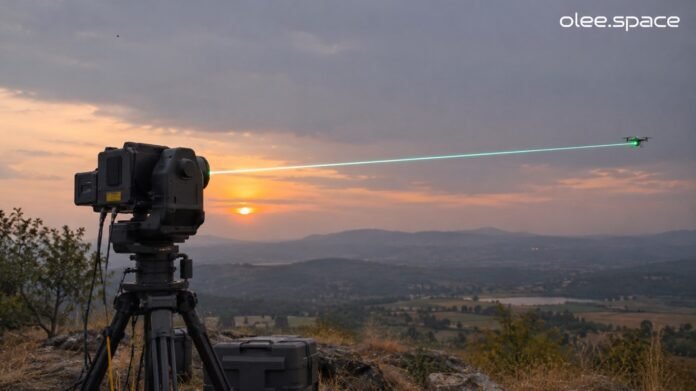
Pune: olee.space has been awarded a contract by the Defence Research & Development Organisation (DRDO), Ministry of Defence, to develop a laser-link drone communication system. The system will carry secure, high-speed data both ways between ground stations and drones in flight.
In the Russia–Ukraine war, radio jamming became so effective that drones began flying with kilometres of fibre-optic cable trailing behind them just to stay connected. The cables can’t be jammed, but they limit range and can snag or break.

Laser links offer the same advantage without the tether. Data travels on a narrow beam of light through open air. The result is fibre-like speed, impossible to interception, and no vulnerability to radio jamming.
Under the contract, olee.space will indigenously design and develop complete ground and airborne FSOC terminals with automatic Pointing, Acquisition and Tracking (PAT) within 18 months. The system pairs a tripod-mounted ground terminal with a compact optical payload integrated into a drone, providing a high-bandwidth, full-duplex link over long line-of-sight ranges.
James Solomon, Co-founder, olee.space, said, “Holding a laser link on a moving drone is one of the hardest problems in communications, and olee.space is one of very few companies globally working on this capability. We launched this programme a year ago, and we’re proud to have DRDO’s trust. This is Aatmanirbhar Bharat in action: frontier technology, built in India, competing with the world.”
olee.space is a Pune-based deep-tech company building laser communication systems for defence, aerospace and critical infrastructure. It does all of its work in-house, from optical design to field trials, to make secure, jam-proof laser links practical on the ground, in the air and in space.