


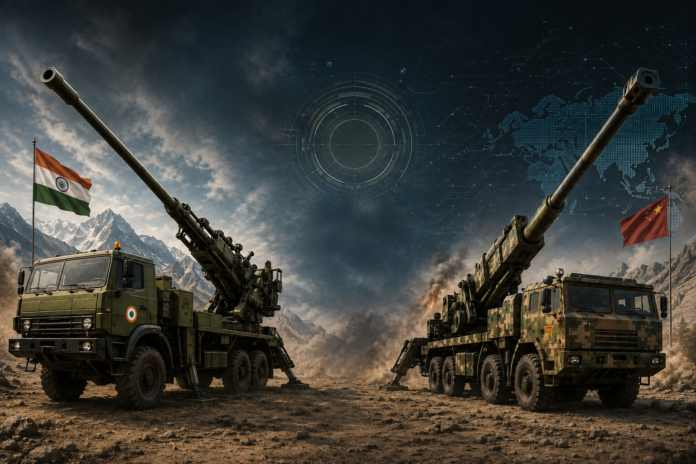
Pakistan has deployed the majority of its 250 Chinese-manufactured SH-15 truck-mounted artillery guns along the border with India. This is the export version of China’s PCL 181, 155mm/52 calibre gun. Its induction is a qualitative improvement to Pakistan’s artillery profile. It is mounted on a wheeled chassis and has a projected range of 30-40 km, while with extended-range projectiles it can fire beyond 60 km.
Since it is mounted, it can ‘shoot and scoot’, thereby reducing exposure to counter-artillery fire, though it remains vulnerable to loitering munitions operating in the battlefield. A total of 250 guns implies that 10-11 regiments would have been equipped, the balance forming part of reserves to cater for losses due to war, accidents, etc. The figures are thus not alarming. The Indian artillery has over 220 regiments, most of which will become 155mm in the near future, though they cater for two fronts, western and northern.

Further, extended-range projectiles are always limited in numbers as they are far more costly. They are employed sparingly. It is also true that the longer the ranges, the greater the inaccuracies, thus necessitating more rounds to achieve the same results. How well Pakistan’s sensor-shooter links are integrated with its systems to reduce inaccuracies at longer ranges is currently unknown.
Another unknown factor is whether SH-15 is capable of firing precision ammunition, employing jam-proof GPS and inertial navigation systems, for pinpoint accuracy. This ammunition is prohibitive in cost. It may be recalled that India has placed fresh orders for Excalibur precision ammunition for its 155mm M777 guns imported from the US. Orders have been placed for only 216 rounds, expended during Operation Sindoor, when they accurately targeted Pakistan’s terrorist camps, located in the midst of populated regions, avoiding collateral damage, at a cost of $47.1 million.
The parliamentary defence committee had mentioned in its report submitted on July 23 this year, “Considering the current geopolitical scenario, the Army cannot function with obsolete artillery for such long periods of time.” It recommended that the government enhance its pace of modernisation
The Indian artillery modernisation is ongoing, albeit slower than expected. Though it was planned almost two decades ago, it suffered a setback when the government switched to Aatmanirbharta, stalling imports. It has since picked up pace. The parliamentary defence committee had mentioned in its report submitted on July 23 this year, “Considering the current geopolitical scenario, the Army cannot function with obsolete artillery for such long periods of time.” It recommended that the government enhance its pace of modernisation.
As per the committee report, the original field artillery rationalisation plan envisaged induction of around 3,000 guns of 155 mm calibre by the mid-2020s. Current figures are lower, though gathering pace. As per media sources, India has inducted 72 Dhanush artillery guns from the 114, which were initially on order, while fresh orders for 300 more are being placed. The balance guns from initial orders are expected shortly and with increased production capacity, fresh orders would be completed by the end of the decade.

It has also ordered 307 ATAGS (Advanced Towed Artillery Gun System) from DRDO, Bharat Forge and Tata Advanced Systems. Further orders of ATAGS are unlikely as future artillery is moving towards self-driven, vehicle-mounted, self-propelled, rather than towed, to cater to the changing battlefield milieu.
The Indian artillery has also inducted 109 Vajra SP guns while having placed an order for 100 more in 2024, which should commence induction next year. An added order for 300 guns is in the pipeline. India has also completed induction of 145 M777 Howitzers from the US.

India is also developing its own vehicle-mounted 155mm guns. The DRDO’s MGS (Mounted Gun System) as well as Kalyani Strategic Systems Limited’s MArG (Mounted Artillery Guns) have been test-fired in India. They are likely to commence induction next year. MArG has also received some export orders. To add to its firepower, the artillery is inducting longer-range Pinaka as well as Pralay rocket and missile systems.
Developing technology to produce domestically long-range precision ammunition in large quantities is essential. This would save immense foreign exchange. Just 216 rounds of Excalibur ammunition cost $47.1 million. Such ammunition also has a shelf life. If produced locally, it would be at a fraction of the cost
The Indian artillery modernisation is currently based on 45 calibres, viz-viz 52 calibres of Pakistan. Whether we continue with the same or change to 52 calibres is unknown.
Most medium guns fire at a maximum range of around 40 km with normal ammunition. Beyond 40 km, they need additional means of propulsion. IIT Madras is developing Ramjet-powered 155 mm ammunition in conjunction with DRDO. This will enhance range by 30-50%. The Armament Research and Development Establishment (ARDE) is researching High-Explosive Base-Bleed ammunition. Both these prototypes are being test-fired at various ranges. Their accuracy would depend on shooter-sensor networks.
The number of guns alone being inducted is not the solution for effective artillery. What is needed is simultaneous integration of real-time sensor-shooter networks. As range increases, inaccuracies tend to creep in due to multiple reasons. These are offset by sensor-shooter links, which integrate surveillance drones, loitering munitions, and radar data directly with guns and missiles, ensuring accuracy at longer ranges.
What is equally important is that sensor-shooter cycles must have the minimum time (preferably in seconds), employing networked systems using AI. The induction of these systems alongside modernisation of artillery will change the scenario on the battlefield. This implies inducting a complete package and not just platforms to enhance firepower.
The raising of Shaktibaan artillery regiments, equipped with drones and loitering ammunition, alongside guns, and Divyastra fire units equipped with UAVs with both surveillance and strike capabilities, is a welcome step. This will form the base of the sensor-shooter loop. The longer the range of drones and loitering ammunition, the greater is the reach of the artillery. With accurate target acquisition, the adversary can be destroyed by the available equipment alongside Post Strike Damage Assessment.
Effective sensor-shooter links imply that airspace management of the battle area must remain with the army. Troops deployed along hostile borders cannot bank on any other service seeking to coordinate airspace management, especially as it impacts coordination of accurate artillery fire.
What makes the development of precision ammunition difficult is that India’s GPS NavIC satellite is not yet completely reliable. Unless its own satellite systems are fully functional, domestically produced precision ammunition may face difficulties
Another essential requirement is developing technology to produce precision long-range ammunition domestically in large quantities. This would save immense foreign exchange. Just 216 rounds of Excalibur ammunition cost $47.1 million. Such ammunition also has a shelf life. If produced locally, it would be at a fraction of the cost. There are reports that it is under development at ARDE, with prototypes available by next year and production commencing by 2029-30.
What makes development of precision ammunition difficult is that India’s GPS NavIC satellite is not yet completely reliable. Unless own satellite systems are fully functional, domestically produced precision ammunition may face difficulties.
A forward move has been made in the production of a variety of other ammunition needed by the artillery. As per reports, most ammunition variants are being produced domestically. Even scales of production are high. What is needed are dedicated quality checks at every level.
The Indian artillery is modernising steadily; however, the pace needs a push. Funds do not appear to be the issue; development, the rectification of shortcomings during trials, and the construction of production facilities are the stumbling blocks. Setting deadlines by the MoD and imposing penalties for delivery delays must be considered if India is to be fully equipped to fight a two-front conflict. Finally, airspace management for the army deployed along hostile borders is non-negotiable as it plays a major role in ensuring effective sensor-shooter links.

The writer is a strategic analyst and a motivator. He can be reached at @kakar_harsha. The views expressed are of the writer and do not necessarily reflect the views of Raksha Anirveda





