


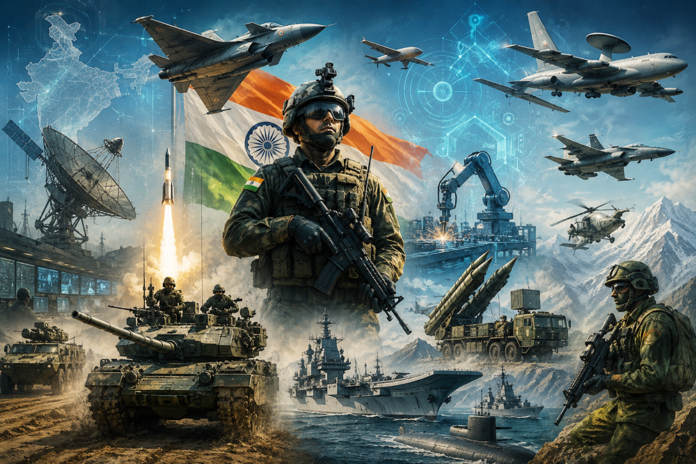
Confronted with persistent challenges along its northern and western borders, as well as an increasingly complex Indo-Pacific security landscape, India has steadily shifted from reactive defence procurement towards a long-term strategy centred on capability development, technological innovation and indigenous production. This transformation extends well beyond the acquisition of modern weapon systems. It encompasses higher capital investment, institutional reform, defence-industrial development, technological integration and greater jointness among the three Services.
Understanding the scale of this transition requires a closer examination of India’s evolving defence expenditure, structural reforms and modernisation priorities.

Funding the Future Force
For decades, India’s defence expenditure remained constrained by an enduring structural imbalance. A substantial proportion of the defence budget was devoted to revenue expenditure—including salaries, allowances and pensions—leaving comparatively limited resources for capital acquisition and military modernisation. Recent budgetary allocations, however, indicate a significant correction in this long-standing trend.
The Union Budget 2026–27 provides a record allocation of ₹7.85 lakh crore to the Ministry of Defence, representing an increase of 15.19 per cent over the previous financial year. Even more significant is the allocation of ₹2.19 lakh crore towards Capital Outlay, representing a 21.8 per cent year-on-year increase dedicated to modernisation, future combat systems and strategic deterrence. As noted in EY’s Defence Sector Highlights, this substantial increase reflects a sustained commitment to strengthening military capability.
Higher allocations, however, tell only part of the story. India’s defence expenditure continues to remain at approximately 1.9 per cent of projected GDP, significantly below the 3 per cent benchmark recommended by parliamentary standing committees to address potential two-front security contingencies.
At the same time, defence pensions account for approximately ₹1.71 lakh crore, illustrating the continuing fiscal challenge of balancing legacy personnel commitments with investments in advanced military technologies.

The challenge before policymakers is therefore not merely to increase defence spending, but to optimise the allocation of available resources between personnel, operational readiness and future capability development.
From Imports to Indigenous Capability
The centrepiece of India’s current defence strategy is Aatmanirbharta (self-reliance).

Having long been among the world’s largest importers of military equipment, India is steadily transforming its defence-industrial ecosystem through Positive Indigenisation Lists, which progressively reserve thousands of defence items for domestic development while restricting future imports.
The results are becoming increasingly visible. Indigenous defence production has expanded from ₹46,429 crore in 2014–15 to ₹1.78 lakh crore in 2025–26, while defence exports have reached a record ₹38,424 crore, supplying military equipment to more than 80 countries.
Equally significant, ₹1.39 lakh crore of the ₹2.19 lakh crore capital modernisation budget has been earmarked specifically for domestic procurement, creating a sustained demand pipeline for Indian defence manufacturers.
The Remaining Technology Gap
Despite these encouraging trends, self-reliance remains a work in progress. India has made substantial progress in platform manufacturing, shipbuilding, armoured vehicles and weapons integration. However, critical technologies continue to rely on foreign original equipment manufacturers (OEMs). High-thrust aero-engines, advanced radar components, semiconductor chips and specialised materials such as rare-earth magnets remain important areas of dependence.
Recognising this challenge, the Government has launched the ₹7,280 crore Rare Earth Permanent Magnets (REPM) Scheme, aimed at strengthening domestic supply chains for missiles, radars and combat aircraft.
Ultimately, true strategic autonomy will depend not only on assembling advanced military platforms but also on mastering the critical technologies that power them.
Transforming the Indian Army
The Indian Army is steadily moving away from manpower-intensive doctrines towards technology-enabled, precision-oriented operations. Drawing lessons from recent conflicts and operational deployments, the Army has accelerated the development of specialised “Rudra” Integrated Brigades, designed to decentralise surveillance, reconnaissance and precision fire support.
Infantry battalions are also being restructured to incorporate dedicated “Ashni” drone units, reflecting the growing importance of unmanned aerial systems (UAS) in tactical operations.
More than 30 different UAS platforms are now being integrated across a range of battlefield roles, from surveillance and target acquisition to logistics support and precision strike missions.
India’s defence expenditure continues to remain at approximately 1.9 per cent of projected GDP, significantly below the 3 per cent benchmark recommended by parliamentary standing committees to address potential two-front security contingencies
Simultaneously, artillery modernisation continues with the induction of the indigenous 155 mm/52-calibre Advanced Towed Artillery Gun System (ATAGS), complemented by high-altitude logistics drones operating along the Line of Actual Control (LAC).
Collectively, these initiatives illustrate the Army’s transition towards a networked, technology-intensive force capable of responding to the demands of contemporary warfare.
A Navy for the Indo-Pacific
The Indian Navy’s modernisation strategy is centred on strengthening blue-water capabilities to safeguard India’s expanding maritime interests across the Indian Ocean Region (IOR). A key element of this transformation is the emphasis on indigenous warship construction, reinforcing both operational capability and defence-industrial self-reliance.
The commissioning of INS Vikrant, India’s first indigenously built aircraft carrier, together with the induction of INS Arihant-class nuclear-powered ballistic missile submarines (SSBNs), marks a significant enhancement of India’s maritime deterrence.
Attention is now turning towards addressing critical underwater capability gaps through Project-75I, under which advanced conventional submarines equipped with Air-Independent Propulsion (AIP) systems will substantially improve underwater endurance and operational flexibility. These initiatives collectively reinforce the Navy’s ability to operate effectively across the wider Indo-Pacific while strengthening India’s long-term maritime security.
Modernising Air Power
Among the three Services, the Indian Air Force (IAF) continues to confront perhaps its most pressing force-structure challenge—maintaining its authorised strength of 42 fighter squadrons.
As ageing MiG-series aircraft are progressively retired, the IAF is placing increasing reliance on the indigenous Light Combat Aircraft (LCA) Tejas programme while simultaneously pursuing advanced multi-role fighter acquisitions.
Modernisation, however, extends well beyond the acquisition of combat aircraft.
The Integrated Air Command and Control System (IACCS) now links ground-based radars, airborne early warning platforms and space-based assets into a unified operational network, substantially enhancing situational awareness and command-and-control capabilities. The result is an increasingly network-centric air force, capable of integrating sensors, weapons and decision-making across multiple operational domains.
Preparing for Next-Generation Warfare
India’s military modernisation is no longer confined to conventional platforms. The Defence Forces Vision 2047 outlines a phased transformation towards a fully integrated, all-domain military force capable of operating seamlessly across land, air, sea, cyber and space.
The roadmap envisages three broad phases:
- Transition Era (until 2030): Joint theatre commands, drone and counter-drone integration, and enhanced electronic border surveillance.
- Consolidation Era (2030–2040): Greater integration of cyber and space capabilities, alongside the deployment of layered missile-defence systems.
- Excellence Era (2040–2047): Autonomous systems, AI-enabled command networks and comprehensive technological self-reliance.
Unified logistics, integrated communications, common operational doctrines and joint command structures will enable the Army, Navy and Air Force to operate as a single, cohesive fighting force rather than as three largely independent Services
This phased approach reflects the recognition that future military superiority will depend as much on information dominance and technological integration as on traditional combat power.
The Rise of Data-Centric Warfare
Perhaps the most significant conceptual shift is the transition from network-centric warfare to data-centric warfare.
Modern conflicts increasingly reward militaries capable of collecting, processing and exploiting data faster than their adversaries, enabling quicker and more informed operational decisions.
India’s rapidly expanding drone ecosystem reflects this shift. Supported by the Innovations for Defence Excellence (iDEX) framework, 676 startups and innovators are contributing to the development of next-generation unmanned systems, with numerous prototypes already approved for procurement.
Projected military drone orders exceeding US$2 billion (approximately ₹17,000 crore), particularly in loitering munitions, swarm technologies and long-endurance surveillance platforms, underscore the growing importance of autonomous systems in India’s future force structure.
At the same time, institutions such as the Defence Cyber Agency (DCyA) and the Defence Space Agency (DSA) are strengthening India’s ability to secure satellite communications, protect critical digital infrastructure and enhance decision superiority across multiple domains.
Institutional Reforms: The Next Frontier
Despite significant progress in military modernisation, institutional reforms remain essential to sustain long-term transformation.
Although the Defence Acquisition Procedure (DAP) has undergone important reforms, procurement processes continue to be affected by procedural delays and administrative complexities. As the Brookings Institution observes, India’s military modernisation requires “a transparent, legitimate and efficient procurement process.”
India’s military transformation should be understood as far more than a programme of equipment acquisition. It represents a comprehensive effort to strengthen technological capability, industrial resilience, operational readiness and institutional integration simultaneously
One persistent challenge is the annual nature of defence budgeting. The inability to seamlessly carry forward unspent capital allocations into multi-year acquisition programmes can result in year-end expenditure pressures or delays in project implementation, reducing overall procurement efficiency. Addressing these structural constraints will be critical if India is to maintain the momentum of its modernisation programme.
The Imperative of Jointness
Another major institutional priority is the continued transition towards integrated Theatre Commands.
The creation of the Chief of Defence Staff (CDS) has already improved coordination among the three Services by streamlining capability planning and promoting greater operational integration.
The next phase, however, requires moving beyond coordination towards genuine jointness. Unified logistics, integrated communications, common operational doctrines and joint command structures will enable the Army, Navy and Air Force to operate as a single, cohesive fighting force rather than as three largely independent Services. Such reforms are increasingly indispensable in an era of multi-domain warfare, where military success depends upon seamless integration across land, sea, air, cyber and space.
Building a Future-Ready Force
India’s military transformation should therefore be understood as far more than a programme of equipment acquisition. It represents a comprehensive effort to strengthen technological capability, industrial resilience, operational readiness and institutional integration simultaneously.
Higher defence budgets, expanding indigenous production, increasing defence exports, tri-service capability development and investments in artificial intelligence, cyber warfare, space capabilities and autonomous systems all point towards a broader strategic transformation rather than isolated procurement initiatives.
India’s military modernisation will be judged by its ability to build a technologically advanced, institutionally integrated and strategically autonomous force capable of safeguarding national interests across an increasingly contested Indo-Pacific
The challenge now is to ensure that these parallel efforts mature into a coherent national military capability, supported by efficient institutions, sustained technological innovation and long-term policy continuity.
Completing the Transformation
India has made remarkable progress in transforming its armed forces from an import-dependent military into one increasingly supported by indigenous industry, advanced technologies and integrated capability development. The steady rise in capital investment, expanding domestic defence production, growing export performance and continued emphasis on Aatmanirbharta reflect an important shift in national defence strategy.
Yet modernisation is not a destination but a continuous process. Sustaining this momentum will require further reforms in procurement, stronger investments in research and development, deeper technological self-reliance and the successful implementation of integrated Theatre Commands. Equally important will be the ability to translate technological innovation into operational effectiveness, ensuring that future investments strengthen both combat capability and strategic resilience.
Ultimately, India’s military modernisation will be judged not simply by the number of new platforms it acquires, but by its ability to build a technologically advanced, institutionally integrated and strategically autonomous force capable of safeguarding national interests across an increasingly contested Indo-Pacific. That transformation is already under way. Completing it will determine India’s ability to emerge as one of the world’s leading military powers in the decades ahead.

–The writer is Assistant Professor, ICFAI School of Liberal Arts, ICFAI University, Jaipur. The views expressed are of the writer and do not necessarily reflect the views of Raksha Anirveda





