


Several decades have passed since India was considered a ‘global power in waiting’, as the world order created after the Second World War was the major factor of the balance and stability in the community of nations in the bi-polar world order, albeit with Cold War rivalry and regional armed conflicts.
Today, with a strong nationalist government in New Delhi with the aspirations of cashing on the global churning to seek a just place for a powerful India in the new emerging economic and security architecture, when yesteryears’ nuclear super powers are capable of only destruction but not of creation for the benefit of common people. It is the unique opportunity for it to grab its place as a global power.

Speaking in Manila on July 22, 2026 External Affairs Minister S Jaishankar stated that the world is “extremely turbulent”, and it is evident that “no single nation” or “even grouping” can deal with it on its own. He underlined the need for deeper cooperation between India and ASEAN and like-minded partners.
India has a very rich experience of navigating through the choppy waters of international politico-economic turbulence since its independence.
However, one thing remained constant with the changing times, governments and geopolitical quakes like the fragmentation of the Union of Soviet Socialist Republics – bilateral special relations and friendship between New Delhi and Moscow, which matured into special and privileged strategic partnership.
“Such a relationship was not built overnight, or over the course of a few years. It is the result of decades of cooperation. The Soviet Union established diplomatic relations with India in 1947 and consistently supported the development of the young nation. We are happy to see that, thanks to the tireless work, talent and determination of the Indian people, India has achieved remarkable success and made tremendous progress in its development”, Russian President Vladimir Putin said talking to international press in St Petersburg in June 2026.

External Affairs Minister S Jaishankar stresses that no single nation can handle today’s fractured geopolitical landscape alone, reinforcing India’s push for deeper regional and global cooperation
This statement was a tribute to India’s first prime minister Jawaharlal Nehru and Soviet leader Nikita Khrushchev and their successors, including Indira Gandhi, Leonid Brezhnev, Gorbachev, Rajeev Gandhi, PV Narasimha Rao, Atal Bihari Vajpayee and Dr Manmohan Singh, who played personal role in nurturing the New Delhi-Moscow ties.
President Putin never misses any opportunity to mention India of its longest serving Prime Minister Narendra Modi as ‘the world’s third economic power by PPP (purchasing power parity)’ after the US and China.

“India is currently demonstrating the highest economic growth rates among the world’s major economies. This doesn’t fall out of the sky; it is the result of consistent and purposeful efforts, above all by the government led by Prime Minister Narendra Modi. The country’s strong economic performance reflects the successful implementation of the policies and development strategies pursued under his leadership,” Putin said speaking at the St Petersburg International Economic Forum in June 2026.
During their July 2026 meeting in Manila, on the sidelines of ASEAN foreign ministers’ meeting, the External Affairs Minister Dr S Jaishankar and Russian Foreign Minister Sergei Lavrov agreed to “further develop joint cooperation in the spirit of mutual trust”.
Moscow, which is under unprecedented Western sanctions over its Ukraine military campaign, appreciated India’s courageous stance of purchasing sanctioned Russian crude despite pressure from Washington and Brussels. It was a win-win deal and cemented India’s strategic autonomy.
From Soviet support in 1947 to today’s “special and privileged strategic partnership,” the New Delhi-Moscow relationship has endured shifting global orders through bipartisan, decades-long nurturing
During the Hormuz crisis again, it was Russia which came forward to ensure India’s energy security. During his New Delhi visit in December 2025 for the annual summit President Putin assured energy security for India despite sanctions.
The strategic partnership may be a term in the political lingo but for India in the case of relations with Russia it is something tangible.
The trans-Atlantic media outlet Politico in one of its recent articles declared, “Russia importing sensitive UK, EU tech through India. Data shows that researchers tracked around 50,000 sensitive and dual-use goods reaching Russia via India since the 2022 invasion of Ukraine, raising questions as Britain and the EU deepen trade ties with New Delhi”.
It is no more a secret that India has been a source of massive supplies of refined petroleum products to Russia after its remote refineries were hit by massive Ukrainian drone-strikes, allegedly guided by the US and Western intelligence.
Only global powers can boast of reliable partners in the rapidly changing geopolitical scenario to safeguard their vital national interests. It is not necessary to enter into any formal alliance with anyone, but have courage to fight for its vital national interests on the basis of equality.
Despite intense Western sanctions and international pressure, India’s courageous procurement of Russian crude and Russian guarantees during the Hormuz crisis have anchored national energy security
Often it is suggested that India’s strategic partnership with Russia is creating problems in developing New Delhi’s cooperation with the United States and vice-versa.
Responding to this view President Putin in his interview to PTI in June 2026 said, “We are glad that India is developing relations with all countries. India is a major global power with a population of 1.5 billion people, a rapidly growing economy, and is regarded as the world’s largest democracy. It is entirely natural for India to develop relations with a wide range of countries in accordance with its national interests”.
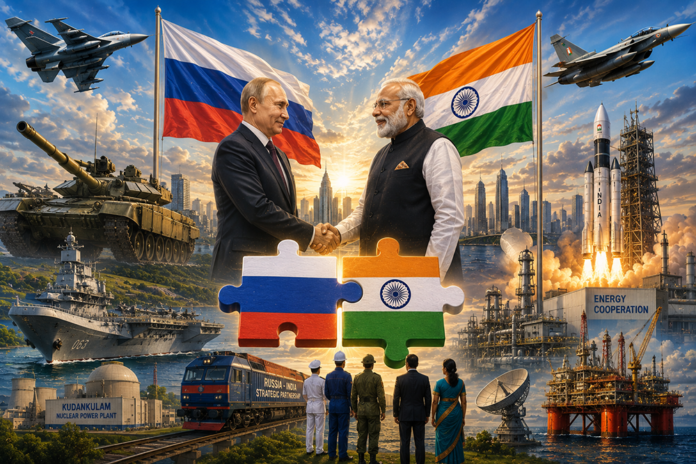
Energy, including civil nuclear, space and defence remain the main pillars of India-Russia strategic partnership. Russia has been a longstanding and time-tested partner for India. Development of India-Russia relations remains a key pillar of India’s foreign policy, Indian diplomats say.
Since the signing of the “Declaration on the India-Russia Strategic Partnership” in October 2000, India-Russia ties have acquired a qualitatively new character with enhanced levels of cooperation in almost all areas, including political, security, defence, trade and economy, science & technology, culture and people-to-people ties.
Although, in academic discourse one can often come across “Russia-Pakistan-China axis” and Russia as the “junior” partner of China, but prevalent domestic discussions in Russia on Moscow’s relations with Beijing are often intentionally ignored.
Just recently Russia’s biggest retail lender – Sber Bank’s Indian branch published a handbook for Russian businesses’ seeking world class alternatives to Chinese precision machine tools in India.
With bilateral trade soaring past $60 billion, both nations are aggressively targeting $100 billion by 2030, spanning energy imports, high-tech alternatives and expanding Indian exports
Russia is perhaps the only country in the world, with which India has several institutionalised dialogue mechanisms, to retain forward looking orientation of their strategic cooperation at political and bureaucratic levels.
The India-Russia Intergovernmental Commission (IRIGC) has two divisions – the Trade, Economic, Scientific, Technological and Cultural Cooperation (IRIGC-TEC) co-chaired by the External Affairs Minister from India and one of the First Deputy Prime Ministers from Russia, and the Military & Military-Technical Cooperation (IRIGC-M&MTC) headed by the Defence Ministers of the two countries.
The Annual Summit between the Prime Minister of India and the President of the Russian Federation is the highest institutionalised dialogue mechanism in the strategic partnership between India and Russia. So far, 23 Annual Summits have taken place alternatively in India and Russia.
Trade and Economic Cooperation
Intensifying the trade and economic relations has been identified as a priority area by both the nations who have set the targets of increasing bilateral trade to USD 100 billion by 2030.
Bilateral trade between India and Russia reached a record high of USD 68.7 billion in FY 2024-25 and 59.863 billion for FY 2025-26. Last year, India’s exports were worth USD 4.88 billion and imports from Russia amounted to USD 55.369 billion.
Defence Cooperation
The longstanding and wide-ranging military technical cooperation between India and Russia has evolved from a buyer-seller framework to one involving joint research, development and production of advanced defence technologies and systems.
Military ties have evolved into joint research and manufacturing—exemplified by BrahMos missile exports and licensed production of Su-30 MKI jets – forming an iceberg of deep defence integration
Russia is also an important source for the supply of defence equipment, engines, spare parts and components. Several defence platforms are also assembled/produced in India such as T-90 tanks and Su-30 MKI aircraft.
Jointly produced supersonic BrahMos cruise missile is now exported to Philippines and more countries are showing interest in buying it, after Ukraine air chief accepted that they are unable to intercept its Russian origin “Onyx”.
As a former ambassador in Moscow once said, the defence cooperation between India and Russia is ‘like an iceberg- you can see only the tip of it”.
Science and Technology Cooperation
According to the Indian Embassy’s web-portal in Moscow, Science & Technology has played a key role in the bilateral India-Russia partnership, especially in the early days after India’s independence.
Today, India and Russia work together on basic sciences, materials science, mathematics and cutting-edge areas like India’s manned spaceflight programme (Gaganyaan), nanotechnologies etc.
From supporting the Gaganyaan manned spaceflight programme to powering the Kudankulam Nuclear Power Plant, Russia remains a cost-competitive pillar in India’s high-tech and clean energy infrastructure
India’s only nuclear power plant, established with another country is in Kudankulam in Tamil Nadu, which was established in collaboration with Russia. On the other hand, projects under discussion with France and the US have been unable to offer the competitive cost of a unit of electricity, as compared to the Russians.
Overall, experience shows that uninterrupted special relations and strategic partnership with Moscow served to make India a great power capable of defending its vital interest in different parts of the world, even without being a permanent member of the UN Security Council.
At its 80th Independence Day, India must confidently walk as a global power cherishing its trusted partners and extending a hand of friendship to all willing to honour its national interests as a civilisation, which gave the world the mathematical concepts of ‘zero’ and ‘decimal’.

–The writer is a Moscow-based independent defence analyst. The views expressed are personal and do not necessarily reflect the views of Raksha Anirveda





