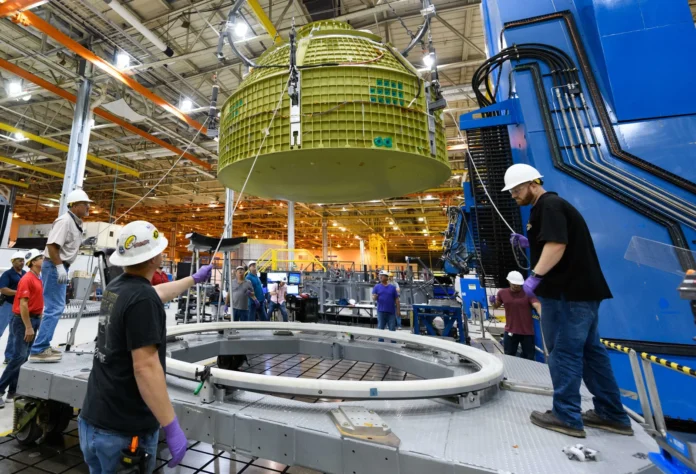
DENVER, August 28, 2018. Technicians have completed construction on the spacecraft capsule structure that will return astronauts to the Moon, and have successfully shipped the capsule to Florida for final assembly into a full spacecraft. The capsule structure, or pressure vessel, for NASA’s Orion Exploration Mission-2 (EM-2) spacecraft was welded together over the last seven months by Lockheed Martin technicians and engineers at the NASA Michoud Assembly Facility near New Orleans.
At the NASA Michoud Assembly Facility in Louisiana, Lockheed Martin technicians have completed construction of the first Orion capsule structure that will carry humans to deep space on Exploration Mission-2. Image courtesy of NASA.

Orion is the world’s only exploration-class spaceship, and the EM-2 mission will be its first flight with astronauts on board, taking them farther into the solar system than ever before.
“It’s great to see the EM-2 capsule arrive just as we are completing the final assembly of the EM-1 crew module,” said Mike Hawes, Lockheed Martin vice president and program manager for Orion. “We’ve learned a lot building the previous pressure vessels and spacecraft and the EM-2 spacecraft will be the most capable, cost-effective and efficient one we’ve built.”
Orion’s pressure vessel is made from seven large, machined aluminum alloy pieces that are welded together to produce a strong, light-weight, air-tight capsule. It was designed specifically to withstand the harsh and demanding environment of deep space travel while keeping the crew safe and productive.
“We’re all taking extra care with this build and assembly, knowing that this spaceship is going to take astronauts back to the Moon for the first time in four decades,” said Matt Wallo, senior manager of Lockheed Martin Orion Production at Michoud. “It’s amazing to think that, one day soon, the crew will watch the sun rise over the lunar horizon through the windows of this pressure vessel. We’re all humbled and proud to be doing our part for the future of exploration.”

The capsule was shipped over the road from New Orleans to the Kennedy Space Center, arriving on Friday, August 24. Now in the Neil Armstrong Operations and Checkout Building, Lockheed Martin technicians will immediately start assembly and integration on the EM-2 crew module.