


India hosts the third largest number of unicorns – almost ready to provide windfall returns to their investors. Did you invest in any of them? It’s quite a task to find that real soon-to-be-unicorn and invest at the right time. And above all, to have that courage and risk appetite. Investing in startups is a very high risk, high reward game. That investment could even be in “sweat equity” or working for stock in the startup.
A PIB (Press Information Bureau) release published in April this year, showcased a lot of data spread across the various government incentive schemes for startups. The data revealed that the list of such soon-to-be-unicorns has steadily increased over the years. These statistics provide a perspective on the startup ecosystem in India. But a startup cannot be successful on government incentives alone. To be viable they not only require a steady revenue stream but also need to showcase a highly profitable future. The larger the estimated RoI (return on investment), the higher the chances of private funding. That RoI also has another prerequisite – be more than what the market provides at lesser risk. Only then would the investor risk investing for the returns. Without such an RoI, the startup would never wean off government support. Global statistics show a strong majority of startups disappear in that gap.

This warrants the question: how do the commandos of the investment world – the venture capitalists (VCs), succeed in such high-risk environment? They spread their risk across a portfolio of startups. For example, say a VC shortlists and invests one lakh rupees each in ten startups with the expectations that each startup would give a 50% return or more. But unfortunately, six of them fail, and thus six lakhs are lost. But the remaining four become successful, as predicted, and give 200%, 300%, 200%, 100% returns, respectively. And the VC still profits.
The best-known VC investment ever was in 1997, by an American VC firm named Benchmark Capital in the then upcoming startup, eBay. That investment over a two-year period gave a return 750 times the investment, an annual return of 2,632% per annum.
The Indian Venture Capital Association (IVCA) reported, last year Indian startups (growth stage) received US$16B in funding, behind China at US$ 43B and the US at US$ 375B. The data also revealed that 803 seed stage investments were made last year, only 47 more than the previous year. During a similar time period, the PIB stated that DPIIT recognised more than 55,200 new startups, a 51% increase year on year. Implying, last year, for each new startup receiving private funding, 69 new startups were registered.
Last year, for each new startup receiving private funding, 69 new startups were registered. For defence startups, technology alone is not enough; sustainable business models remain the key to long-term success
Apart from non-serious, fake and pseudo-startups – built for other purposes – the viable but unfunded startups thus lack the potential for a VC to risk investing. These low-return startups are no more than micro, small and medium enterprises (MSMEs). The grey area differentiating these viable low-return startups from MSMEs is still a government policy shy.

Defence Ecosystem, Startups, MSMEs and the Venture Capital Challenge
Unfortunately, the defence sector witnesses many such MSMEs masquerading as startups. Many defence sector startups today leverage open-source solutions and/or a sizeable number of imported components in their bill of materials. This reduces the level of original Intellectual Property (IP) leveraged by the startup. It also increases competition and exponentially decreases the potential for VC funding. Entrepreneurs often quip that the components are not manufactured in India – well then, the real gold rush opportunity is in making those components.
Moreover, the defence sector has only a handful of customers, if not just one or two and their order quantities are also limited and aperiodic. Therefore, worldwide defence startups are advised to look at dual use business models and sustain from a civilian revenue stream. Without the civilian component many def-tech startups/MSMEs do not have a long-term sustainable model. The most viable growth trajectory for the one-trick-pony startups/MSMEs is to get acquired by a larger company once their product has reached a level of maturity or once the defence orders get harder to obtain.

An example can be found in a poster child of the drone industry, ideaForge. Since its IPO in mid-2023 its shares are yet to go past their initial listing price. Full disclosure, I am not aware of the complete reasons for its share price performance. Nevertheless, ideaForge is in a very crowded marketplace. And the fact that it did not take the VC route but preferred an IPO, tends to follow the above hypothesis.
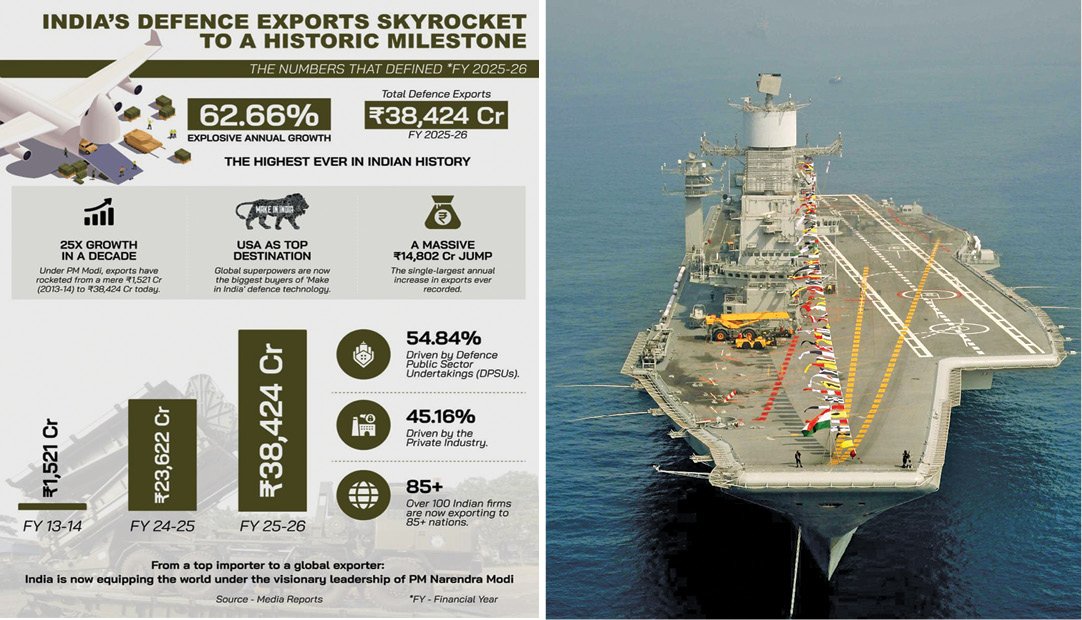
Such wild west brutality is expected in the startup world and hence the government provides the best support it can. While the startup/MSME ecosystem continues to thrive, it bodes well for the indigenisation effort of the Indian defence sector. Just a decade ago India was a net importer; today its defence exports surpass ₹ 38,000 crores.
Aircraft Carrier Diplomacy: India’s Missed Opportunity?
Meanwhile India seems to have overlooked a golden opportunity to boost its defence exports by two or three orders of magnitude. As India takes pride in its indigenously built aircraft carrier, INS Vikrant, it also stresses to sustain the ecosystem that built the carrier. Official data shows, over 650 OEMS and MSMEs contributed towards building INS Vikrant. The subsequent order, to replace the INS Vikramaditya might be over a decade away. By then this ecosystem might be lost.
The grey area differentiating viable low-return startups from MSMEs is still a government policy shy.The defence sector witnesses many such MSMEs masquerading as startups
In the meantime, another ship building superpower made multiple efforts towards its own carrier of the INS Vikrant tonnage, but in vain. That was South Korea – worthy of an aircraft carrier diplomacy. A multi-billion-dollar co-development and training programme would not only have taken defence exports off the charts and sustained the ecosystem but also given India a geopolitical ally for life. After at least two false starts over the recent years, Seoul course corrected towards a smaller UAV carrier instead.
Nevertheless, all is not lost as in 2024, another nation published its desire for an aircraft carrier in a peer reviewed paper at a European international conference, later published by Elsevier. The paper researched and analysed several aircraft carriers the world over, and shortlisted the INS Vikramaditya, as one of its top three choices. That nation is Brazil. Today exploring an aircraft carrier diplomacy with Brazil is worth a serious deliberation.
To conclude, it is very apparent, the startup/MSME ecosystem is maturing, enabling India to come of age in the defence export market. The inventory ranges from the smallest of drones to the largest of warships.
Jai Hind!

The writer is a guest faculty at WASP and has international experience in implementing entrepreneurial ecosystems in emerging technologies. He is also a former member of the National Security Advisory Board. The views expressed are of the writer and do not necessarily reflect the views of Raksha Anirveda





