


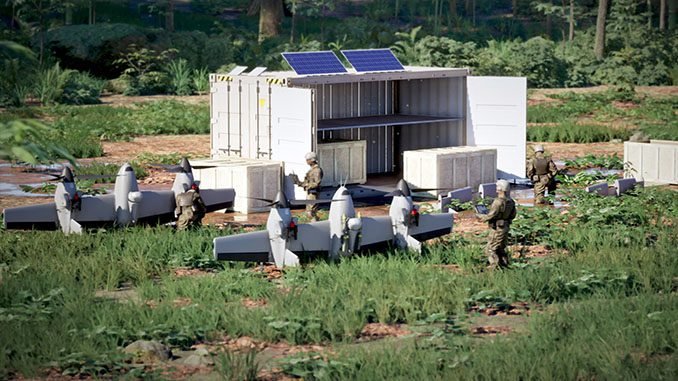
The Nomad 100 Fast Pack combines four vertical take-off and landing uncrewed aircraft with mission-command software, communications, power and sustainment equipment inside a standard 20-foot shipping container. Sikorsky introduced the concept on October 12 at the Association of the US Army’s annual meeting in Washington, DC.
The package is intended to make it easier to deploy and relocate small groups of aircraft from austere locations. The container can be transported to a forward site, opened for operations and moved again after a mission. Sikorsky says the system can operate without a runway from places such as naval vessels, tactical vehicle staging areas and improvised landing zones.

According to the company’s planned configuration, two Nomad 100 aircraft can be made mission-ready in less than 15 minutes. The other two, stored on an upper shelf in the container, could be available within four to six hours. The figures describe the planned setup, not a demonstrated deployment time for a fielded system.
The container is designed as a self-contained package, reducing the need to assemble a larger ground-control footprint at each location. Sikorsky executives said the system is aimed at commanders seeking situational awareness, targeting capability and the ability to operate multiple autonomous assets. The package could be moved by truck or trailer; a promotional video also depicts a Black Hawk helicopter carrying it as a slung load.
Nomad 100 combines vertical lift and hovering with fixed-wing flight. This configuration is intended to let it take-off and land in confined areas while using airplane-style flight once airborne. Sikorsky’s broader Nomad family uses its MATRIX autonomy software. The aircraft is classified as a Group 3 drone, has an 18-foot wingspan, and is intended for operations across land and sea. The company has not publicly specified the aircraft’s payload, range or endurance.
Depending on customer configuration, Sikorsky says the Fast Pack could support intelligence, surveillance, reconnaissance and targeting, light attack and contested-logistics missions. The company has not described a specific customer, operational deployment or order for the containerised package. Its announcement presents the Fast Pack as a deployment concept designed around the Nomad 100, rather than confirmation that armed forces have acquired it.

The distinction is significant. While the Fast Pack announcement describes how the aircraft and support equipment could be transported and set-up, the available reporting says Sikorsky has not stated whether a complete Fast Pack has been built or whether a military service is evaluating or buying one. The promised setup times are therefore company estimates for the planned arrangement, not evidence of an operational unit already in service.
The aircraft itself is further along than the container concept. Sikorsky developed Nomad 100 with funding from the Defence Advanced Research Projects Agency’s Early VTOL Aircraft Demonstration programme. In July, the company said it had completed initial ground and flight testing and was preparing for an intensive flight-test campaign at a government facility. Sikorsky has a contract for three Nomad 100s under EVADE; the company said in July that the first had been delivered to the customer. The US Marine Corps is also buying two aircraft, according to Sikorsky.

The Fast Pack reflects a broader military interest in smaller, mobile autonomous aircraft that can operate from dispersed locations. In the Indo-Pacific, long distances and limited infrastructure make rapid relocation and runway-independent operations attractive, while fixed bases may be vulnerable in a conflict. A compact container could simplify transport and resupply, but its usefulness would depend on communications, maintenance, crew training and the aircraft’s actual performance in demanding conditions.
For now, Sikorsky’s pitch is logistical as much as aerodynamic: package four vertical-take-off drones and their essential support gear together, then move the capability where it is needed. Whether the concept becomes a fielded military system will depend on testing, customer interest and procurement decisions.






