

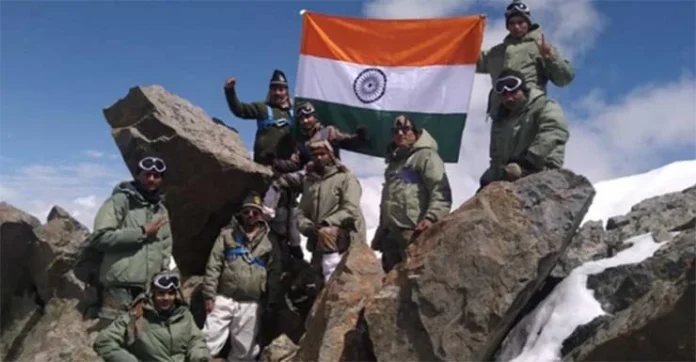
In May 1999, Indian shepherds noticed movement on the icy heights above Kargil. Within days, the Indian Army realised they were not ordinary infiltrators. Pakistani regulars from the Northern Light Infantry had occupied ridgelines across the Line of Control (LoC), disguised as militants.
The exact date of their occupation remains unclear, with signs observed as early as February 1999. It was a command failure to address the void, allowing the enemy to occupy key positions across the LoC. What followed was eleven weeks of high-altitude combat that cost India 527 soldiers and forced the country to fight uphill, quite literally, against an enemy dug in above 16,000 feet.

Kargil was not just a battle. It was a mirror held up to India’s entire security apparatus, revealing something uncomfortable. Yet, it also revealed the bravery and sacrifices of junior officers who turned the tables and did India proud, at the cost of their lives. The nation must never forget them and their families.
Twenty-seven years later, the war deserves study not as history but as a case study in how nations misjudge risk and how they recover from that misjudgement. The lessons remain unfinished business and need to be addressed upfront. Ironically, the official report on the Kargil War remains unpublished, creating more ambiguities than solutions.
The Failure Before the Battle
The most important fact about Kargil is that it should not have surprised anyone. The area had been vacated by Indian troops every winter since the 1971 war, on the reasonable assumption that no army could survive, let alone fight, in such terrain during the peak winter.
This assumption and prediction became a routine. Routine bred complacency. Patrolling declined and vigilance slackened. Pakistan studied this pattern for years and struck precisely when the gap was widest.

When strategy and intelligence fell short, young captains, lieutenants and jawans fought uphill against fortified enemy positions above 16,000 feet. Their incredible heroism and personal sacrifices that turned the tide of the war
The Kargil Review Committee, led by K Subrahmanyam and set-up within days of the war’s end, was blunt about this. It identified intelligence failures, lack of inter-agency coordination, outdated military assumptions and inadequate use of surveillance technology as the main reasons for the intrusion.
This was not a failure of courage. It was a failure of imagination and command responsibility. The deeper lesson was that India had prepared for the war it expected, not the war its adversary was willing to fight. That distinction remains critical.

A military that plans only for known patterns eventually creates opportunities for an adversary willing to break them. The weakness lay in a reactive disposition and complacency in recognising warning signals that led to the crisis.
The intelligence failure ran deeper than a missed warning. The Kargil Review Committee highlighted systemic weaknesses across India’s security architecture, spanning intelligence, border management and defence planning.
Human intelligence in the sector proved inadequate, while signals intelligence produced valuable intercepts that confirmed Pakistan’s involvement only after the intrusion had become evident. Intelligence delivered after events have unfolded may explain a crisis, but it cannot prevent one.
Equally significant was the absence of effective coordination between intelligence agencies and the armed forces. Fragments of information existed across different organisations, yet they were never fused into a coherent operational picture that could prompt timely action.
Pakistan calculated that its nuclear capabilities would freeze Indian options, but India proved that decisive conventional force can succeed under a nuclear overhang – reclaiming territory without escalating into full-scale war
The enduring lesson is straightforward: intelligence is valuable only when it is shared, understood and reaches commanders early enough to shape decisions rather than merely explain failures.
Why Pakistan Chose That Moment
Kargil cannot be understood without its nuclear backdrop. Both nations had tested weapons the previous year. Pakistan’s calculation, as later analysis suggests, rested on the belief that a nuclear overhang would deter India from expanding the conflict, thereby enabling a limited land grab to succeed without a full-scale war.
Subsequent statements by Pakistani leaders, including veiled nuclear threats during the crisis, suggest that Islamabad believed the newly acquired nuclear balance created an opportunity for such an operation.
This was a serious miscalculation, but an instructive one. Pakistan assumed that nuclear capability on both sides would freeze India’s strategic options while leaving tactical space for limited aggression.
India’s response, restrained yet forceful, disproved this theory. Indian forces recaptured peak after peak without crossing the Line of Control or escalating to full war. This restraint was not a weakness.
It demonstrated that conventional resolve can operate confidently even under a nuclear shadow, provided political and military leadership remain aligned. It also established a difficult but important principle for India’s future: nuclear deterrence may limit the space for escalation, but it does not remove the need for credible conventional options below that threshold. Deterrence fails when an adversary believes that nuclear risk has made conventional response impossible.
The Cost of Fighting Uphill
Militarily, Kargil exposed a harsher truth. India possessed superior artillery, air power and manpower, yet had to fight from a severe positional disadvantage because the enemy held the high ground first.
Battles like Tololing and Tiger Hill became infantry assaults on fortified bunkers at extreme altitude, where every metre gained cost disproportionate casualties. This is what happens when an army loses the initiative before the first shot is fired. No amount of firepower fully compensates for ceding terrain in advance.
While the Kargil Review Committee laid out crucial recommendations – from advanced surveillance to inter-agency integration – bureaucratic inertia delayed key reforms, like the Chief of Defence Staff post, for nearly two decades
The Indian Air Force’s induction into the battle through Operation Safed Sagar marked the first significant use of air power in the Kargil sector, but it also revealed gaps in high-altitude targeting and inter-service coordination that needed urgent correction.
War, when it finally arrives, exposes peacetime shortcuts instantly.
The Men Who Closed the Gap
No policy failure tells the full story of Kargil without accounting for the men who paid the price. Captain Vikram Batra led his company up Point 5140 under direct fire and later gave his life, pulling a wounded officer to safety on Tiger Hill.
Rifleman Sanjay Kumar charged a bunker alone after his weapon jammed, taking bullets so his section could advance. Grenadier Yogendra Singh Yadav, badly wounded early in the climb up Tiger Hill, kept moving and helped clear three enemy positions before collapsing.
These were not senior commanders directing the battle from a distance. They were young men, many barely out of their twenties, leading sections and platoons up slopes that offered no cover and no room for error. Junior leadership carried this war more than any single strategy.
When intelligence failed, and terrain favoured the enemy, it was the courage of captains, lieutenants and jawans that closed the gap between a flawed plan and a hard-won victory.
Their sacrifice deserves to be remembered on its own terms, not merely as a footnote to institutional failure. These are only a few names; there are scores of unsung heroes who did the nation proud.
What Changed and What Did Not
To its credit, India did not simply mourn Kargil. It restructured. The Kargil Review Committee advocated greater reliance on satellites, surveillance and advanced technology in border management, alongside a long-term, policy-based approach to national security rather than reactive responses.
Modern technological successes, like rapid precision strikes, cannot erase the core lessons of Kargil. True national readiness requires continuous vigilance across the full spectrum of warfare rather than relying on recent triumphs
This thinking eventually shaped the creation of dedicated surveillance systems, improved border infrastructure, and a more assertive doctrine on forward positioning in sensitive sectors.
Institutionally, the most significant outcome took nearly two decades to materialise. The recommendation for a Chief of Defence Staff, first proposed in the Group of Ministers report following the Kargil Review Committee, was implemented only in December 2019.
Ironically, the authority structure remained sub-optimal for national-level transformation. Twenty years is too long a gap between diagnosis and treatment for a problem this serious.
It reflects a recurring pattern in Indian security reform: a crisis produces excellent analysis, but bureaucratic inertia slows implementation until either political will or another crisis forces the issue.
Some recommendations remain incomplete even today and continue to evolve. This reflects a broader weakness in India’s approach to national security: reforms often gain momentum after a crisis but lose urgency once the immediate danger passes. Lasting preparedness demands a different mindset.
Surveillance must be continuous, intelligence must be fused across agencies, commanders must receive timely and actionable information and institutions must be held accountable for closing known vulnerabilities.
The next conflict will favour the side that has acted on yesterday’s lessons before the first warning signs appear, rather than the side forced to relearn them under fire.
Operation Sindoor and the Danger of Comparison
More recently, in May 2025, India launched Operation Sindoor in response to the Pahalgam terror attack, striking terrorist infrastructure deep inside Pakistan within a matter of minutes and concluding hostilities within days.
India must build readiness for the full spectrum of contingencies, from high-altitude warfare to full-scale conflict to short-duration precision campaigns, rather than assuming that recent success has settled questions first raised by Kargil twenty-seven years ago
The operation demonstrated real gains in precision strike capability, integrated air defence and restrained yet decisive signalling to an adversary.
It is tempting, in the glow of that success, to view Kargil as a closed chapter belonging to a less capable India. That temptation must be resisted. The two events are not comparable to the conflict they represent.
Kargil was a prolonged infantry battle for physical terrain, fought over weeks at extreme altitude against an enemy already dug in.
Op Sindoor was a short, technology-led punitive strike against known targets, concluded before a sustained ground response was required. Kargil was a conflict, whereas Op Sindoor was at best a stand-off precision strike skirmish.
Success in one form of conflict says nothing about readiness for another. India’s adversaries adapt after every engagement, and the next contingency, whether short and precise or prolonged and attritional, may not resemble either Kargil or Sindoor.
The real lesson is that India must build readiness for the full spectrum of contingencies, from high-altitude warfare to full-scale conflict to short-duration precision campaigns, rather than assuming that recent success has settled questions first raised by Kargil twenty-seven years ago.
A War Worth Learning
The strategic value of Kargil lies not in proving that India can recover from surprise, but in reminding policymakers that surprise itself must become unacceptable.
Future conflicts may unfold in the Himalayas, cyberspace, space or through autonomous systems, yet they will still reward the side that anticipates change before its adversary does. Kargil remains relevant because it teaches that preparedness is ultimately a habit of mind rather than a function of technology.
The writer, a PVSM, AVSM, VSM has had an illustrious career spanning nearly four decades. A distinguished Armoured Corps officer, he has served in various prestigious staff and command appointments including Commander Independent Armoured Brigade, ADG PP, GOC Armoured Division and GOC Strike 1. The officer retired as DG Mechanised Forces in December 2017 during which he was the architect to initiate process for reintroduction of Light Tank and Chairman on the study on C5ISR for Indian Army. Subsequently he was Consultant MoD/OFB from 2018 to 2020. He is also a reputed defence analyst, a motivational speaker and prolific writer on matters of military, defence technology and national security. The views expressed are personal and do not necessarily carry the views of Raksha Anirveda





