


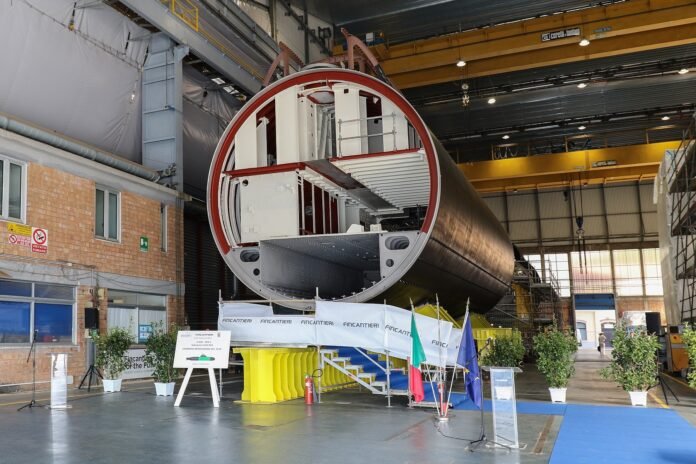
Rome/La Spezia. Fincantieri held the keel-laying ceremony for the Italian Navy’s second U212NFS (Near Future Submarine) at its Muggiano shipyard on October 1, with delivery scheduled for 2030. The milestone moves a four-boat programme into its next phase and shows Italy is building up its undersea capability.
Bigger and More Capable than its Predecessor
The U212NFS is a diesel-electric boat that builds on the German-designed Type 212A. OCCAR, the European body managing the programme says the new class has an extended pressure hull, updated combat and platform control systems and features tailored for warm-water operations. Fincantieri’s specifications list a length of 58.35 metres, a pressure-hull diametre of 7 metres, and a displacement of 1,550 tonnes surfaced and 1,750 tonnes submerged. That is slightly under the 1,800 tons in some headlines.

Italian-developed innovations include a lithium-ion propulsion battery and a new combat management system. Fincantieri says these will improve stealth, endurance, efficiency and cyber resilience. The boats will also carry air-independent propulsion, which lets a submarine stay submerged far longer than conventional diesel-electric designs.
A Steady Production Rhythm
The first boat’s keel was laid on February 27, 2026, with delivery planned for 2029. The second keel followed about eight months later. First steel for the fourth submarine was cut in December 2025, so several hulls are advancing at once.
A July contract amendment sped up the schedule. The €317 million deal brings forward delivery of the fourth boat from 2034 to 2032, so the Navy should receive one new submarine a year from 2029. It also covers torpedo countermeasure systems from Fincantieri subsidiary WASS, plus rescue interfaces and the Navy’s new SAVER system.
Reported delivery dates are not entirely consistent. One outlet cites 2027 and 2029 for the first two boats, but Fincantieri’s own releases put the first at 2029 and the second at 2030. The company’s schedule is the more recent and authoritative.

Replacing a Veteran Fleet
The new boats will replace the four Nazario Sauro-class submarines, which entered service between the late 1980s and mid-1990s. Planned missions include anti-piracy patrols, securing energy supply routes, counter-terrorism and protecting offshore and subsea infrastructure. That last role matters in Europe, where undersea cables and pipelines have become a security concern.
Fincantieri has not published detailed weapons loadouts. Like other modern conventional submarines, it is expected to be multi-mission, covering surveillance and intelligence gathering as well as anti-ship and anti-submarine roles.

Industrial Stakes
The programme matters to Rome as much for industry as for defence. Fincantieri is design authority and prime contractor, with Italian suppliers contributing new onboard technologies. Muggiano has more than a century of activity and over one hundred submarines built. Greater national content reduces reliance on foreign suppliers and keeps specialist skills in the country.
The costs are substantial. The first two boats were contracted at €1.35 billion including logistics support, and the fourth unit is valued at about €500 million.
Looking Ahead
Italy is already planning successors, including a U212 NFS EVO variant and a New Generation Submarine, along with a large autonomous underwater vehicle to support the fleet. If the delivery schedule holds, the Italian Navy will have four modern submarines by 2032 and a much stronger presence in the Mediterranean and beyond.
For now, the second hull is on the slipway. The next test is whether Muggiano can keep-up this pace across four boats and deliver on the programme’s promises.






