


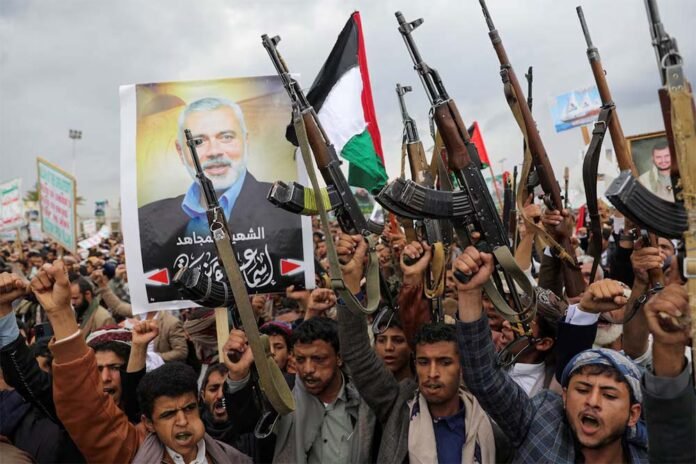
Iran’s ‘Axis of Resistance’ was designed to keep war away from Iranian territory. The irony of the recent conflict is that when Iran came under direct attack, the network did not respond as a single military formation. Hezbollah, the Houthis, Iraqi militias and Hamas each calculated their response through the prism of their own interests, constraints and vulnerabilities. The lesson is significant: Iran’s regional network remains an important instrument of power, but it is increasingly a network of partners with divergent priorities rather than a command structure that Tehran can activate at will.
I encountered an early indication of this complexity while commanding 15 Punjab in Lebanon in 2007 as part of the UN peacekeeping force. I spent considerable time with Lebanese Armed Forces officers trying to understand their institution and, at times, asking the blunt question: why the Lebanese Army was not stronger than Hezbollah?

One explanation I encountered was rooted in Iran’s strategy since the 1980s. After the Islamic Revolution, Iran began cultivating armed partners abroad and deployed the Islamic Revolutionary Guard Corps to train Hezbollah in Lebanon. The underlying logic was straightforward: a relatively weak conventional military could compensate by developing forward defences through allied armed groups, projecting Iranian power while keeping the battlefield away from Iran.
The Houthis present a different case. From lightly armed insurgents, the Houthis developed missiles, drones and anti-ship capabilities that have enabled them to threaten shipping around the Red Sea and Bab-al-Mandeb. Their resilience has made them one of the most consequential non-state armed actors in the region
For decades, this strategy worked remarkably well. Hezbollah became Iran’s most formidable regional partner, while Iranian support helped build a network stretching through Lebanon, Syria, Iraq, Yemen and, in a different ideological category, the Palestinian movement Hamas. The network provided Tehran with strategic depth and multiple pressure points against Israel and the United States.
But the events since October 7, 2023, have exposed the limits of the model. The Hamas attack triggered a regional cascade that eventually brought direct war to Iran itself. Hezbollah has been severely weakened, the Assad regime in Syria has disappeared, and Iran’s land corridor through Syria to Lebanon has been disrupted. The Iraqi government is also pressing armed groups to bring weapons under state control, although powerful militias continue to resist full disarmament.
Hezbollah illustrates the problem most clearly. Before the recent wars, it possessed an arsenal estimated at more than 100,000 rockets and missiles and had developed a sophisticated military organisation. Its fighters also acquired extensive battlefield experience in Syria while helping preserve Bashar al-Assad’s regime. Hassan Nasrallah, Hezbollah’s long-standing leader, projected an image of considerable autonomy even while remaining deeply connected to Tehran.

The Houthis share Tehran’s hostility towards Israel, the United States and Saudi Arabia, but shared enemies do not eliminate independent interests. Recent reporting indicates growing coordination between Houthi and Iraqi armed groups, suggesting that Iran’s network may be evolving horizontally as well as vertically
That autonomy has now been sharply reduced. Nasrallah was killed, numerous Hezbollah commanders have been eliminated, and the organisation faces growing domestic pressure over its weapons. Lebanon’s government has sought to establish greater state control over arms, while Hezbollah’s military capacity has been significantly degraded. The organisation remains capable of violence, but its political and military circumstances are fundamentally different from those before 2023.
Iran is unlikely to abandon Hezbollah. Its value to Tehran is no longer simply what it can do militarily. Hezbollah’s survival itself preserves an Iranian foothold in the Levant and prevents the complete dismantling of a decades-old strategic investment. Iran may therefore seek to preserve the organisation even as it adapts to a much more constrained environment.

The Houthis present a different case. The movement began as a local insurgency in northern Yemen in the 1990s. Iranian financial, military and technological assistance subsequently transformed its capabilities. From lightly armed insurgents, the Houthis developed missiles, drones and anti-ship capabilities that have enabled them to threaten shipping around the Red Sea and Bab-al-Mandeb. Their resilience has made them one of the most consequential non-state armed actors in the region.
Hamas has been an awkward fit within the predominantly Shia network. Its relationship with Tehran was also strained by Iran’s support for Assad during the Syrian civil war. Yet the relationship survived because both sides regarded Israel as a common adversary
Yet the Houthis are not simply an Iranian instrument. Their strategic interests are rooted in Yemen, and their participation in regional conflicts has fluctuated according to their own calculations. The recent war has again demonstrated this autonomy. Even when they act in concert with Tehran, their objectives cannot automatically be assumed to be identical to Iran’s. Their growing domestic weapons production, independent political relationships and outreach beyond Iran’s immediate network further reinforce this distinction.
This matters because Iran’s ability to exercise influence does not necessarily translate into command. The Houthis share Tehran’s hostility towards Israel, the United States and Saudi Arabia, but shared enemies do not eliminate independent interests. Recent reporting also indicates growing coordination between Houthi and Iraqi armed groups, suggesting that Iran’s network may be evolving horizontally as well as vertically.
Iraq may become the most consequential arena for this evolution. Many of the country’s Shia militias emerged or expanded following the 2003 US-led invasion, with Iranian support becoming an important source of weapons, money and military expertise. Some were subsequently incorporated into the Popular Mobilisation Forces and became embedded within the Iraqi state. Baghdad’s current attempt to bring their weapons fully under state control therefore confronts not merely an armed group, but a deeply institutionalised political and security constituency. Powerful factions have resisted disarmament, making the September deadline for weapons control difficult to implement.
The future Middle East may be shaped not by the disappearance of Iran’s Axis of Resistance, but by its mutation. Its components may survive, yet diverge. For policymakers in New Delhi, that means reading the region through the behaviour and incentives of individual actors rather than treating “Iran’s proxies” as a single strategic entity
Hamas was always an awkward fit within the predominantly Shia network. Its Sunni Islamist identity and Palestinian nationalism gave it an independent political logic. Its relationship with Tehran was also strained by Iran’s support for Assad during the Syrian civil war. Yet the relationship survived because both sides regarded Israel as a common adversary. Even now, Hamas’s internal calculations include competing possibilities of closer alignment with Iran or greater engagement with countries such as Turkey.
The strategic consequence is not that Iran’s Axis of Resistance has collapsed. Rather, it is becoming more decentralised. Iran has lost important assets and spent enormous resources sustaining its regional posture. Its conventional deterrence has also been tested directly. But the surviving groups retain local constituencies, weapons, organisational structures and political interests. These characteristics make them harder to control, but also harder to eliminate.
For India, the distinction is important. A weaker Hezbollah does not necessarily mean a weaker Iranian influence; a more autonomous Houthi movement does not necessarily mean less regional instability. The strategic environment may instead become more fragmented, with Iran acting less as the commander of a unified axis and more as the principal node of a network whose members increasingly pursue their own interests.
The future Middle East may therefore be shaped not by the disappearance of Iran’s Axis of Resistance, but by its mutation. Its components may survive, yet diverge. For policymakers in New Delhi, that means reading the region through the behaviour and incentives of individual actors rather than treating “Iran’s proxies” as a single strategic entity. The axis may endure, but increasingly, it may no longer move as one.

The writer commanded 15 Punjab in Lebanon under United Nations Flag, commanded 27 Sector as DIG in Churachandpur and was Brigadier Operational Logistics in HQ Western Command. He is currently an analyst on geopolitics, international and defence affairs. The views expressed are personal and do not necessarily carry the views of Raksha Anirveda





