


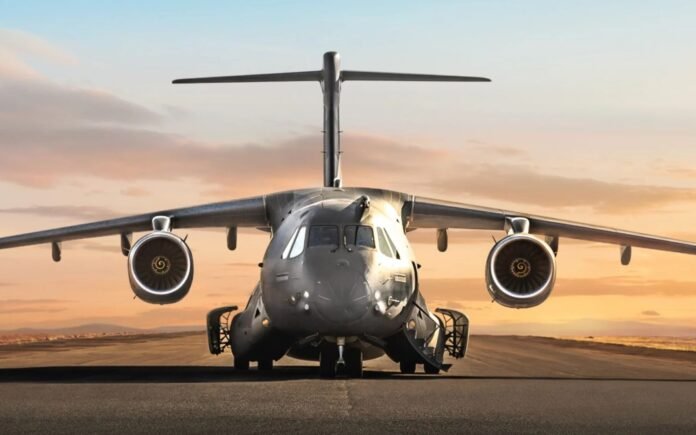
the strategic realities of two-front border management and rapid out-of-theatre deployment have forced the Indian Air Force (IAF) to radically accelerate its heavy logistical lift capabilities. Facing an aging inventory of Soviet-era Antonov An-32s and payload limitations within its medium-lift segments, New Delhi has advanced a high-stakes procurement programme for an initial batch of 40 to 80 Medium Transport Aircraft (MTA).
Valued at several billion dollars, the MTA tender has evolved beyond a standard defence contract into a complex chess game of industrial diplomacy, pitting three global aerospace heavyweights – Airbus Defence and Space, Embraer, and Lockheed Martin – against one another.

The European Manoeuvre: Air Chief Marshal’s Flight in the A400M
The competition entered a highly visible operational phase during an extensive, high-level military visit to France by Air Chief Marshal AP Singh, Chief of the Air Staff. Amid deep-running bilateral discussions aimed at strengthening Indo-French defence ties and enhancing aerospace cooperation, the IAF Chief conducted an on-site evaluation of the Airbus A400M Atlas at an operational French Air Force base.
The visit was far more than symbolic protocol. Air Chief Marshal AP Singh co-piloted the massive transport aircraft during a specialised test flight, gaining firsthand experience with its tactical performance, low-altitude handling qualities, and multi-role versatility. The A400M Atlas sits at the upper limit of the IAF’s MTA payload requirement, utilising a powerful quad-turboprop design capable of hauling an impressive 37 metric tons of cargo.
Airbus positions the Atlas as a unique strategic-tactical hybrid that can land on short, unpaved, and soft-soil runways in high-altitude zones like Ladakh, while possessing the range and volume to transport heavy armoured vehicles, helicopters, or humanitarian payloads directly from industrial hubs to the frontline.
Valued at several billion dollars, the MTA tender has evolved beyond a standard defence contract into a complex chess game of industrial diplomacy, pitting three global aerospace heavyweights – Airbus Defence and Space, Embraer, and Lockheed Martin – against one another
During his European tour, the IAF chief also held extensive strategy sessions with his French military counterparts, focusing on shared logistical challenges, future combat airspace integration, and the maintenance architecture required to keep large transport fleets operational under severe weather conditions.

The Brazilian Confidence: Embraer Anticipates the Next Stage
Simultaneously, Brazilian aerospace pioneer Embraer is expressing high confidence that the Indian government will formalise and push ahead with the military cargo jet tender in the coming months. Speaking transparently about the programme’s timeline, Bosco da Costa Junior, Chief Executive of Embraer Defense & Security, confirmed that the company expects India to issue a formal Request for Proposal (RFP) soon, marking the next decisive step in the acquisition process.
Embraer is aggressively pitching its C-390 Millennium, a highly advanced tactical transport aircraft driven by a modern dual-turbofan engine setup. Boasting a robust maximum payload capacity of 26 metric tons, the C-390 is specifically engineered to deliver rapid tactical jet speed alongside maximum operational availability and lower life-cycle costs compared to older turboprop designs. The aircraft’s high transit speed allows it to complete missions faster, optimising crew hours and aircraft utilisation during intense humanitarian or combat surges.

To firmly root its bid in India’s “Make in India” defence localisation framework, Embraer signed a comprehensive Memorandum of Understanding (MoU) with India’s Mahindra Defence Systems. This joint venture guarantees that if the C-390 Millennium is selected, the companies will establish a complete domestic final assembly line (FAL) within India. This facility would not only handle local manufacturing but would also position the Indian plant as a global regional MRO hub for future C-390 export clients throughout Asia and the Middle East.
The American Benchmark: Lockheed Martin’s Strong Lineage
While Airbus pushes its heavyweight turboprop and Embraer champions its rapid tactical jet, the veteran competitor in the arena remains American defence giant Lockheed Martin with its legendary C-130J Super Hercules. The C-130J represents the baseline standard against which all modern tactical airlifters are measured, featuring a reliable quad-turboprop legacy and a maximum payload capacity of approximately 20 metric tons. This proven combat veteran holds a formidable operational synergy advantage in this competition, as the Indian Air Force already operates a highly active, specialised fleet of 12 C-130J units.
Brazilian aerospace pioneer Embraer is expressing high confidence that the Indian government will formalise and push ahead with the military cargo jet tender in the coming months. Speaking transparently about the programme’s timeline, Bosco da Costa Junior, Chief Executive of Embraer Defense & Security, confirmed that the company expects India to issue a formal Request for Proposal (RFP) soon, marking the next decisive step in the acquisition process
These existing planes are operated by the IAF’s 77 “Veiled Vipers” Squadron out of Hindon Air Force Station, and have proved utterly indispensable during critical border standoffs, landing on rugged, unpaved Advanced Landing Grounds (ALGs) like Daulat Beg Oldie at an altitude of 16,614 feet. This pre-existing fleet dynamics means that pilot training protocols and logistical supply lines are already fully mature within the IAF system.
Furthermore, Lockheed Martin has spent more than a decade cultivating an expansive industrial footprint in India through its joint venture with Tata Advanced Systems Limited, known as Tata Lockheed Martin Aerostructures Limited (TLMAL) in Hyderabad. This facility serves as the sole global supplier for C-130J empennages, meaning every single tail assembly for this aircraft worldwide is manufactured in India. By leveraging this existing, highly trained domestic ecosystem, Lockheed Martin can pitch a low-risk, highly optimised path to total domestic manufacturing, reminding the Indian defence establishment that its supply chains, pilot training infrastructure, and maintenance protocols are already fully operational.
Balancing Power, Payload, and Sovereign Technology Transfer
The final decision by the Ministry of Defence will require balancing competing operational philosophies and long-term geopolitical strategies. The technical specifications of the three contenders reveal distinct operational trade-offs that the IAF must navigate:
- Airbus A400M: Offers unparalleled heavy lift and volume, bridging the gap between tactical transports and strategic heavy lifters like the C-17 Globemaster III, but comes with a higher acquisition cost.
- Embraer C-390: Brings modern, high-speed turbofan efficiency and an agile, digitally controlled fly-by-wire cockpit, backed by a robust assembly partnership with Mahindra.
- Lockheed Martin C-130J: Delivers maximum combat reliability, unmatched high-altitude performance history in the Himalayas, and frictionless integration into an existing IAF infrastructure.
The veteran competitor in the arena remains American defence giant Lockheed Martin with its legendary C-130J Super Hercules. The C-130J represents the baseline standard against which all modern tactical airlifters are measured, featuring a reliable quad-turboprop legacy and a maximum payload capacity of approximately 20 metric tons. This proven combat veteran holds a formidable operational synergy advantage in this competition, as the Indian Air Force already operates a highly active, specialised fleet of 12 C-130J units
Beyond payload numbers and engine types, the absolute deciding factor in the MTA tender will be the depth of technology transfer. India has made it clear that it will no longer accept simple fly-away purchases or basic kit-assembly arrangements. Whichever aerospace giant secures the contract must be prepared to share proprietary manufacturing techniques, source components from Indian MSMEs, and allow domestic engineers full access to the aircraft’s software codes.
As global tensions rise and supply chain vulnerabilities deepen, the MTA acquisition programme will fundamentally reshape India’s aviation architecture, ensuring the nation can rapidly project power across its borders and deep into the international skies.
Ultimately, while all three global contenders bring sophisticated and latest capabilities to the table, Embraer’s C-390 Millennium emerges as the most balanced and forward-looking choice for India’s long-term defence architecture.
Both Airbus and Lockheed Martin remain exceptionally strong contenders with deep roots in the Indian market; Airbus boasts an active, immediate inventory alongside a formidable manufacturing partnership with TATA, while Lockheed Martin shares a legendary operational lineage with the IAF. Given that the IAF’s current C-130J fleets will eventually face retirement, it makes better strategic sense to replace them with the same company’s modernised aircraft to maintain logistical continuity.
However, the most optimised path forward for New Delhi involves an uneven split: awarding the lion’s share of the contract to Embraer to anchor its “Make in India” defence ecosystem, while dividing the remaining portion between Airbus and Lockheed Martin to retain crucial strategic partnerships and bridge immediate inventory gaps.

-The writer is a New Delhi-based senior commentator on international and strategic affairs, environmental issues, an interfaith practitioner, and a media consultant. The views expressed are personal and do not necessarily carry the views of Raksha Anirveda





