


On Thursday, 2nd July, India and Japan officially launched their very first joint defence project together. Both countries will now work side by side to build a special naval technology called the UNICORN mast. Prime Minister Narendra Modi called this a new chapter in the defence friendship between the two nations. He said that in today’s complex world, trust is the most vital strategic asset any two nations can share.
The original agreement was signed in Tokyo way back in November 2024. It was signed by India’s Ambassador to Japan, Sibi George, and Ishikawa Takeshi of Japan’s technology agency, ATLA. This deal was officially confirmed during the 16th India-Japan Annual Summit in New Delhi, where Japanese Prime Minister Sanae Takaichi was also present. With this, India has become the second Asian country, after the Philippines, to receive this advanced Japanese technology.

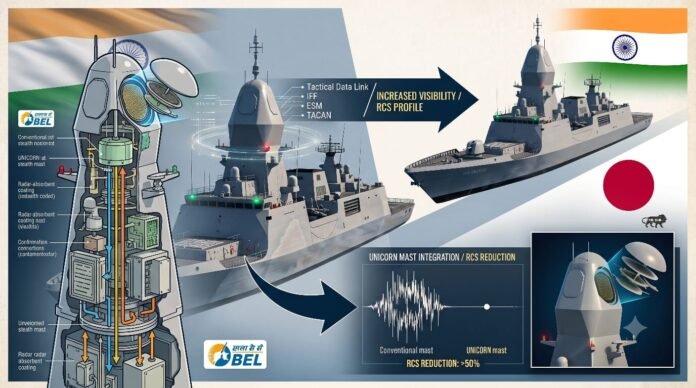
So, what exactly is this UNICORN mast? UNICORN stands for Unified Complex Radio Antenna. It is also known as NORA-50. On a warship, the mast is the tall structure that holds all the radars, antennas, and communication equipment. Normally, a ship has many antennas fixed at different spots. UNICORN is clever because it brings all these important systems together into one single, neat radar mast.
UNICORN stands for Unified Complex Radio Antenna. It is also known as NORA-50. On a warship, the mast is the tall structure that holds all the radars, antennas, and communication equipment. Normally, a ship has many antennas fixed at different spots. UNICORN is clever because it brings all these important systems together into one single, neat radar mast
Let us understand what all sits inside this single system. First is the Tactical Data Link, which shares live battle information with other friendly ships and aircraft. Then there is TACAN, short for Tactical Air Navigation System, which helps aircraft know their exact position and find their way. It also holds the communication systems for sending and receiving voice and data. Next is IFF, or Identification Friend or Foe, which quickly tells the crew whether an approaching aircraft or ship is a friend or an enemy. Finally, there is ESM, or Electronic Support Measures, which quietly detects and listens to enemy radar and communication signals. All of this is packed inside one protective cover called a radome, a special dome that shields the antennas from rain, wind, and heat while still letting the signals pass through freely.
Now comes the most interesting part, which is stealth. In older warships, every single antenna sticking out from the ship acts like a small mirror. When enemy radar signals hit these many antennas, they bounce back strongly. This makes the ship appear bigger and clearer on the enemy’s radar screen, which is dangerous in war. The size a ship appears on enemy radar is called its Radar Cross Section, or RCS.
UNICORN solves this problem beautifully. By hiding all the antennas inside one smooth dome, it greatly reduces the signals that bounce back. As a result, UNICORN can reduce the Radar Cross Section by a substantial margin, some estimates say close to half, compared to older masts. In simple words, the warship almost becomes a ghost on enemy radar, much harder to spot and much safer during battle.

The benefits do not stop at stealth. Because all the antennas are placed together in one perfect location, the ship can pick up enemy radio and radar signals from a much greater distance. This gives the crew early warning and more time to react. The single design also frees up a lot of extra space on the deck. And repairs become far easier, because technicians now work on just one combined system instead of running around the whole ship to fix many separate antennas.
UNICORN can reduce the Radar Cross Section by a substantial margin, some estimates say close to half, compared to older masts. In simple words, the warship almost becomes a ghost on enemy radar, much harder to spot and much safer during battle
Here is a fact that adds real weight to this deal. This technology is not just on paper. It is already proven and running on Japan’s modern Mogami-class stealth frigates, which are considered among the sneakiest warships in the world. For India, the biggest good news is that this UNICORN mast will be built right here at home by Bharat Electronics Limited, our own defence company, under the Make in India programme. This means Indian engineers will learn cutting-edge skills, and our factories will gain valuable technology.

There is a strategic angle too. In recent years, rival navies, especially China, have been carefully recording the unique signal patterns of each Indian ship to track them. By hiding everything inside one dome, UNICORN wipes out these signatures, making it very hard for anyone to identify or follow our warships.
This one project has opened the door to a much bigger friendship. Both leaders announced that the next India-Japan “2+2” meeting of foreign and defence ministers will be held by the end of 2026. Their navies will hold more joint exercises in the Indian Ocean, and Japan has also promised to support India’s full membership in the International Energy Agency.
In short, the UNICORN mast is far more than just an antenna. It is a proud symbol of growing trust, shared technology, and a stronger, stealthier Indian Navy sailing confidently into the future ahead.

-The writer is an award-winning science communicator and a Defence, Aerospace & Geopolitical Analyst. He is the Managing Director of ADD Engineering Components India Pvt. Ltd., a subsidiary of ADD Engineering GmbH, Germany. You can reach him at: girishlinganna@gmail.com. The views expressed are personal and do not necessarily carry the views of Raksha Anirveda





