


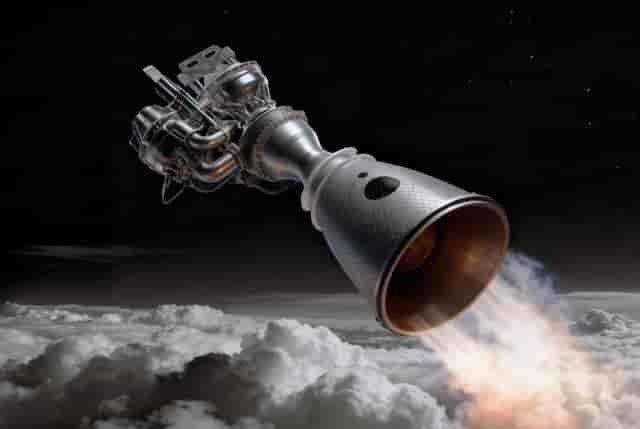
Bengaluru/Anantapur. On 21.5 acres of scrubland near Anantapur in Andhra Pradesh stands India’s first privately owned test stand rated for 200 tonnes of thrust. It was built for an engine still under assembly in a Bengaluru workshop, where the country’s largest industrial metal 3D printer was installed last winter.
The company behind it, Astrobase, was founded in 2024 and is chasing what propulsion engineers call the “Everest” of rocket engine cycles: full-flow staged combustion. Unlike the workhorse gas-generator cycle used by SpaceX’s Merlin and ISRO’s Vikas engines, which burns a little propellant to spin turbopumps and dumps the exhaust overboard, full-flow designs use two separate pre-burners – one oxygen-rich, one fuel-rich – so that essentially all the propellant is converted to hot gas and driven through turbines before combustion, delivering higher efficiency, cooler-running turbines and the elimination of a failure-prone seal between fuel and oxidiser systems.

Only SpaceX’s Raptor engine has completed the cycle and flown, first firing in 2019; as of this year, just seven full-flow engines have ever run on a test stand anywhere, including a Soviet attempt in the 1960s that was abandoned after persistent combustion instability.
Astrobase wants to build an 800-kilonewton version of this engine, cluster seven of them beneath a partially reusable rocket, and reach orbit by 2029. That would mean accomplishing something India’s own space agency, ISRO, has never attempted.
The company pairs unusual founders: Neeraj Khandelwal, co-founder of the crypto exchange CoinDCX, provides capital and risk appetite, while technical co-founder Devakumar Thammisetty brings over a decade of ISRO cryogenic propulsion experience along with a bench of senior former ISRO engineers.
Astrobase has raised roughly $10 million in seed funding led by BanyanCo and says it has invested more than ₹100 crore in propulsion and manufacturing infrastructure – a fraction of what SpaceX, Blue Origin, and even ISRO’s own next-generation launcher programme (budgeted around ₹8,240 crore) have spent chasing comparable or simpler engines.

On the technical record, Astrobase says it hot-fired a sub-scale version of its engine successfully in September 2025 and ran its roughly five-megawatt turbopumps this January with results it describes as beating predictions.
In June, the government’s IN-SPACe body selected Astrobase as one of three inaugural recipients of its ₹500-crore Technology Adoption Fund, from 43 applicants – notably backing Astrobase’s own engine design rather than transferring any existing ISRO blueprint.

Like SpaceX, Blue Origin and China’s LandSpace, Astrobase has chosen methane-oxygen propellant, prized for burning cleaner than kerosene and enabling rapid reuse, a combination widely seen as the recipe behind the collapse in launch costs achieved by SpaceX’s Falcon 9.
Within India, Astrobase trails rivals Skyroot Aerospace and Agnikul Cosmos, both of which have already flown rockets, albeit on conventional, simpler engine cycles. Neither is attempting full-flow staged combustion.
Independent technical scrutiny of Astrobase’s claims remains scarce, and skeptics point to the years-long, resource-intensive struggles SpaceX, Blue Origin and Rocket Lab faced developing far better-funded engines, as well as the Soviet RD-270’s failure at a similar development stage. Astrobase itself has called the effort “the hardest rocket engine cycle ever built.”
The company’s fate likely hinges on its first full-scale, fully integrated hot fire, expected this year, followed by a hop-test demonstrator in 2027 ahead of the planned 2029 orbital debut.






