


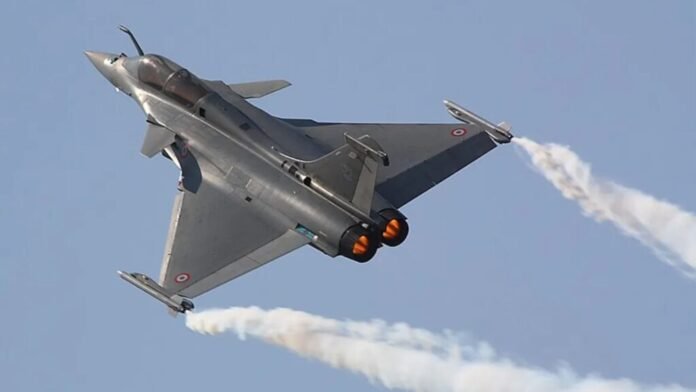
In the space of just a few days in May 2025, Operation Sindoor reshaped several assumptions about South Asian air power. Launched in response to the Pahalgam attack of April 22, which resulted in the deaths of 22 people, India’s campaign marked the deepest conventional strikes carried out inside Pakistani territory since 1971, according to the Observer Research Foundation (ORF).
More importantly, it showed that New Delhi was no longer thinking in terms of symbolic retaliation alone. Op Sindoor reflected a broader doctrinal shift towards multi-domain coercion, long-range precision strike and escalation control.

At the centre of this evolution stood the Rafale–SCALP pairing. The operation did not unfold flawlessly. Indian Chief of Defence Staff, General Anil Chauhan later acknowledged the loss of at least one aircraft, and admitted adaptations had to be made during the campaign.
Reuters reported that Indian tactics were rapidly modified after “suffering losses in the air on the first day of the campaign”, allowing the Indian Air Force to continue stand-off strikes against deeper targets.
Op Sindoor mattered because it validated this combat architecture built around survivable platforms, long-range weapons and rapid adaptation under contested conditions. The Rafale emerged from this experience with its reputation strengthened in India.
Indian Air Force Vice Chief Air Marshal Nagesh Kapoor described the aircraft as “definitely the hero” of Op Sindoor, speaking in February 2026 ahead of the Vayu Shakti firepower demonstration. Indian media quickly linked this operational feedback to new procurement momentum.

Despite early tactical losses and a heavily contested environment, the Rafale proved to be the cornerstone of Operation Sindoor. The operation highlighted the necessity of survivable platforms, long-range stand-off capabilities and fast OODA-loop adaptation
In February 2026, the Indian Defence Acquisition Council approved the Acceptance of Necessity for the MRFA programme centred on additional Rafales, while reports also pointed towards expanded purchases of SCALP and Meteor missiles.
A Doctrine Built Around Stand-off Coercion
For years, Indian conventional doctrine remained constrained by the risk of nuclear escalation with Pakistan. Op Sindoor suggests New Delhi increasingly believes deep precision strikes can create political and military pressure without automatically crossing that threshold. That logic explains the renewed importance of stand-off systems.

According to former Indian Air Marshal Anil Khosla, the Rafale multiplied India’s “decision-making” options because it allowed strikes without having to “cross the lines that presently demarcate the border with Pakistan or China”. The value of the Rafale therefore lies not simply in air superiority, but in its ability to operate as part of a broader deep-strike ecosystem integrating SCALP, Meteor, electronic warfare and networked targeting.
Long before Op Sindoor, the French Air and Space Force had accumulated experience with SCALP in Libya, the Levant and anti-ISIS operations. Ukraine later reinforced the missile’s reputation, with SCALP-EG strikes repeatedly demonstrating the ability to hit hardened Russian targets at long range. So much so that Kyiv has just obtained authorisation from Paris to manufacture these missiles under licence, alongside other French weapons deemed crucial against the Russian army.
This operational pedigree matters in India because Op Sindoor also exposed the realities of contested air warfare. The lesson drawn in New Delhi is that emphasis has shifted towards survivability, sensor-shooter integration, deep precision strike and the ability to adapt rapidly in an environment saturated with drones, cyber warfare and information operations.
Beyond combat effectiveness, the partnership with France strengthens India’s industrial sovereignty. Agreements with Dassault Aviation and MBDA pave the way for local assembly of 94 out of 114 proposed Rafale jets, turning “Make in India” into a operational reality
Indian official discourse increasingly reflects this shift. The Press Information Bureau described Op Sindoor as a demonstration of “tri-service” jointness and “multi-domain warfare”; General Chauhan has since urged a move beyond Multi-Domain Operations towards “All Realm All Domain Operations”; and in May 2026 Army Chief General Upendra Dwivedi cast Op Sindoor as continuing preparation for the “next generation of warfare”. In practical terms, this places the Rafale–SCALP pairing at the heart of India’s future deterrence posture.
A Growing Industrial Partnership
Indeed, what makes the Franco-Indian relationship particularly significant is that it no longer revolves around simple off-the-shelf procurement. The Rafale’s future in India is increasingly tied to Make in India ambitions and industrial on-shoring.
For example, on June 5, 2025, Dassault Aviation announced four transfer-of-production agreements with Tata Advanced Systems to manufacture Rafale fuselage sections locally. The Hyderabad facility is expected to become the first Rafale fuselage production line outside France, eventually capable of producing two complete fuselages per month.
At the same time, MBDA signed agreements allowing the Indian Air Force to progressively develop local maintenance and overhaul capabilities for MICA missiles. A year later, in June 2026, AP Singh’s talks with Dassault, MBDA, Thales and Safran sought to build on this groundwork, advancing the “Make in India” framework of the 114-Rafale programme, under which roughly 94 of the jets would be assembled locally.
This industrial push mirrors France’s own rearmament drive; as defence minister Catherine Vautrin put it at Eurosatory 2026, “victory is no longer decided on the battlefield alone, but on production lines, the first weapon is the factory.”
Nonetheless, India is not abandoning Russian or American equipment entirely, and Sindoor reinforced concerns about over-dependence on any single supplier or strategic bloc. The New Delhi-based Institute for Defence Studies and Analyses notes that this high-intensity episode has encouraged India to strengthen its ties with Israel, whilst the ORF observes that the relationship with France in the aeronautics sector has emerged even stronger.
The Rafale, in this context, therefore serves a dual purpose: strengthening Indian capabilities while diversifying strategic dependencies.
A Future Beyond SCALP?
The most important aspect of the Rafale story may ultimately concern what comes next. Dassault is already developing the Rafale F5 standard, intended to operate alongside unmanned combat systems and remain relevant beyond 2060. MBDA, meanwhile, is preparing the next generation of deep-strike weapons through the STRATUS programme.
To maintain its technological edge against evolving regional threats, India is positioning itself for future upgrades – ranging from SCALP Mk2 missiles to the integration of next-generation deep-strike systems like the STRATUS programme and Rafale F5 standards
Officially unveiled in 2025 as the new name for the Franco-British FC/ASW programme, STRATUS includes two complementary missiles designed for deep strike, anti-ship warfare and SEAD/DEAD missions against advanced air defence systems.
France has already earmarked the supersonic Stratus RS for the SEAD/DEAD role of its Rafale F5, the standard toward which India’s new jets are set to migrate. This matters because Op Sindoor highlighted precisely these requirements.
Future Indian air operations are likely to depend increasingly on the ability to suppress enemy air defences, strike hardened infrastructure and maintain operational freedom inside heavily contested environments. In Europe as well, the return of high-intensity warfare has revived interest in long-range strike capabilities once neglected after the Cold War.
Pending the arrival of this new capability in the 2030s, and as Pakistan has entered the air-launched cruise missile race with systems such as the Taimur, the Indian Air Force would have strong grounds to negotiate access with France to the recently announced Mk2 version of the SCALP.
The upgraded missile would help preserve India’s technological edge thanks to the enhancements reported by specialist media, particularly in target recognition and acquisition in highly contested environments, as well as improved mission planning interfaces.
In this regard, MBDA recently unveiled its FASTRIKE solution at Eurosatory, enabling operators to generate optimised cruise missile flight paths within minutes while taking enemy air defence networks into account. The concept is closely aligned with India’s efforts to accelerate and optimise its OODA loop.
Furthermore, licensed production, following the model recently introduced with Ukraine, would help mitigate any potential delays in domestic programmes, in line with Air Chief Marshal A P Singh’s 2024 remarks emphasising the priority of military effectiveness in procurement policies: “Aatmanirbharta cannot be at the cost of the nation’s defence. The nation’s defence comes first and foremost,” he said.
The Rafale–SCALP combination offers a way to consolidate a new doctrine built around stand-off coercion and controlled escalation. For France, it validates decades of investment in deep-strike expertise within a rapidly rearming international environment. And for both countries, it suggests that the next phase of air power will be defined not simply by platforms, but by the ecosystems of weapons, industry and doctrine built around them.

–The writer is a defence and security industry consultant with varied experience of working with medium and large companies majorly in European market. The views expressed are of the writer and do not necessarily reflect the views of Raksha Anirveda





