


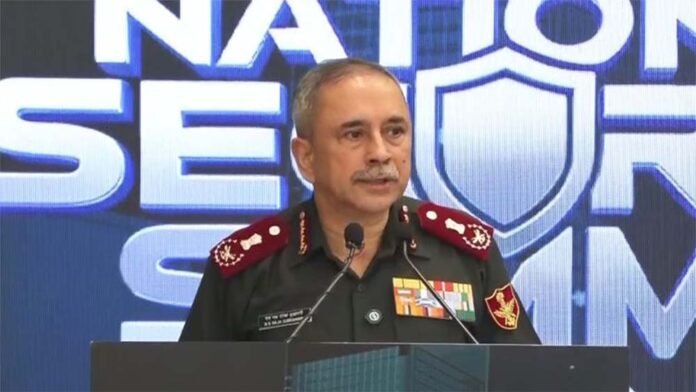
India’s military preparedness must keep pace with a battlefield expanding beyond land, sea and air, Chief of Defence Staff General NS Raja Subramani said at the ANI National Security Summit 3.0 in New Delhi on November 16. He highlighted the changing economics of warfare, the contest for control of critical technologies and the growing reach of conflict.
Subramani warned that low-cost weapons could strain defences built around expensive systems. He illustrated the imbalance with a comparison between a million-dollar missile and a drone costing $2,500 or $3,000, arguing that relying on high-priced interceptors alone could make the economics of defence unsustainable. Militaries, he said, need both sophisticated platforms and the ability to produce affordable equipment at scale.

That challenge extends beyond procurement. Gen Subramani cautioned against assuming future wars would be short, stressing the need for industrial capacity and resilient supply chains to sustain operations. Defence companies, he said, should develop not only complete weapons systems but also critical components, including servos, magnetometers and sensors, and retain the intellectual property and technology needed to manufacture them.
He described self-reliance as “the freedom to decide, the capability to act and the capacity to endure,” rather than an effort to make every item domestically. The broader objective, he said, is to ensure India can make strategic choices, access essential technologies and adapt equipment quickly as operational needs change.
The expansion of the battlespace is another central concern. Gen Subramani said future conflicts could involve operations under the sea and across cyber, electronic warfare, space and information domains, as well as the traditional services. He warned that military networks, energy sources and the data used to make decisions could also become targets. The consequences, he said, reach beyond frontline forces to infrastructure and the wider country.
Space-based communications, in particular, cannot be treated as guaranteed. Citing the war in Ukraine, the CDS said disruption or degradation of Starlink services affected the effectiveness of Ukrainian long-range drones. He called for India to build reliable satellite communications and space capabilities through both the Indian Space Research Organisation and private companies, reducing vulnerability if access to external services is interrupted.

Gen Subramani pointed to Operation Sindoor as an example of joint planning and multi-domain integration. He said the operation demonstrated India’s ability to fight with Indian weapons and cited the role of indigenous air-defence systems, including Akash, in deterring Pakistani aerial attacks. The lesson, in his account, was that domestic production and coordination among the three services must translate into operational capability.
He also defended the government’s revision of the Agnipath recruitment scheme, rejecting claims that the changes amounted to a rollback. He said periodic review had been envisaged from the programme’s beginning and that, after four years, the scheme’s performance and effectiveness needed assessment. The changes, he said, followed review and recommendations from the armed forces.

The revised arrangement gives Agniveers not selected for regular service after their initial four-year tenure the option of serving for two additional years. Those who wish to continue can then be considered for regular enrolment, subject to selection criteria. The change has drawn political debate: opposition leaders have questioned whether the extension addresses the scheme’s original concerns, while the CDS has described it as an adjustment following review.
Together, the remarks set out a broad agenda: produce weapons and components at scale, secure access to critical technologies, strengthen space-based capabilities and improve coordination across military domains. For Gen Subramani, preparing for future conflict means planning not only for the weapons adversaries may use, but also for the disruption of the systems and supply chains that India relies on.







