


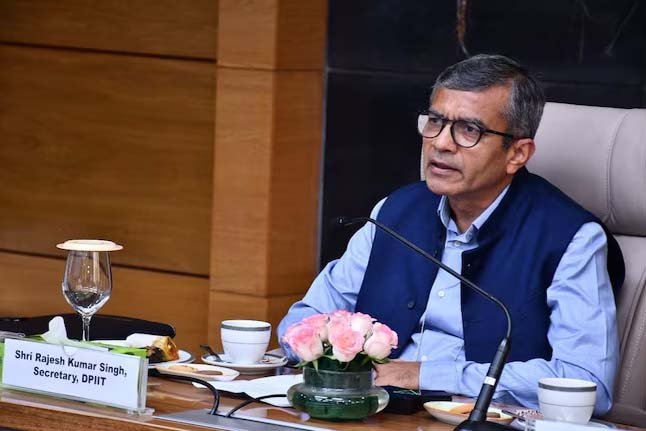
India is seeking to reduce dependence on single suppliers and build a broader industrial base for military aircraft, missiles, ammunition and drones, Defence Secretary Rajesh Kumar Singh said at a Public Affairs Forum of India conference on September 25.
The proposed expansion includes at least two, and potentially three, fighter-aircraft production lines; around six missile manufacturers; and hundreds of drone companies. Singh said the objective was to create greater capacity, resilience and competition across critical defence segments.

The announcement comes as India’s defence exports and domestic production reach record levels. Government data shows defence exports rose to ₹38,424 crore in 2025-26 from ₹686 crore in 2013-14. Indigenous defence production also increased to approximately ₹1.78 lakh crore during 2025-26.
Singh said India could achieve its ₹50,000-crore defence-export target by 2028, nearly two years ahead of the government’s 2030 goal. He attributed the optimism to growing overseas interest in Indian missiles, artillery, mounted gun systems and air-defence equipment.
The Akash surface-to-air missile system is among the products attracting international attention. Designed to intercept aircraft, helicopters, drones and certain cruise missiles, the system has been inducted by the Indian armed forces in substantial numbers. Earlier procurement included seven additional Air Force squadrons under a ₹5,400-crore contract, while the Army has also inducted Akash regiments.
Singh said Indian missile systems could be offered at almost one-fourth the price of comparable products supplied by foreign original-equipment manufacturers, although he did not identify the specific system or systems being compared. Cost competitiveness, he argued, could become one of India’s strongest advantages in export markets.

The country’s export basket is also widening beyond missiles. BrahMos remains India’s most prominent defence export, with Southeast Asian countries showing interest, while Indian companies are supplying or marketing artillery, radars, helicopters, aircraft, naval vessels and other military equipment. India now exports defence products to more than 80 countries, according to government figures.
The government is simultaneously trying to diversify production of ammunition and propellants. Singh said more private-sector companies were being allowed into these areas to reduce reliance on a single public-sector undertaking. A wider supplier base could help prevent production bottlenecks and improve delivery schedules during periods of heightened military demand.

The fighter-aircraft plan is particularly significant because India’s combat-aircraft manufacturing capacity has historically been concentrated in state-owned Hindustan Aeronautics Limited. The planned expansion is expected to support future programmes, including the Advanced Medium Combat Aircraft, or AMCA. Singh said proposals were being considered from three shortlisted companies for the next-generation fighter programme.
A second production line could also help India absorb larger aircraft orders and develop a network of suppliers for engines, avionics, radar, weapons and maintenance. However, establishing new lines would require sustained investment, technology access, skilled workers and reliable supply chains.
Private companies and smaller manufacturers are expected to play a larger role. By March 2026, India had 834 defence industrial licences, around 500 licenced defence companies, 16 defence public-sector undertakings and nearly 17,000 micro, small and medium enterprises linked to the sector.
For India, the push is about more than export revenue. Defence sales create long-term relationships through spare parts, maintenance, upgrades and technical support. If production scales successfully, New Delhi hopes the expanding ecosystem will strengthen military readiness, generate employment and shift the country further from being primarily a weapons buyer to becoming a competitive defence manufacturer and supplier.






