


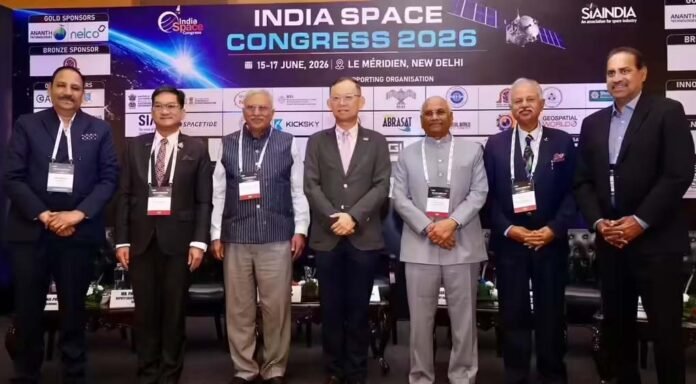
Speaking at the high-energy India Space Congress (ISC) 2026 in New Delhi, space industry leaders declared that historic regulatory overhauls have successfully transformed the country’s space sector. Pioneering technologist and President of the SatCom Industry Association of India (SIA-India), Dr Subba Rao Pavuluri, revealed that domestic private firms are aggressively transitioning from basic component fabrication to designing comprehensive, high-bandwidth Low Earth Orbit (LEO) and Geostationary (GEO) satellite constellations.
Redefining Commercial Empires via ‘Dharmic’ Entrepreneurship
In an extensive address detailing India’s commercial cosmic trajectory, Dr Rao – who also serves as the Chairman and Managing Director of Ananth Technologies Limited (ATL) – strongly emphasised that the country’s private ecosystem is no longer restricted by legacy state-monopolised boundaries.

“We contributed to 106 satellites of ISRO and about 88 launch vehicles of ISRO,” Dr Rao noted, highlighting the foundational engineering equity built by domestic private firms over decades of supporting the Indian Space Research Organisation. “Now, since after the reforms, we can have our own satellites, so we’re given the opportunity to work on a geostationary satellite now.”
Reflecting on the massive global financial valuations achieved by western corporations like Elon Musk’s SpaceX, Dr Rao argued that Indian aerospace companies are powered by a distinct philosophical framework that will uniquely enable them to scale global industrial empires sustainably.
The Indian space growth architecture is built upon three foundational pillars. First, the concept of ‘Dharmic’ Enterprise focuses on broad public utility and long-term value over pure financial extraction. Second, Constellation Sovereignty targets scaling low Earth orbit (LEO) and geostationary (GEO) satellite fleets to reliably deliver distributed bandwidth exceeding 100 Mbps. Finally, Infrastructure Autonomy anchors the ecosystem by shifting operational control toward private port management alongside dedicated domestic rocket pipelines.
“The way Indians look at their entrepreneurship is something different than what westerners look at,” Dr Rao stated. “In the western world, money and the goal is only around that. But in India, we always look at a dharmic entrepreneurship. So therefore, Indians also can build large empires, large industrial segments in this area to serve the global population.”

Breaking the Bandwidth Bottleneck
A prime objective of this industrial expansion is breaking dependency on foreign data routing networks. Dr Rao announced that private initiatives are actively designing next-generation geostationary communication hubs engineered to deliver high-fidelity connectivity.
The ATL’s private geostationary objective follows a structured deployment sequence. It begins by establishing an architecture capable of delivering 100 Mbps+ throughput. This foundation feeds directly into high-speed data pipelines, which ultimately allow robust, high-bandwidth connectivity to be seamlessly distributed across India.

“The Government of India is also equally supporting the constellation to be built in the country, and it can be launched from India itself,” Dr Rao explained. He noted that his firm is targeted on deploying satellites capable of distributing high-speed gigabit-per-second processing scales seamlessly across the subcontinent. “So, both in the communications area and earth observation area, we have been effectively contributing. We can continue to develop that area further.”
Regulatory Accelerators and Capital Infusions
Responding directly to these commercial ambitions, Dr Pawan Kumar Goenka, Chairman of the Indian National Space Promotion and Authorisation Centre (IN-SPACe), outlined a series of sweeping institutional measures designed to remove structural risks for private operators. Addressing a plenary session focused on the theme “Reinventing Collaboration in Space”, Dr Goenka highlighted that the nation’s space startup ecosystem has ballooned to nearly 400 active firms, establishing it as the largest commercial space cluster in Asia.
The strategic roadmap for the space ecosystem maps core sector priority vectors to specific regulatory action blueprints to unlock targeted economic outcomes.
First, addressable Launch Infrastructure relies on private management models, which are realised by handing operational control of the Small Satellite Launch Complex at Kulasekarapattinam to private consortia. Second, strengthening the Academic Pipeline involves a dedicated ₹900 crore R&D fund engineered to inject targeted research capital into universities for co-designing advanced space technology curricula. Third, bolstering Financial Security is driven by launch incentive frameworks that provide state-backed financial offsets for local enterprises utilising sovereign Indian spaceports. Finally, long-term industrial funding secures future Investment Horizons, effectively mitigating production-scale and demand-side risks via patient, non-speculative capital vehicles.
Dr Goenka insisted that the country’s projected $44 billion space economy by 2033 cannot be sustained through speculative startup valuations or isolated launch services alone. Instead, he urged the investment community to view space as a highly secure, long-term industrial asset class, with vast downstream potential spanning ground station infrastructure, maritime tracking, and automated defence networks.
“Technology risks have fallen sharply; what remains are production-scale and demand-side risks – precisely the challenges that informed, patient capital is designed to address,” Dr Goenka stated. He concluded by urging premier tier-one companies and tech labs to invest deeply in one another through deliberate corporate collaboration, solidifying India’s stance as a global manufacturing hub that exports resilient, uncrewed communications infrastructure to the world.

-The writer is a New Delhi-based senior commentator on international and strategic affairs, environmental issues, an interfaith practitioner, and a media consultant. The views expressed are personal and do not necessarily carry the views of Raksha Anirveda





