


New Delhi. The Indian Air Force has acknowledged that delays in the delivery of the Tejas Mk-1A fighter have become significantly longer than planned, highlighting the pressure facing India’s effort to strengthen its combat fleet through domestic production.
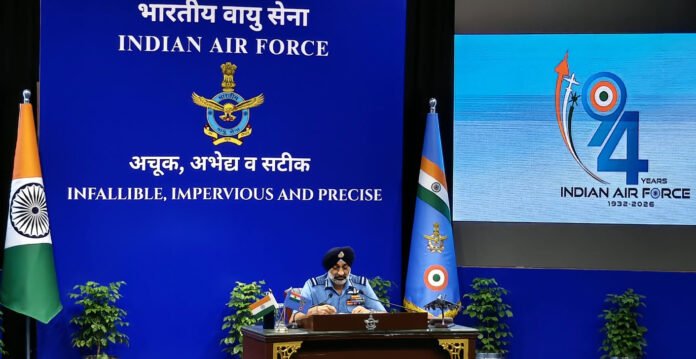
Air Chief Marshal AP Singh, speaking at a press conference ahead of the Indian Air Force’s 94th anniversary, said the service was also looking to the Tejas Mk-2 to help address capability gaps. His remarks placed the Light Combat Aircraft programme at the centre of a wider discussion on operational readiness, industrial capacity and India’s drive for defence self-reliance.

Asked whether Hindustan Aeronautics Limited could face penalties over the delayed deliveries, Singh said delays were not unusual in complex defence programmes but conceded that the current setback was substantial.
“It happens that you plan something, but things get delayed. But this time, the delay has been much,” he said, adding that the Mk-2 was also being considered as part of the solution.
The Mk-1A is an upgraded version of the Tejas featuring improved avionics, an active electronically scanned array radar, electronic-warfare systems and compatibility with modern beyond-visual-range weapons. India ordered 83 aircraft in 2021 and later approved an additional 97, making the programme a crucial element of the IAF’s planned fleet expansion.
The delivery problems have broader significance because the IAF has faced a persistent shortfall in fighter squadrons. Delays in replacing older aircraft increases the burden on existing fleets, including the Su-30MKI, Mirage 2000, MiG-29 and Rafale. The Tejas Mk-2, a larger and more capable medium-weight fighter, is intended to provide a stronger indigenous option for replacing ageing aircraft.

Singh framed the manufacturing challenge within the geopolitical environment, arguing that dependence on foreign suppliers had become increasingly risky amid conflicts, disruptions to global supply chains and uncertainty over access to defence equipment.
“Having self-reliance is an essential requirement as of today. And for us it is a necessity,” he said.

The Air Chief identified the Tejas Mk-1A, Tejas Mk-2 and Advanced Medium Combat Aircraft programmes as key parts of that effort. The AMCA is planned as a twin-engine, fifth-generation stealth fighter for the IAF and Navy. It is designed to combine low observability with advanced radar, electronic warfare, internal weapons carriage and networked operations. Prototype development is under way, with first flight and serial production expected later in the decade and the mid-2030s respectively.
The AMCA programme is also expected to test India’s ability to coordinate government laboratories, state-owned manufacturers and private industry. Recent plans have envisaged a private-sector-led production consortium, a shift from the traditional model dominated by HAL. Potential industrial groupings include Tata Advanced Systems, Larsen & Toubro with Bharat Electronics, and Bharat Forge with BEML.
For the IAF, the challenge is balancing long-term technological ambition with immediate operational requirements. Indigenous aircraft promise greater control over upgrades, weapons integration and maintenance, but development and production delays can create capability gaps before new systems enter service.
The anniversary briefing therefore carried a message beyond ceremony. The IAF’s modernisation plans depend not only on approving advanced platforms, but also on delivering them on schedule. As India pursues strategic autonomy in aerospace, the Tejas delays have underscored the distance between ambition and execution.






