


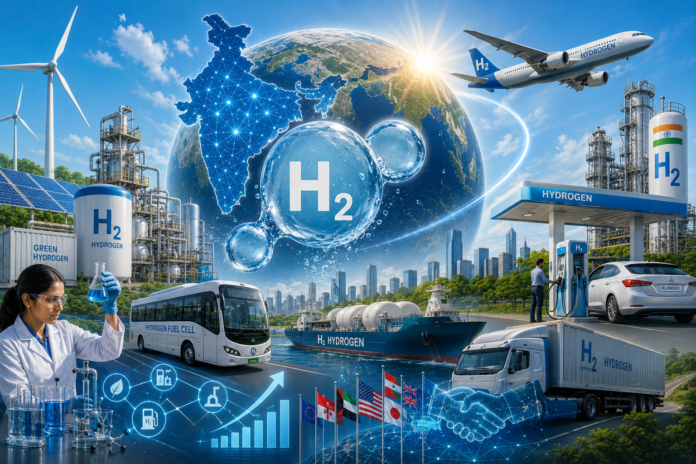
On July 17, India flagged off its first hydrogen fuel cell powered commercial train from Jind to Sonipat, marking its transition to global power. With this feat, India has joined Germany, Japan, China and United States in deploying or trying the hydrogen fuel for rail services.
Use of Hydrogen technology puts India at the forefront of Global Clean Energy Transition and is a step towards achieving the target of net zero carbon emission by 2070. India aims to fulfil 50 per cent of its energy requirements from renewable sources by 2030.

India launched the National Green Hydrogen Mission in January 2023 targetting 5 million metric tonnes of annual production by 2030. The mission reflected India’s sincere approach towards reducing carbon emission and fostered its status as the fastest growing Renewable Energy capacity in the world.
Green Hydrogen can play a key role in low-carbon and self-reliant economic pathways for India. Green Hydrogen can replace the fossil fuels in the petroleum refineries, fertiliser industry and steel manufacturing.
It can also help in decarbonisation of the mobility sector when used as a fuel in automobiles and marine vessels. The Proton Exchange Membrane (PEM) technology is very useful for use of hydrogen in the mobility sector.
The rollout of hydrogen fuel cell rail services puts India alongside global pioneers like Germany and Japan. Utilising Proton Exchange Membrane (PEM) technology, which produces only heat and water vapour as byproducts, green hydrogen promises to de-carbonise heavy mobility, marine shipping and energy-intensive manufacturing like steel and fertilisers
It enables the hydrogen stored onboard to react with oxygen from the air for generation of electricity while emitting non-polluting heat and water vapour as a biproduct.

India realises that asymmetries in demand and production of green hydrogen in different regions will lead to international trade of green hydrogen and its derivatives like green ammonia and green methanol.
The sensitivity of fossil fuels to geopolitical upheavals and resultant supply chain disturbances as evident during COVID and the ongoing disruptions in the Strait of Hormuz due to the US-Iran war, that has engulfed the entire Middle East, has provided an impetus towards green fuel transition.

India intends to capitalise on its abundant renewable energy and benefit from the growing global demand for Green Hydrogen. Its objective is to become the Global Hub for production, usage and export of Green Hydrogen and its derivatives.
Understanding the significance of required infrastructure development and regulatory ecosystem, India is focusing on production, storage, transportation and utilisation of green hydrogen in various sectors.
Launched to drive India’s 2070 net-zero goals, the Mission targets an annual production of 5 million metric tonnes of green hydrogen and 125 GW of renewable capacity addition by 2030. Backed by an initial outlay of Rs 19,744 crore, it operates in two phases focusing on demand generation, electrolyser manufacturing and industrial scale-up
Along with that it is investing in accelerated technology development to improve the overall performance, efficiencies, safety and reliability. More importantly, India understands that the global value chain for Green Hydrogen is in its initial phase and international cooperation and coordinated engagements will be needed to provide the required momentum to the hydrogen energy.
In this decade, India has undertaken pilot projects for production of Green Hydrogen through electrolysis of water using renewable electricity and from biomass through thermochemical and biochemical routes.
India’s green hydrogen mission has designed an outlay of Rs 455 crore up to 2029-30 for low carbon steel projects, Rs 496 crore up to 2025-26 for mobility pilot projects and Rs 115 crore up to 2025-26 for shipping pilot projects.
India’s hydrogen mission aims to advance the Green Hydrogen production and ensure widespread accessibility. It also emphasises on the development of port infrastructure for export of green hydrogen while aiming to make green hydrogen competitive with grey hydrogen.
Grey hydrogen is produced from natural gas via steam methane reformation releasing pollutants like CO2 while green hydrogen is produced from electrolysis of water with only heat and water vapour as bi-products.
The hydrogen mission will be implemented in two phases; Phase I (2022-2026) and Phase II (2026-2030). In the first phase, the focus will be on creating demand while enabling adequate supply by increasing the domestic electrolyser manufacturing capacity.
Amid global supply chain shocks and Middle East conflicts, green hydrogen offers an alternative to volatile fossil fuels. India aims to capitalise on regional demand asymmetries by developing specialised port infrastructure to export green hydrogen and derivatives like green ammonia, positioning itself as a central node in the global energy trade
In the second phase, the potential for taking up large scale Green Hydrogen based projects in steel, mobility and shipping sectors will be explored.
India has adopted an integrated approach instead of a piecemeal method and has ensured coordination among various ministries and bodies for smooth transition to green hydrogen.
Ministry of New and Renewable Energy will be responsible for overall coordination and implementation of the Mission. Ministry of Power, Ministry of Petroleum and Natural Gas, Ministry of Chemicals and Fertilisers, Ministry of Road Transport and Highways, Ministry of Steel, Ministry of Ports, Shipping and Waterways, Ministry of Finance, Ministry of Commerce & Industry, and the Ministry of Railways will work in tandem.
Availability of skilled human resource consistently will be a pre-requisite for green hydrogen production and Ministry of Education and Ministry of Skill Development and Entrepreneurship will build skillset and employability through suitable courses and programmes across the value chain.
Furthermore, Ministry of External Affairs will actively build bilateral and multilateral partnerships for supporting the Green Hydrogen production, consumption and the entire ecosystem development in India and abroad.
Ministry of External Affairs will also facilitate cooperation among academia, universities, technical institutions, industry and research laboratories under bilateral and multilateral collaborations.
International Partnership for Hydrogen and Fuel Cells in the Economy was founded in 2003, and its 41st Steering Committee Meeting held an Industry Outreach Programme in March 2024.
India is a growing economy with rapid urbanisation and young demography. To fulfil the needs of its growing population, it requires consistent growth in terms of commercial and residential infrastructure and energy availability.
Overcoming high production costs and market infrastructure hurdles requires a unified strategy. India’s framework integrates over ten ministries – from Renewable Energy and Steel to Skill Development and External Affairs – ensuring a skilled workforce, robust R&D, stream-lined regulations and strong international partnerships to mitigate operational and market risks
Currently, 60 per cent of its energy needs are met through coal, 29 per cent through crude oil and 7 per cent through natural gas and renewables.
Green hydrogen is a clean fuel alternative that can play an important role in fulfilling the energy needs through clean sources. It can also help in reduction of carbon footprints through production of green steel or green hydrogen-based steel.
By 2030, India expects to produce 5 MMT green hydrogen annually, capacity addition of 125 GW renewable energy, total investment of over Rs 8 lakh crore, create over 6 lakh full time employment and avert 50 MMT CO2 emission annually. For this the mission has laid out a massive initial financial outlay of Rs 19,744 crore.
Despite promising future, hydrogen fuel faces multiple challenges pertaining to high cost, lack of differentiation between low and high carbon hydrogen, lack of price index and hydrogen market, and limited infrastructure.
However, India is not oblivious to the risks and intends to deal with supply chain disruptions through diversification, technological disruptions through investing in R&D, land-water-pollution related operational challenges through optimised location of hydrogen plants, and market risks through creation of sustainable demand.
Green hydrogen and hydrogen technology is India’s key to becoming not only a global power but a responsible global power.

The writer is Associate Professor at Jawaharlal Nehru University, New Delhi. She is an expert in Middle East Studies with experience in policy-oriented think tanks in India. She has published several articles and contributes write-ups on the geopolitical and socioeconomic issues of the region frequently. Earlier she has worked as Research Fellow at the Indian Council of World Affairs, and was a research scholar at the Manohar Parrikar Institute for Defence Studies and Analyses. The views expressed are of the writer and do not necessarily reflect that of Raksha Anirveda





