


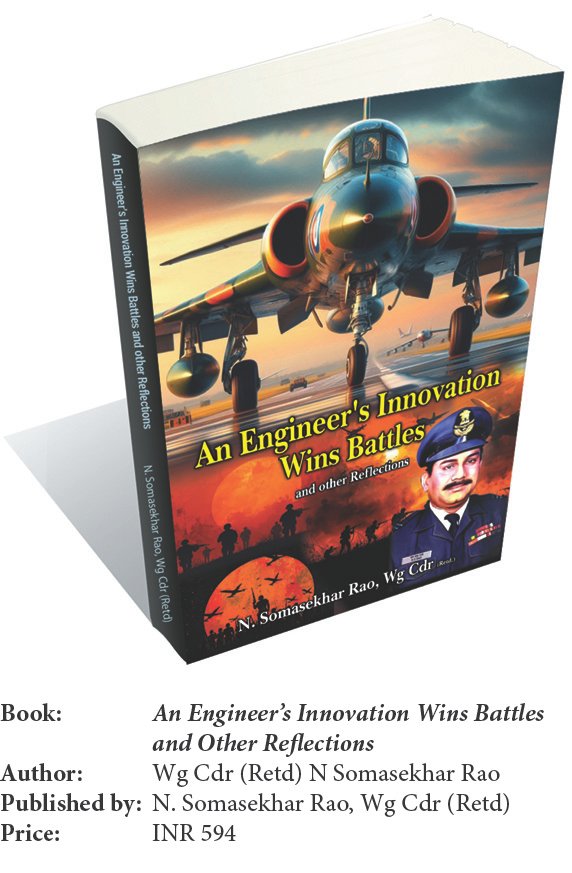
Featuring an authoritative foreword by former Chief of the Air Staff, Air Chief Marshal NC Suri, the book moves past standard military historiography. It reframes the role of the military engineer not as a mere backend maintainer, but as a primary force multiplier on the battlefield. Through a structural exploration of his upbringing, his legendary “Eureka moment” modifying the Hawker Hunter fighter aircraft, and his post-retirement observations on public sector inefficiency and national integrity, Rao delivers a passionate critique of bureaucratic inertia and a blueprint for youth empowerment through localised innovation.
Structural Architecture and Narrative Arc
The book is structured into fifteen chronologically and thematically distinct chapters, supported by critical framing elements including a forward-looking preface, an introspective prologue, and a philosophical epilogue. The narrative arc can be cleanly divided into three distinct phases:

1. The Formative Years and Ideological Grounding
Rao begins his journey by anchoring his identity as a “small-town boy” originating from the rural and politically complex landscapes of Salur, Veeraghattam, and Kunta (located in the modern-day, conflict-ridden Sukma district of Chhattisgarh). This section functions as an institutional critique of mentorship. Rao attributes his core values of discipline and systemic observation to two local figures: his old-school science teacher, Sri Chada Samba Siva Rao, who ran the Auxiliary Cadet Corps (ACC) with military precision, and Sri Vinjamuri Kamalakar Rao, who sustained the local Scout movement.
Rao’s transition into engineering at the Government College of Engineering, Kakinada (ECK), and his ultimate entry into the IAF in July 1964 via the Air Force Technical College (AFTC) in Jalahalli, highlights a critical thematic element: the transformation of a civilian mindset into a structured military asset modelled on inherited British Royal Air Force (RAF) standards.
The operational core of the book centers on Rao’s assignment to the No 20 “Lightnings” Squadron, flying the British-made Hawker Hunter Mk 56 and Mk 56A fighter aircraft. This segment is an illuminating study in tactical aviation logistics
2. The Crucible of Innovation: The Hunter Modification

The operational core of the book centers on Rao’s assignment to the No 20 “Lightnings” Squadron, flying the British-made Hawker Hunter Mk 56 and Mk 56A fighter aircraft. This segment is an illuminating study in tactical aviation logistics. When the IAF procured the upgraded Hunter Mk 56A, the aircraft featured a major architectural flaw: it could carry massive 230-gallon fuel drop tanks to double its operational range, but these heavy tanks could only be mounted on the inboard wing stations.
Because these stations used cartridge-fired Ejector Release Units (ERUs), the squadron was forced into a crippling operational compromise: they could carry the extended fuel tanks or a heavy weapon payload on the inboard stations, but not both simultaneously, as the outboard stations were structurally unequipped to handle mixed ordinance loadouts while maintaining weapon synchronisation.

Before Rao’s modification, this design flaw forced pilots to make a dangerous trade-off between operational range and available firepower. To solve this, Pilot Officer Rao (affectionately dubbed “Genius” by his peers) engineered a complex modification that allowed the 230-gallon drop tanks to be safely retained on the inboard stations for maximum range, while the outboard wing stations were completely rewired, structurally strengthened, and integrated with a synchronised cockpit gun-sight. The final result allowed the aircraft to simultaneously carry maximum fuel and a full offensive weapons load, such as Sneb rocket pods and bombs, which could be accurately fired on frontline targets.
Operating under the command of then-Wing Commander NC Suri, Rao completed this task in record time. Rao notes that this localised engineering feat saved the Government of India vast amounts of foreign exchange and vastly amplified the penetration capability of the IAF during the Indo-Pakistani Wars of 1965 and 1971.
3. Post-Military Reflections, Corporate Realities, and Civic Duty
The final third of the text shifts from tactical aviation to sociopolitical commentary. Drawing on his experiences handling logistical operations like the “Caribou Capers” and witnessing the human costs of war, Rao turns his analytical gaze toward India’s Public Sector Undertakings (PSUs), bureaucratic red tape, and systemic corruption.
His subsequent careers in the private sector, appraisal valuation business, and his time teaching postgraduate management students at Osmania University allow him to cross-examine military institutional efficiency against civilian organisational decay.
A sharp running commentary throughout the book highlights the tension between the frontline innovators and the institutional bureaucrats. This friction exposes two radically different faces of national infrastructure
Major Thematic Frameworks
The Philosophy of Everyday Creativity = Might
The book’s central philosophical thesis is captured in the algebraic formulation of its first edition title: Might of People = Might of Nation
Rao argues that resourcefulness is not an elite artistic privilege, but a measurable, democratic form of problem-solving. By utilising the historical example of his Hunter modification alongside contemporary macro-economic policies – such as the Jan Dhan Yojana, which he praises for bypassing corrupt middlemen – Rao illustrates how minor, localised contributions accumulate into massive institutional strengths.
Institutional Betrayal vs. Individual Integrity
A sharp running commentary throughout the book highlights the tension between the frontline innovators and the institutional bureaucrats. This friction exposes two radically different faces of national infrastructure. On one side stands the frontline innovator, characterised by field-tested, adaptive resourcefulness and an absolute focus on operational readiness, efficiency, individual integrity, and the collective “might”.
On the opposite side sits the rigid systemic bureaucracy, which frequently suffers from frozen policies, structural inertia, and excessive red tape. These rigid, top-down hierarchies often suffocate grassroots ideas and leave the system highly vulnerable to political expediency and corruption.
Rao contrasts the professional courage of unyielding whistleblowers and civil servants (mentioning figures like PC Parekh and Ashok Khemka) against this bureaucratic machinery, providing a stark, realistic look at how organisations often systematically undermine creative internal disruptors.
The Intergenerational Duty of Leadership
Rao reserves his most urgent rhetoric for the relationship between older veterans and the younger generation. He adamantly refuses to blame modern youth for systemic apathy, arguing instead that disillusionment is a rational response to a lack of genuine, ethical role models. The core responsibility of leadership, he asserts, is to lead by direct, living example rather than abstract moralising.
Literary Style and Readability
Rao explicitly states in his prologue that the book has “no literary pretensions… it is not a spicy love story or a riveting thriller.” This self-assessment is accurate, but it undersells the raw, conversational clarity of his prose. The writing style is unvarnished, direct, and pragmatic – characteristic of an engineer who values functional utility over aesthetic ornamentation.
An Engineer’s Innovation Wins Battles and Other Reflections is an invaluable addition to Indian military literature. It successfully rescues the identity of the technical officer from the background of military histories, placing tactical engineering exactly where it belongs: at the cutting edge of combat success.
The narrative effectively balances technical descriptions of aircraft wiring and pylon physics with deeply human anecdotes of small-town Indian life and wartime loss. While some transitions between chapters feel abrupt, the text remains highly readable and engaging due to its authentic tone and historical value.
A Lasting Contribution
An Engineer’s Innovation Wins Battles and Other Reflections is an invaluable addition to Indian military literature. It successfully rescues the identity of the technical officer from the background of military histories, placing tactical engineering exactly where it belongs: at the cutting edge of combat success.
Rao’s work is a manual for institutional survival, a call to action for civic responsibility, and a testament to the power of individual initiative within rigid systems. It is highly recommended for defence analysts, engineering students, corporate leaders, and anyone seeking an honest, field-tested perspective on how a nation can leverage its collective talent to achieve genuine self-reliance.

-The writer is a New Delhi-based senior commentator on international and strategic affairs, environmental issues, an interfaith practitioner, and a media consultant. The views expressed are personal and do not necessarily carry the views of Raksha Anirveda





