


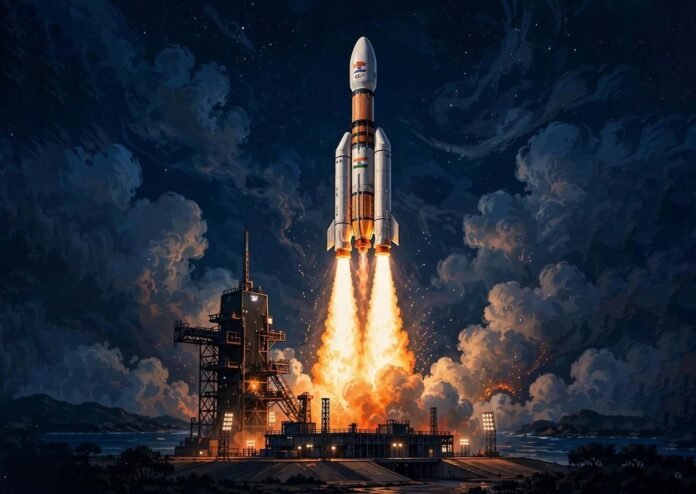
PARIS. The European Space Agency (ESA) and the Indian Space Research Organisation (ISRO) are exploring expanded cooperation in human spaceflight, lunar exploration and planetary science, as the International Space Summit brings global space leaders together in Paris from September 9 and 10.
The discussions mark a possible broadening of an established relationship between the two agencies. ESA Director General Josef Aschbacher is expected to meet ISRO Chairman V Narayanan during the summit, while senior officials from both organisations are examining areas where their programmes and technologies can complement one another.

The immediate focus is India’s Gaganyaan human-spaceflight programme. ESA and ISRO have already signed a Technical Implementing Plan under which European ground stations will provide tracking and communication support for Gaganyaan missions. The arrangement is intended to maintain contact with the spacecraft and ensure continuity in the flow of data between the crew module and mission controllers.
Gaganyaan aims to demonstrate India’s ability to send a three-member crew into a roughly 400-kilometre orbit for three days before bringing the astronauts safely back to Earth. ESA’s ground-network support could strengthen mission communications, particularly when the spacecraft is outside the visibility of Indian ground stations.
Officials are also discussing cooperation in low-Earth-orbit activities and India’s planned Bharatiya Antariksh Station. The proposed space station is part of India’s longer-term human-spaceflight ambitions and is expected to follow the initial Gaganyaan missions.
Potential collaboration could cover astronaut training, life-support systems, mission operations, scientific experiments and the use of international ground infrastructure.

Lunar exploration is another prospective area. Both agencies are developing capabilities for robotic and human missions around the Moon, where international partnerships are increasingly focused on sustained operations rather than one-time landings. Cooperation could involve scientific instruments, navigation, communications, surface mobility and the exchange of mission data.
The agencies are also examining possible links between ESA’s planetary-science objectives and India’s Venus Orbiter Mission. India’s first dedicated mission to Venus has been approved at a cost of ₹1,236 crore and is scheduled for launch in March 2028 aboard the LVM-3 rocket. The spacecraft is expected to take about 112 days to reach Venus.

The mission will carry 19 payloads, including Indian instruments, collaborative payloads and an international experiment. Scientists hope it will improve understanding of Venus’s atmosphere, surface processes and interaction with solar radiation. ESA officials have indicated that discussions with ISRO could help ensure that the Indian mission complements European research objectives rather than duplicating existing efforts.
The Paris summit comes at a critical moment for Europe’s space programme. ESA has said the event will address Europe’s future role in exploration, Earth observation, secure connectivity, scientific research and industrial competitiveness. It is also taking place before major funding and policy decisions, including ESA’s Intermediate Ministerial Meeting in Rome in December 2026.
For India, deeper engagement with ESA would bring access to specialised expertise, tracking infrastructure and a broad network of scientific and industrial partners. For Europe, cooperation with ISRO offers access to India’s growing launch capabilities, cost-conscious mission planning and expanding human-spaceflight programme.
No final agreement on all the proposed areas has been announced. However, the discussions signal that India-Europe space cooperation is moving beyond satellite launches and data-sharing towards human exploration, lunar operations and interplanetary science. As competition and collaboration intensify beyond Earth, the ESA-ISRO partnership could become an important pillar of the emerging international space architecture.






