

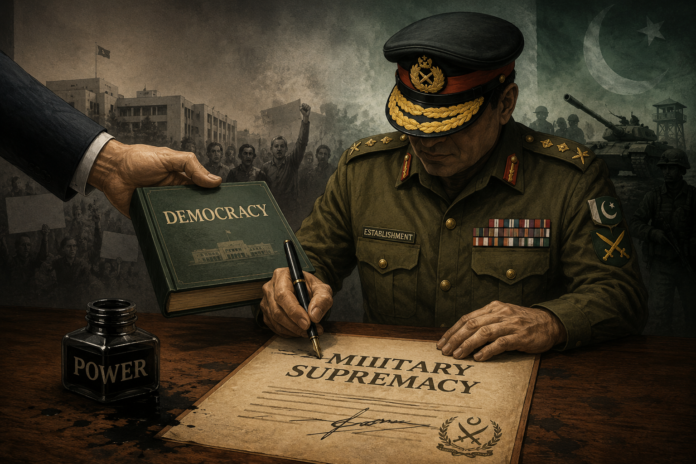
Pakistan’s Parliament has just done what its army could never achieve with a tank on the street. It has legislated a coup and called it reform. On August 21, 2026, the National Assembly passed the Defence Forces of Pakistan Act – 2026, along with sweeping amendments to the National Command Authority Act – 2010. The Opposition walked out.
Even the Pakistan People’s Party, a coalition partner of the ruling Pakistan Muslim League-Nawaz, objected to the manner in which the bills were rushed through the House. None of it mattered. The vote went through anyway, because in today’s Pakistan, Parliament exists to ratify decisions already taken by the General Headquarters.

The Act gives statutory muscle to what the 27th Constitutional Amendment had already established in November 2025. Field Marshal Asim Munir, already Chief of Army Staff, is now formally the Chief of Defence Forces, commanding the Army, Navy and Air Force through a new Defence Forces Headquarters answerable to him alone.
The Defence Forces of Pakistan Act – 2026 merges army, navy and air force command under Field Marshal Asim Munir, granting him absolute authority over military promotions, retirements and operational decisions without requiring civilian or inter-service consultation
He need not consult the service chiefs of the Navy or Air Force before acting. He decides who gets promoted, who gets pushed out, whose resignation is accepted and whose is refused, and whose retirement age is quietly extended.
The law even leaves a door open for the federal government to hand him further powers not listed in the Act itself, a blank cheque dressed up as legislative caution.
This is not military reform. It is the formal burial of civilian oversight in a country that never had much of it to begin with.

Pakistan’s history did not need this reminder. Four coups, decades of army rule and a security establishment that has treated every elected government as a temporary inconvenience should have made it clear what streamlining command means in Rawalpindi.
What is new this time is the paperwork. Munir has not seized power at gunpoint. He has had it handed to him, clause by clause, by the very parliamentarians who are supposed to check him. The 27th Amendment already made him Field Marshal for life, with the same constitutional immunity from prosecution enjoyed by the President.

Building on the 27th Constitutional Amendment, the legislation guarantees Field Marshal Munir lifetime constitutional immunity from prosecution for any actions taken in uniform, completely insulating him from judicial review even after leaving office
Even after he leaves office, no court in Pakistan can touch him for anything he does while wearing that uniform. The new Act simply operationalises that immunity by giving him command of the machinery to wield it.
The most alarming aspect of this restructuring lies quietly in the amendments to the National Command Authority Act. Pakistan’s nuclear command has now been folded into the same unified structure, aligned with the new post of Commander of National Strategic Command, a four-star office created only last month and already filled by a general promoted directly into it.
A country with a documented history of nuclear proliferation through its own scientific establishment, and where terrorist groups have operated with the tacit protection of sections of its security apparatus, has just placed its entire nuclear architecture one layer closer to a single military officer who now sits above civilian control. This should worry every capital that has ever lectured India about restraint and proportionality.
For New Delhi, none of this is academic. Operation Sindoor already demonstrated what a chastened Pakistani military looks like after losing bases and face. Munir’s public posturing since that conflict, his refusal to be intimidated and his doubling down on hostility towards India, is an ideological necessity rather than a strategic calculation, and never the language of a professional soldier managing a rational deterrent relationship.
It was the language of a man consolidating personal power and needing an external enemy to justify it. Now that man commands every uniformed service in Pakistan, controls personnel policy across the armed forces, serves as the Prime Minister’s principal adviser on national security and oversees the country’s nuclear command chain. There is no institutional brake left between Munir’s instincts and Pakistan’s strategic behaviour towards India.
Islamabad’s civilian leadership will insist this is about efficiency, unity of command, and modernising decision-making for a multi-domain battlespace. Strip away the language and look at the mechanics.
With Pakistan’s military leadership unchecked by civilian institutions or domestic friction, India must adapt its defence posture, intelligence assessments and diplomatic strategies to counter a fundamentally unaccountable and consolidated command structure across the border
A two-thirds parliamentary majority is now required to remove the Chief of Defence Forces, the same threshold needed to amend the Constitution itself. A simple majority is enough to remove a sitting Prime Minister.
Pakistan has constitutionally made its senior general harder to sack than its head of government. That is not command modernisation. That is a hierarchy of power, openly declared.
What should concern India and the wider region is not merely that Pakistan has formalised military supremacy over its civilian institutions. It is what that supremacy does to predictability. Elected governments, however flawed, eventually answer to voters, courts, public opinion and some feedback loop that imposes a measure of caution.
A military establishment that answers only to itself, shielded by lifetime immunity, controlling nuclear command and led by a man who has staked his legitimacy on confrontation with India, has no such feedback loop.
For Pakistan’s decision-makers, escalation becomes cheaper because the person making the decision bears no personal consequence for getting it wrong.
India’s response should be sober, not alarmist. This is not a moment for chest-thumping. It is a moment for clear-eyed preparation. Every doctrine, every force-posture review and every intelligence assessment on the Western Front now has to account for a Pakistani military that faces zero institutional friction at home.
Deterrence against a rational adversary rests on the assumption that costs matter to the decision-maker. Deterrence against an unaccountable one has to be built differently, with a proactive doctrine, well-defined red lines, redundancy, hardened command resilience and a diplomatic effort that keeps reminding the world exactly what has just happened in Islamabad.
Pakistan’s Parliament did not save its democracy on August 21. It signed its surrender and handed the pen to the man in uniform. India does not need to say much about that. It only needs to watch, prepare, and never again mistake Pakistani parliamentary theatre for genuine civilian control.

The writer, a PVSM, AVSM, VSM has had an illustrious career spanning nearly four decades. A distinguished Armoured Corps officer, he has served in various prestigious staff and command appointments including Commander Independent Armoured Brigade, ADG PP, GOC Armoured Division and GOC Strike 1. The officer retired as DG Mechanised Forces in December 2017 during which he was the architect to initiate process for reintroduction of Light Tank and Chairman on the study on C5ISR for Indian Army. Subsequently he was Consultant MoD/OFB from 2018 to 2020. He is also a reputed defence analyst, a motivational speaker and prolific writer on matters of military, defence technology and national security. The views expressed are personal and do not necessarily carry the views of Raksha Anirveda





